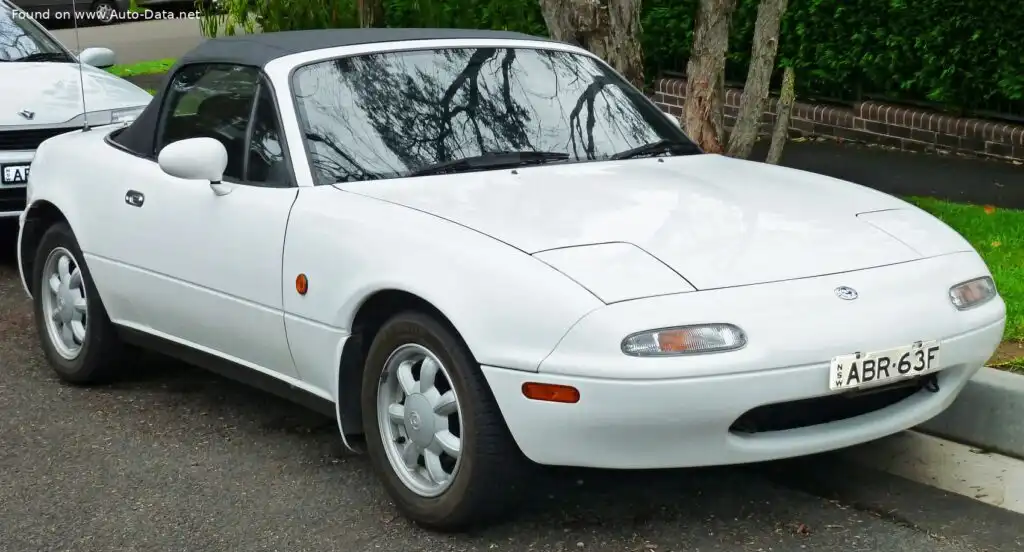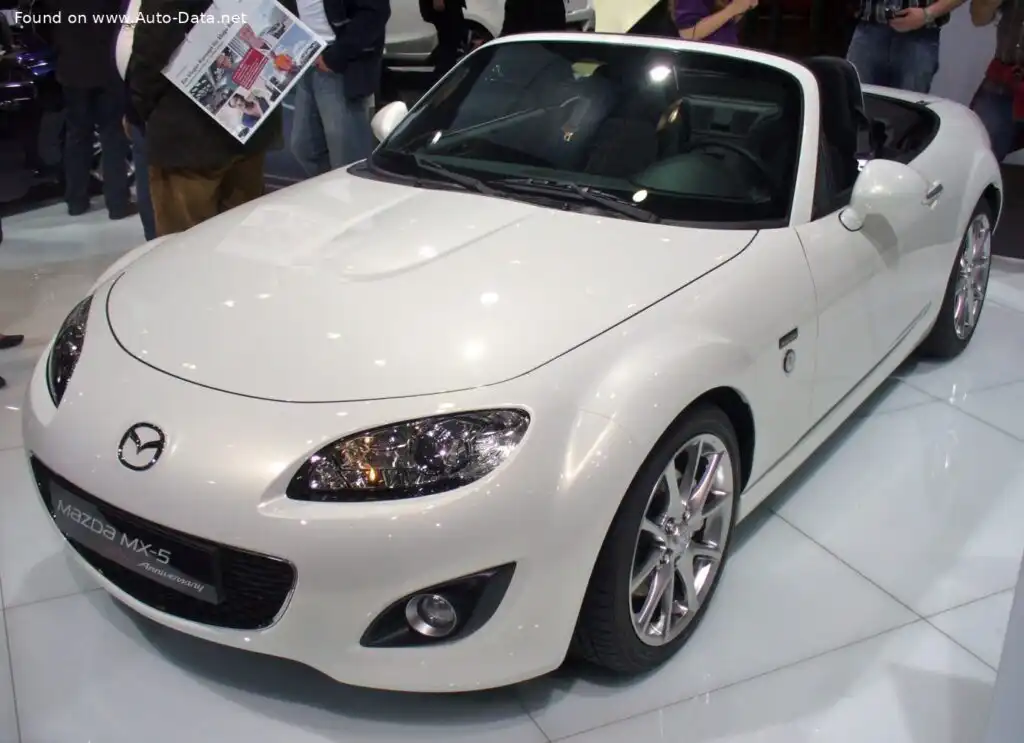
The Mazda MX-5 NC, specifically the 1.8-liter variant produced from 2008 to 2012, represents a significant iteration of Mazda’s iconic roadster. This version, introduced with the NC facelift, aimed to broaden the MX-5’s appeal by offering a more accessible entry point into the sports car market. Positioned as the base model within the NC range, it provided a balance of affordability, fuel efficiency, and the inherent driving pleasure associated with the MX-5 lineage. It was primarily sold in Europe and Asia, offering a more economical alternative to the higher-powered 2.0-liter models.
Technical Specifications
| Brand | Mazda |
| Model | MX-5 |
| Generation | MX-5 III (NC, facelift 2008) |
| Type (Engine) | 1.8 (126 Hp) |
| Start of production | 2008 |
| End of production | 2012 |
| Powertrain Architecture | Internal Combustion engine |
| Body type | Roadster |
| Seats | 2 |
| Doors | 2 |
| Fuel consumption (urban) | 9.5 l/100 km (24.8 US mpg) |
| Fuel consumption (extra urban) | 5.5 l/100 km (42.8 US mpg) |
| Fuel consumption (combined) | 7 l/100 km (33.6 US mpg) |
| Fuel Type | Petrol (Gasoline) |
| Acceleration 0 – 100 km/h | 9.9 sec |
| Acceleration 0 – 62 mph | 9.9 sec |
| Acceleration 0 – 60 mph | 9.4 sec |
| Maximum speed | 194 km/h (120.55 mph) |
| Emission standard | Euro 5 |
| Weight-to-power ratio | 8.5 kg/Hp |
| Weight-to-torque ratio | 6.4 kg/Nm |
| Power | 126 Hp @ 6500 rpm |
| Torque | 167 Nm @ 4500 rpm (123.17 lb.-ft. @ 4500 rpm) |
| Engine layout | Front, Longitudinal |
| Engine displacement | 1798 cm3 (109.72 cu. in.) |
| Engine configuration | Inline |
| Fuel injection system | Multi-port manifold injection |
| Engine aspiration | Naturally aspirated engine |
| Engine oil capacity | 4.3 l (4.54 US qt | 3.78 UK qt) |
| Coolant capacity | 7.7 l (8.14 US qt | 6.78 UK qt) |
| Kerb Weight | 1075 kg (2369.97 lbs.) |
| Max. weight | 1375 kg (3031.36 lbs.) |
| Max load | 300 kg (661.39 lbs.) |
| Length | 4020 mm (158.27 in.) |
| Width | 1720 mm (67.72 in.) |
| Wheelbase | 2330 mm (91.73 in.) |
| Front track | 1490 mm (58.66 in.) |
| Rear track | 1495 mm (58.86 in.) |
| Minimum turning circle | 10 m (32.81 ft.) |
| Drivetrain | Rear wheel drive |
| Number of gears | 5 gears, manual transmission |
| Front suspension | Double wishbone |
| Rear suspension | Independent multi-link suspension |
| Front brakes | Ventilated discs |
| Rear brakes | Disc |
| Assisting systems | ABS (Anti-lock braking system) |
| Steering type | Steering rack and pinion |
| Power steering | Hydraulic Steering |
| Tires size | 205/50 R16 |
| Wheel rims size | 16 |
Powertrain & Engine Architecture
The heart of the MX-5 1.8 is the Mazda MZR 1.8-liter inline-four cylinder engine. This engine, internally designated with various codes depending on the market, is a naturally aspirated powerplant featuring multi-point fuel injection. The engine’s design prioritizes smooth power delivery and fuel efficiency over outright performance. It utilizes a single overhead camshaft (SOHC) valvetrain, a relatively simple design contributing to its reliability and ease of maintenance. The 1.8-liter engine produces 126 horsepower at 6,500 rpm and 167 Nm (123 lb-ft) of torque at 4,500 rpm. This power is sent to the rear wheels through a five-speed manual transmission, the standard offering for this variant. While an automatic transmission was available in some markets, it was less common and generally considered to detract from the driving experience.
Driving Characteristics
The 1.8-liter MX-5 offers a distinctly different driving experience compared to its 2.0-liter siblings. While lacking the raw acceleration of the larger engine, the 1.8 provides a more relaxed and accessible driving style. The five-speed manual transmission is well-matched to the engine’s characteristics, offering precise shifts and a reasonable spread of gears. The lower power output necessitates more frequent gear changes to maintain momentum, particularly when driving on hilly terrain or overtaking. However, this also encourages a more engaged driving style. The car’s lightweight construction (approximately 1075 kg or 2369 lbs) helps to mitigate the power deficit, providing a nimble and responsive feel. The rear-wheel-drive layout contributes to balanced handling and predictable cornering behavior.
Equipment & Trim Levels
The 1.8-liter MX-5 typically came equipped with a relatively basic level of standard features, reflecting its position as the entry-level model. Standard equipment generally included power windows, power steering, alloy wheels, and a basic audio system. Air conditioning was often an optional extra. Interior upholstery was typically cloth, and the dashboard featured a straightforward design with easy-to-read gauges. Optional extras included leather upholstery, a premium audio system, and a limited-slip differential, which enhanced handling performance. The facelifted NC models (2008 onwards) received subtle styling updates, including revised headlights and taillights, as well as minor interior refinements.
Chassis & Braking
The MX-5 NC utilizes a lightweight chassis construction, employing a combination of high-strength steel. The suspension system consists of double wishbones at the front and an independent multi-link setup at the rear, providing a good balance of ride comfort and handling precision. The braking system features ventilated discs at the front and solid discs at the rear. Anti-lock brakes (ABS) were standard equipment. The relatively low weight of the 1.8-liter model contributes to its agile handling and reduces stress on the braking system. Stabilizer bars are fitted front and rear to minimize body roll during cornering.
Market Reception & Comparison
The 1.8-liter MX-5 was generally well-received by automotive critics as an affordable and enjoyable sports car. While some reviewers noted the lack of outright performance compared to the 2.0-liter models, they praised its fuel efficiency, nimble handling, and overall driving experience. Compared to the 2.0-liter MX-5, the 1.8 offered significantly better fuel economy, making it a more practical choice for everyday driving. It also had a lower purchase price and insurance costs. However, the 2.0-liter models provided a more exhilarating driving experience and were better suited for those seeking maximum performance. The 1.8 was often seen as a good option for first-time sports car buyers or those who prioritized fuel efficiency and affordability.
Legacy
The Mazda MX-5 NC 1.8-liter has proven to be a reliable and durable sports car. The MZR 1.8-liter engine is known for its longevity and relatively low maintenance costs. Common issues are typically limited to routine wear and tear items, such as brake pads, tires, and suspension components. On the used car market, the 1.8-liter MX-5 remains a popular choice due to its affordability and engaging driving experience. Well-maintained examples can still provide years of enjoyable motoring. The NC generation, as a whole, is considered a particularly robust and refined iteration of the MX-5, solidifying its place as a modern classic.