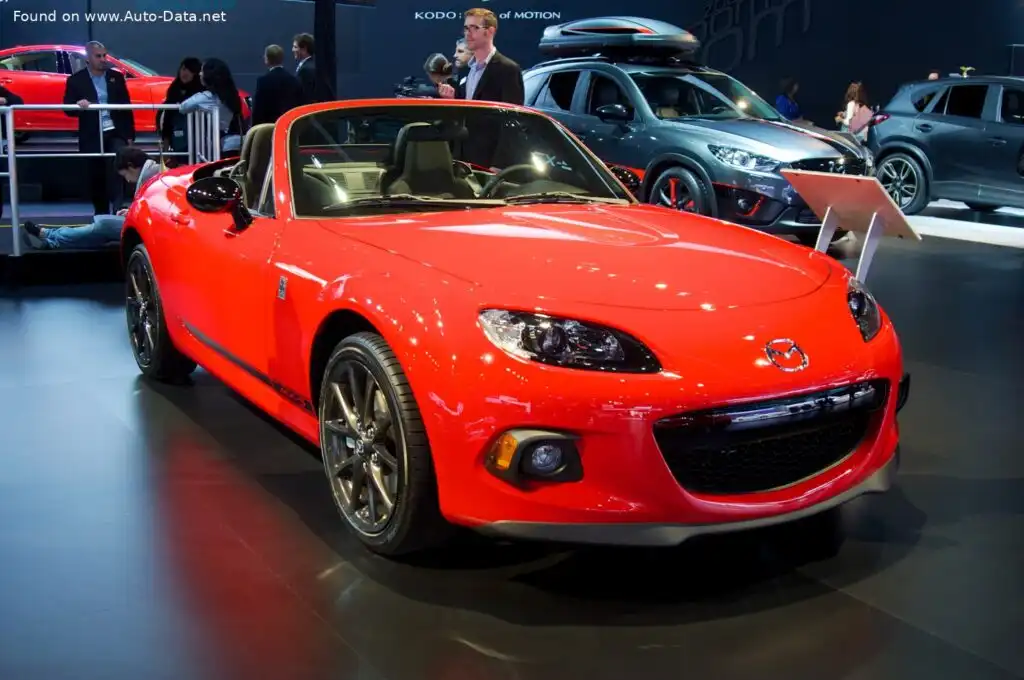
The Mazda MX-5 NC, specifically the 2.0-liter MZR variant produced from 2012 to 2015, represents the final iteration of the third-generation MX-5 (NC) roadster. This facelift brought with it revised styling, improved interior materials, and subtle mechanical refinements. Positioned as the mainstream offering within the NC lineup, the 2.0 MZR 160 hp model served as a sweet spot between the more affordable base models and the limited-edition, performance-focused trims like the Club or PRHT (Power Retractable Hard Top). It aimed to deliver a balanced driving experience, appealing to a broad range of enthusiasts seeking an accessible and engaging sports car.
Technical Specifications
| Brand | Mazda |
| Model | MX-5 |
| Generation | MX-5 III (NC, facelift 2012) |
| Type (Engine) | 2.0 MZR (160 Hp) |
| Start of production | 2012 |
| End of production | 2015 |
| Powertrain Architecture | Internal Combustion engine |
| Body type | Roadster |
| Seats | 2 |
| Doors | 2 |
| Fuel consumption (urban) | 10.9 l/100 km (21.6 US mpg) |
| Fuel consumption (extra urban) | 6.1 l/100 km (38.6 US mpg) |
| Fuel consumption (combined) | 7.8 l/100 km (30.2 US mpg) |
| CO2 emissions | 181 g/km |
| Fuel Type | Petrol (Gasoline) |
| Acceleration 0 – 100 km/h | 7.6 sec |
| Acceleration 0 – 62 mph | 7.6 sec |
| Acceleration 0 – 60 mph | 7.2 sec |
| Maximum speed | 213 km/h (132.35 mph) |
| Emission standard | Euro 5 |
| Weight-to-power ratio | 7.3 kg/Hp |
| Weight-to-torque ratio | 6.2 kg/Nm |
| Power | 160 Hp @ 7000 rpm |
| Torque | 188 Nm @ 5000 rpm (138.66 lb.-ft. @ 5000 rpm) |
| Engine layout | Front, Longitudinal |
| Engine displacement | 1999 cm3 (121.99 cu. in.) |
| Number of cylinders | 4 |
| Engine configuration | Inline |
| Cylinder Bore | 87.5 mm (3.44 in.) |
| Piston Stroke | 83 mm (3.27 in.) |
| Compression ratio | 10.8:1 |
| Number of valves per cylinder | 4 |
| Fuel injection system | Multi-port manifold injection |
| Engine aspiration | Naturally aspirated engine |
| Valvetrain | DOHC |
| Engine oil capacity | 4.55 l (4.81 US qt | 4 UK qt) |
| Coolant | 7.6 l (8.03 US qt | 6.69 UK qt) |
| Kerb Weight | 1165 kg (2568.39 lbs.) |
| Max. weight | 1375 kg (3031.36 lbs.) |
| Max load | 210 kg (462.97 lbs.) |
| Trunk (boot) space – minimum | 150 l (5.3 cu. ft.) |
| Fuel tank capacity | 50 l (13.21 US gal | 11 UK gal) |
| Length | 4020 mm (158.27 in.) |
| Width | 1720 mm (67.72 in.) |
| Height | 1245 mm (49.02 in.) |
| Wheelbase | 2330 mm (91.73 in.) |
| Front track | 1490 mm (58.66 in.) |
| Rear (Back) track | 1495 mm (58.86 in.) |
| Ride height (ground clearance) | 136 mm (5.35 in.) |
| Minimum turning circle (turning diameter) | 10 m (32.81 ft.) |
| Drivetrain Architecture | Rear wheel drive |
| Drive wheel | Rear wheel drive |
| Number of gears and type of gearbox | 6 gears, manual transmission |
| Assisting systems | ABS (Anti-lock braking system) |
| Steering type | Steering rack and pinion |
INTRODUCTION
The Mazda MX-5 NC facelift, launched in 2012, represented a significant refresh of the third-generation MX-5. Built on the 1HX0 platform, this iteration aimed to address some criticisms leveled at the earlier NC models, particularly regarding interior quality and perceived value. The 2.0 MZR 160 hp variant was a core component of the lineup, offering a balance of performance, fuel efficiency, and affordability. It was marketed towards drivers who appreciated the MX-5’s core values – lightweight handling, rear-wheel drive dynamics, and open-top motoring – without necessarily seeking the ultimate in track-focused performance.
Powertrain & Engine Architecture
At the heart of the 2012-2015 MX-5 2.0 MZR lies the MZR engine family, specifically the LF-VE variant. This 1999cc inline-four engine utilizes a cast iron block with an aluminum cylinder head. The engine employs multi-point fuel injection and a double overhead camshaft (DOHC) valvetrain with four valves per cylinder. The 160 horsepower output is achieved at 7000 rpm, while peak torque of 188 Nm (138.66 lb-ft) arrives at 5000 rpm. The engine’s design prioritizes smooth power delivery and responsiveness, rather than outright peak power. The standard transmission for this variant was a six-speed manual, but a six-speed automatic transmission was also available, though it slightly altered the driving experience. The automatic transmission featured manual shift mode for more driver control.
Driving Characteristics
The 2.0 MZR 160 hp MX-5 offered a distinctly engaging driving experience. While not as brutally quick as some of its competitors or higher-spec MX-5 variants, it provided ample power for spirited driving on winding roads. The rear-wheel-drive layout and relatively lightweight chassis (around 1165 kg / 2568 lbs) contributed to a balanced and predictable handling characteristic. The six-speed manual transmission offered precise shifts and allowed drivers to fully exploit the engine’s powerband. The automatic transmission, while convenient, resulted in a slight reduction in acceleration and a less direct connection to the engine. Gear ratios were tuned to prioritize acceleration in the lower gears, making it enjoyable for everyday driving and canyon carving.
Equipment & Trim Levels
The 2.0 MZR 160 hp MX-5 typically came standard with features such as power windows and locks, air conditioning, a basic audio system, and alloy wheels. Interior upholstery was typically cloth, though leather options were available. The dashboard layout was functional and driver-focused, with clearly legible gauges. Optional extras included a premium audio system with Bose speakers, a navigation system, heated seats, and a retractable hardtop (PRHT) which added significant cost but provided increased security and weather protection. Trim levels varied slightly by market, but generally offered packages that bundled popular options together.
Chassis & Braking
The MX-5 NC utilized a MacPherson strut front suspension and a multi-link rear suspension, providing a good balance of ride comfort and handling precision. The suspension was tuned to be relatively firm, contributing to the car’s sporty feel. Braking duties were handled by ventilated disc brakes at the front and solid disc brakes at the rear. Anti-lock Braking System (ABS) was standard. The chassis was designed to be lightweight and rigid, maximizing handling performance. Stabilizer bars were fitted front and rear to reduce body roll during cornering.
Market Reception & Comparison
The 2012-2015 MX-5 2.0 MZR was generally well-received by automotive critics. It was praised for its engaging driving dynamics, responsive handling, and overall fun-to-drive character. Compared to the earlier NC models, the facelifted version was lauded for its improved interior quality and more refined styling. Compared to the higher-output MX-5 variants (such as those with the PRHT or Club trim), the 2.0 MZR offered a more accessible price point and a slightly more relaxed driving experience. Fuel economy was respectable for a sports car, averaging around 30.2 US mpg in combined driving. Reliability was generally good, with the MZR engine proving to be durable and relatively maintenance-free.
Legacy
The Mazda MX-5 NC 2.0 MZR has established itself as a popular choice in the used car market. Its combination of affordability, reliability, and engaging driving dynamics makes it an attractive option for enthusiasts seeking a fun and accessible sports car. The MZR engine is known for its durability, and with proper maintenance, it can provide many years of reliable service. While not as collectible as some of the earlier MX-5 generations, the NC facelift remains a well-regarded and enjoyable roadster that continues to deliver the classic MX-5 experience.