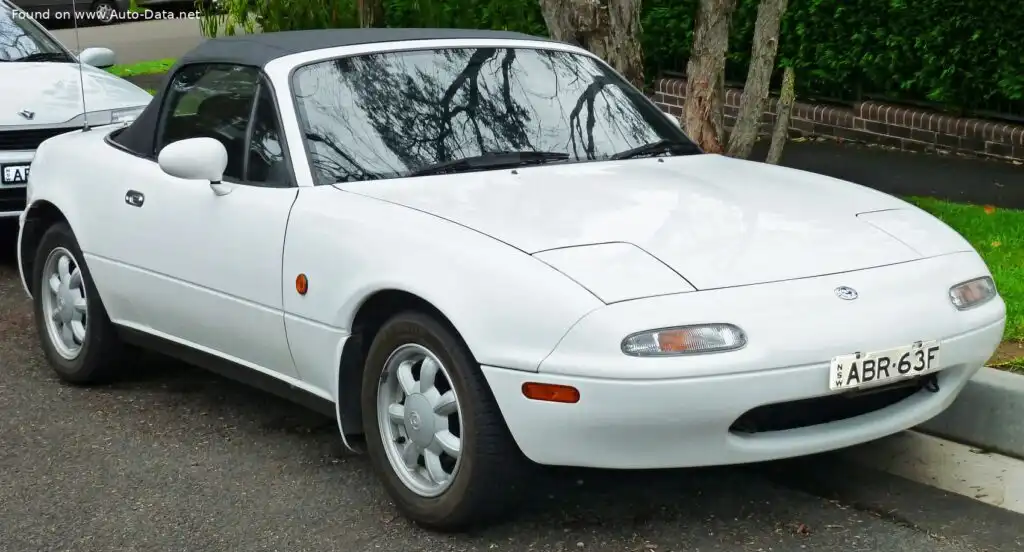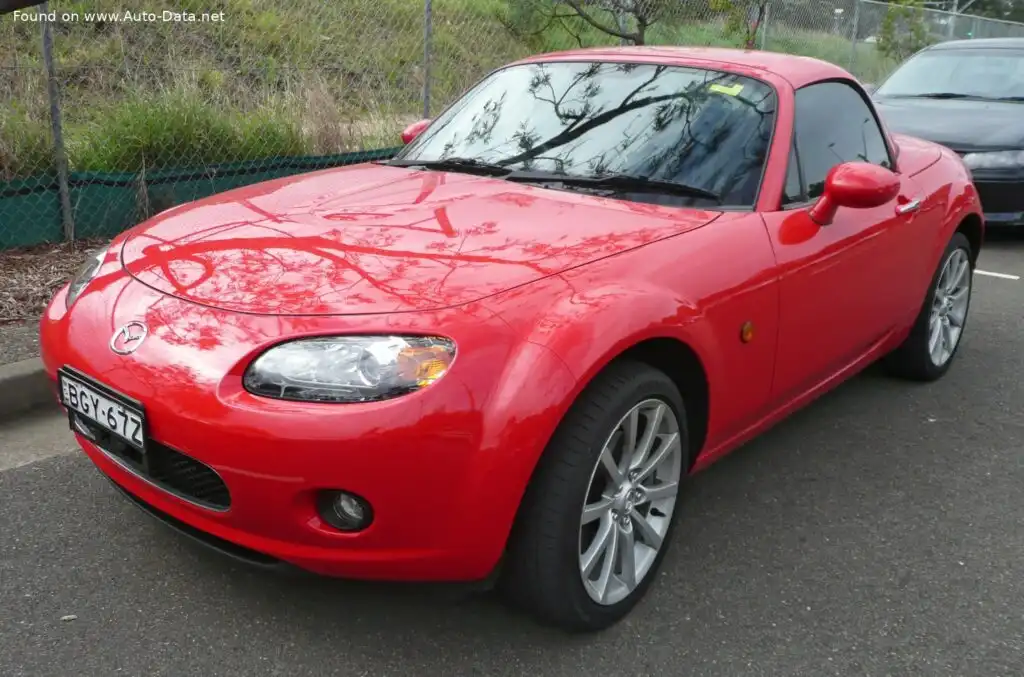
The Mazda MX-5 NC Hardtop 2.0i 16V, produced from 2005 to 2008, represents a significant evolution in Mazda’s iconic roadster lineage. Part of the third-generation (NC) MX-5 series, this variant offered a fixed hardtop roof as an alternative to the traditional soft-top, providing enhanced security, weather protection, and a more refined driving experience. Positioned as a mid-range offering within the NC lineup, it bridged the gap between the base 1.8-liter models and the more performance-focused 2.0-liter variants with manual transmissions. The NC generation, internally designated as the 1HX0 platform, aimed to broaden the MX-5’s appeal while retaining its core values of lightweight agility and driver engagement.
Technical Specifications
| Brand | Mazda |
| Model | MX-5 |
| Generation | MX-5 III (NC) Hardtop |
| Type (Engine) | 2.0 i 16V (160 Hp) |
| Start of production | 2005 |
| End of production | 2008 |
| Powertrain Architecture | Internal Combustion engine |
| Body type | Roadster |
| Seats | 2 |
| Doors | 2 |
| Fuel consumption (urban) | 10.6 l/100 km (22.2 US mpg) |
| Fuel consumption (extra urban) | 6 l/100 km (39.2 US mpg) |
| Fuel consumption (combined) | 7.7 l/100 km (30.5 US mpg) |
| Fuel Type | Petrol (Gasoline) |
| Acceleration 0 – 100 km/h | 8.3 sec |
| Acceleration 0 – 62 mph | 8.3 sec |
| Acceleration 0 – 60 mph | 7.9 sec |
| Maximum speed | 215 km/h (133.59 mph) |
| Emission standard | Euro 4 |
| Weight-to-power ratio | 6.6 kg/Hp |
| Weight-to-torque ratio | 5.6 kg/Nm |
| Power | 160 Hp @ 6700 rpm |
| Power per litre | 80 Hp/l |
| Torque | 188 Nm @ 5000 rpm (138.66 lb.-ft. @ 5000 rpm) |
| Engine layout | Front, Longitudinal |
| Engine displacement | 1999 cm3 (121.99 cu. in.) |
| Number of cylinders | 4 |
| Engine configuration | Inline |
| Cylinder Bore | 87.5 mm (3.44 in.) |
| Piston Stroke | 83.1 mm (3.27 in.) |
| Compression ratio | 10.8:1 |
| Number of valves per cylinder | 4 |
| Fuel injection system | Multi-port manifold injection |
| Engine aspiration | Naturally aspirated engine |
| Valvetrain | DOHC |
| Engine oil capacity | 4.3 l (4.54 US qt | 3.78 UK qt) |
| Coolant capacity | 7.5 l (7.93 US qt | 6.6 UK qt) |
| Kerb Weight | 1055 kg (2325.88 lbs.) |
| Max. weight | 1355 kg (2987.26 lbs.) |
| Max load | 300 kg (661.39 lbs.) |
| Trunk (boot) space – minimum | 150 l (5.3 cu. ft.) |
| Fuel tank capacity | 50 l (13.21 US gal | 11 UK gal) |
| Length | 3995 mm (157.28 in.) |
| Width | 1720 mm (67.72 in.) |
| Height | 1245 mm (49.02 in.) |
| Wheelbase | 2330 mm (91.73 in.) |
| Front track | 1490 mm (58.66 in.) |
| Rear (Back) track | 1495 mm (58.86 in.) |
| Drivetrain Architecture | Rear wheel drive |
| Number of gears and type of gearbox | 5 gears, manual transmission |
| Front suspension | Spring Strut |
| Rear suspension | Spring Strut |
| Front brakes | Ventilated discs |
| Rear brakes | Disc |
| Steering type | Steering rack and pinion |
| Tires size | 205/50 R16 |
| Wheel rims size | 6.5J x 16 ET 55 |
Powertrain & Engine Architecture
The heart of the MX-5 NC 2.0i is the MZR (Mazda Zoom-Zoom) engine, specifically the LF-VE variant. This 1999cc inline-four cylinder engine utilizes a double overhead camshaft (DOHC) valvetrain with four valves per cylinder. The engine employs multi-point fuel injection, delivering fuel directly into the intake ports. The 160 horsepower output is achieved at 6700 rpm, while peak torque of 188 Nm (138.66 lb-ft) arrives at 5000 rpm. The engine’s relatively high compression ratio of 10.8:1 contributes to its responsiveness. This particular variant was paired with a five-speed automatic transmission, offering a more relaxed driving experience compared to the six-speed manual option available on other 2.0-liter models. The automatic transmission, while smooth, was geared more towards fuel efficiency than outright performance.
Driving Characteristics
The MX-5 NC 2.0i with the automatic transmission delivers a comfortable and engaging driving experience, albeit one slightly muted compared to its manual counterparts. The automatic gearbox, while providing convenience, does result in some power loss and a less direct connection to the engine. Acceleration from 0-60 mph takes approximately 7.9 seconds, and top speed is rated at 133.59 mph. The gear ratios are optimized for everyday driving and fuel economy, meaning quick downshifts for overtaking require a deliberate push of the accelerator. The car’s lightweight construction (around 2326 lbs) and well-tuned suspension contribute to its nimble handling, making it enjoyable on winding roads. However, the automatic transmission doesn’t allow for the same level of control and engine braking as a manual gearbox.
Equipment & Trim Levels
The Hardtop 2.0i trim generally included features such as air conditioning, power windows and locks, a CD player, and alloy wheels. The hardtop itself was a significant upgrade, offering a more secure and insulated cabin. Interior upholstery typically consisted of cloth seats, although leather options were available. Optional extras included a Bose sound system, heated seats, and a limited-slip differential (though less common with the automatic transmission). The dashboard layout was driver-focused, with clearly arranged gauges and controls. The hardtop mechanism was manually operated, requiring a few steps to raise or lower the roof.
Chassis & Braking
The MX-5 NC utilizes a MacPherson strut suspension setup at both the front and rear, providing a good balance between comfort and handling. The front suspension incorporates a stabilizer bar to reduce body roll. Braking duties are handled by ventilated discs at the front and solid discs at the rear. The braking system is adequate for the car’s weight and performance, providing confident stopping power. The steering is a rack-and-pinion system, offering precise and responsive control. Tire size is typically 205/50 R16, mounted on 6.5J x 16 inch alloy wheels.
Market Reception & Comparison
The MX-5 NC Hardtop 2.0i was generally well-received by automotive critics. The hardtop was praised for its practicality and refinement, making the MX-5 a more usable car year-round. However, the automatic transmission was often criticized for detracting from the overall driving experience. Compared to the 1.8-liter models, the 2.0-liter offered a noticeable performance boost. Compared to the manual 2.0-liter versions, the automatic was slightly slower and less engaging. Fuel economy was respectable, averaging around 30.5 US mpg in combined driving. Reliability was generally good, with the MZR engine proving to be durable and relatively maintenance-free.
Legacy
The Mazda MX-5 NC Hardtop 2.0i remains a popular choice in the used car market. Its combination of sporty handling, practicality, and reliability makes it an appealing option for those seeking an affordable roadster. The MZR engine is known for its longevity, and parts availability is generally good. While the automatic transmission may not be the preferred choice for driving enthusiasts, it offers a more accessible entry point into MX-5 ownership. The NC generation, and this variant in particular, helped to solidify the MX-5’s reputation as one of the best-handling and most enjoyable sports cars available, continuing a legacy that began with the original NA model.