
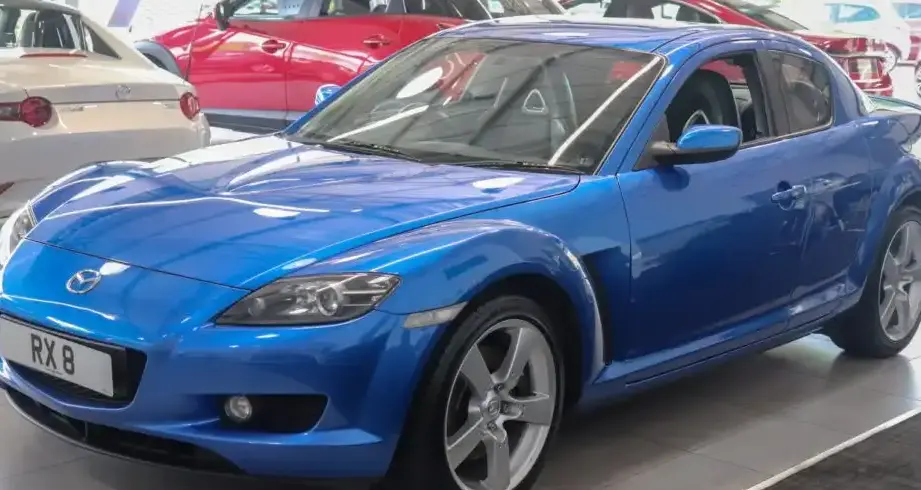
The Mazda RX-8, produced from 2003 to 2012, represented a unique approach to the sports car market. The variant equipped with the 1.3-liter Wankel rotary engine producing 215 horsepower, coupled with a 6-speed automatic transmission, was available primarily from 2005 to 2009 in North America and select international markets. This configuration aimed to broaden the RX-8’s appeal by offering the distinctive rotary engine experience with the convenience of an automatic gearbox, targeting drivers who desired performance but preferred ease of use in daily driving situations. It occupied a middle ground in the RX-8 lineup, positioned between the base manual transmission models and the higher-performance trims.
Technical Specifications
| Brand | Mazda |
| Model | RX-8 |
| Generation | RX-8 |
| Type (Engine) | 1.3 Wankel (215 Hp) |
| Start of production | 2005 |
| End of production | 2009 |
| Powertrain Architecture | Internal Combustion engine |
| Body type | Coupe |
| Seats | 4 |
| Doors | 4 |
| Fuel consumption (urban) | 13.1 l/100 km (18 US mpg, 21.6 UK mpg, 7.6 km/l) |
| Fuel consumption (extra urban) | 9.4 l/100 km (25 US mpg, 30.1 UK mpg, 10.6 km/l) |
| Fuel Type | Petrol (Gasoline) |
| Weight-to-power ratio | 6.5 kg/Hp, 154.1 Hp/tonne |
| Weight-to-torque ratio | 6.5 kg/Nm, 154.8 Nm/tonne |
| Power | 215 Hp @ 7500 rpm |
| Power per litre | 164.4 Hp/l |
| Torque | 216 Nm @ 7500 rpm (159.31 lb.-ft. @ 7500 rpm) |
| Engine layout | Front, Longitudinal |
| Engine Model/Code | 13B-MSP |
| Engine displacement | 1308 cm3 (79.82 cu. in.) |
| Number of cylinders | 2 |
| Engine configuration | Rotary (Wankel) |
| Compression ratio | 10:1 |
| Fuel injection system | Multi-port manifold injection |
| Engine aspiration | Naturally aspirated engine |
| Engine oil capacity | 4.4 l (4.65 US qt | 3.87 UK qt) |
| Coolant capacity | 9.8 l (10.36 US qt | 8.62 UK qt) |
| Kerb Weight | 1395 kg (3075.45 lbs) |
| Max. weight | 1748 kg (3853.68 lbs) |
| Max load | 353 kg (778.23 lbs) |
| Trunk (boot) space – maximum | 290 l (10.24 cu. ft) |
| Fuel tank capacity | 61 l (16.11 US gal | 13.42 UK gal) |
| Length | 4427 mm (174.29 in) |
| Width | 1770 mm (69.69 in) |
| Height | 1340 mm (52.76 in) |
| Wheelbase | 2700 mm (106.3 in) |
| Front track | 1500 mm (59.06 in) |
| Rear (Back) track | 1505 mm (59.25 in) |
| Drivetrain Architecture | Rear wheel drive |
| Drive wheel | Rear wheel drive |
| Number of gears and type of gearbox | 6 gears, automatic transmission |
| Front suspension | Independent coil spring |
| Rear suspension | Independent coil spring |
| Front brakes | Ventilated discs |
| Rear brakes | Disc |
| Assisting systems | ABS (Anti-lock braking system) |
| Tires size | 225/55R16 |
| Wheel rims size | 16 |
Powertrain & Engine Architecture
The heart of the RX-8 1.3 Wankel (215 Hp) is the 13B-MSP rotary engine. Unlike traditional piston engines, the Wankel engine utilizes a triangular rotor spinning within a housing to generate power. This design allows for a remarkably smooth and high-revving engine, but also presents unique challenges in terms of fuel efficiency and emissions. The 13B-MSP featured side intake and exhaust ports, a Renesis design, which improved breathing and increased power output compared to earlier rotary engines. The engine employed a multi-port fuel injection system for precise fuel delivery. The 6-speed automatic transmission was a key component of this variant, offering smoother shifts than a traditional 4-speed automatic and allowing the engine to remain in its optimal power band. The transmission was programmed for both economy and performance, with a manual shift mode available for more driver control.
Driving Characteristics
The RX-8 with the 1.3L rotary and automatic transmission delivered a unique driving experience. While not as overtly powerful as some of its competitors, the engine’s high-revving nature and the automatic transmission’s ability to keep it near its peak powerband provided brisk acceleration. Compared to the manual transmission RX-8, the automatic version sacrificed some driver engagement but gained in ease of use, particularly in stop-and-go traffic. The automatic transmission’s gear ratios were tuned to balance acceleration and fuel economy. The rear-wheel-drive layout contributed to a balanced and engaging handling experience, though the automatic transmission didn’t offer the same level of control as a manual gearbox.
Equipment & Trim Levels
The RX-8 1.3 Wankel (215 Hp) automatic typically came standard with features such as air conditioning, power windows and locks, a CD stereo system, and alloy wheels. Higher trim levels added features like leather upholstery, a sunroof, Bose premium sound system, and heated seats. Optional extras included navigation systems and various cosmetic enhancements. The interior design was driver-focused, with a well-placed steering wheel and easy-to-read gauges. The RX-8’s unique rear “freestyle” doors allowed for easier access to the rear seats, adding to its practicality.
Chassis & Braking
The RX-8 featured an independent suspension system at all four wheels, utilizing coil springs and dampers. This setup provided a comfortable ride while maintaining good handling characteristics. The front suspension geometry was optimized for steering precision, while the rear suspension was designed to minimize body roll. Braking duties were handled by ventilated discs at the front and solid discs at the rear. Anti-lock braking system (ABS) was standard, enhancing safety and control during hard braking. The chassis was designed to be lightweight and rigid, contributing to the car’s agility.
Market Reception & Comparison
The RX-8 1.3 Wankel (215 Hp) automatic received mixed reviews. Critics praised the engine’s smoothness and high-revving nature, as well as the car’s handling and unique styling. However, the automatic transmission was sometimes criticized for being less engaging than the manual gearbox. Fuel economy was also a concern, as rotary engines are inherently less efficient than traditional piston engines. Compared to other sports cars of the time, such as the Honda S2000 or the Nissan 350Z, the RX-8 offered a different driving experience, prioritizing smoothness and handling over outright power. The automatic transmission version appealed to a broader audience, including those who preferred the convenience of an automatic gearbox.
Legacy
The Mazda RX-8, and particularly the 1.3 Wankel (215 Hp) automatic variant, holds a special place in automotive history. While the rotary engine’s inherent challenges ultimately led to the RX-8’s discontinuation, the car remains a popular choice among enthusiasts. The 13B-MSP engine, while requiring diligent maintenance (particularly oil top-ups due to the rotary’s oil consumption), is known for its reliability when properly cared for. Today, well-maintained RX-8s are sought after by collectors and enthusiasts who appreciate their unique engineering and driving experience. The used car market values these vehicles based on condition, mileage, and originality, with lower-mileage examples commanding higher prices. The RX-8 serves as a testament to Mazda’s willingness to innovate and push the boundaries of automotive technology.
