
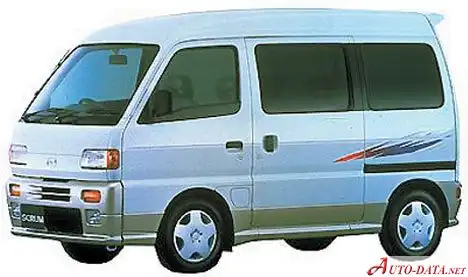
The Mazda Scrum (ED) 0.7 12V Turbo, produced between 1995 and 2000, represents a unique offering within the Japanese Kei car class, adapted for light commercial and personal transport. This variant, powered by a 657cc turbocharged three-cylinder engine, occupied a specific niche in the Scrum lineup, providing a balance between affordability, fuel efficiency, and modest performance. The ED generation of the Scrum, a successor to earlier iterations, was primarily designed for the Japanese domestic market, catering to the demand for compact, maneuverable vehicles suitable for urban environments and narrow roads. It’s a rear-wheel drive, four-door minivan, seating up to four passengers.
Technical Specifications
| Brand | Mazda |
| Model | Scrum |
| Generation | Scrum (ED) |
| Type (Engine) | 0.7 12V Turbo (58 Hp) |
| Start of production | 1995 |
| End of production | 2000 |
| Powertrain Architecture | Internal Combustion engine |
| Body type | Minivan |
| Seats | 4 |
| Doors | 4 |
| Fuel consumption (combined) | 5.5 l/100 km (42.8 US mpg, 51.4 UK mpg, 18.2 km/l) |
| Fuel Type | Petrol (Gasoline) |
| Maximum speed | 130 km/h (80.78 mph) |
| Weight-to-power ratio | 14 kg/Hp, 71.6 Hp/tonne |
| Weight-to-torque ratio | 9.4 kg/Nm, 106.2 Nm/tonne |
| Power | 58 Hp @ 5500 rpm |
| Power per litre | 88.3 Hp/l |
| Torque | 86 Nm @ 3500 rpm (63.43 lb.-ft. @ 3500 rpm) |
| Engine layout | Front, Longitudinal |
| Engine displacement | 657 cm3 (40.09 cu. in.) |
| Number of cylinders | 3 |
| Engine configuration | Inline |
| Cylinder Bore | 65 mm (2.56 in.) |
| Piston Stroke | 66 mm (2.6 in.) |
| Compression ratio | 8.1:1 |
| Number of valves per cylinder | 4 |
| Fuel injection system | Carburettor |
| Engine aspiration | Turbocharger |
| Valvetrain | OHC |
| Kerb Weight | 810 kg (1785.74 lbs.) |
| Fuel tank capacity | 37 l (9.77 US gal | 8.14 UK gal) |
| Length | 3295 mm (129.72 in.) |
| Width | 1395 mm (54.92 in.) |
| Height | 1870 mm (73.62 in.) |
| Wheelbase | 1840 mm (72.44 in.) |
| Front track | 1210 mm (47.64 in.) |
| Rear track | 1200 mm (47.24 in.) |
| Minimum turning circle | 9 m (29.53 ft.) |
| Drivetrain Architecture | Rear wheel drive |
| Drive wheel | Rear wheel drive |
| Number of gears and type of gearbox | 3 gears, automatic transmission |
| Front suspension | Coil spring |
| Rear suspension | Coil spring |
| Front brakes | Disc |
| Rear brakes | Drum |
| Assisting systems | ABS (Anti-lock braking system) |
| Tires size | 145/80 R12 S |
| Wheel rims size | 4J x 12 ET 35 |
Powertrain & Engine Architecture
The heart of the Scrum ED 0.7 Turbo is its F6A engine, a 657cc inline three-cylinder unit. This engine, despite its small displacement, benefits from a turbocharger and a 12-valve configuration (four valves per cylinder) operated by an overhead camshaft (OHC). The use of a carburetor, rather than fuel injection, was a cost-saving measure common in Kei cars of this era. The turbocharger significantly boosts power output compared to naturally aspirated versions of the same engine. The 8.1:1 compression ratio is a compromise between performance and fuel efficiency. The three-speed automatic transmission was a key feature of this variant, aimed at providing ease of use for urban driving. It’s a relatively simple automatic, prioritizing durability and low cost over sophisticated shift programming.
Driving Characteristics
The 58 horsepower and 86 Nm (63.43 lb-ft) of torque produced by the 0.7 Turbo engine translate to modest but adequate performance for its intended purpose. Acceleration is leisurely, but the turbocharger provides a noticeable boost in power during overtaking maneuvers. The three-speed automatic transmission, while smooth, lacks the responsiveness of a manual gearbox or a more modern automatic. Gear ratios are optimized for low-speed torque and fuel economy rather than outright speed. Compared to the naturally aspirated versions of the Scrum, the turbo variant offers a significant improvement in acceleration and hill-climbing ability. However, it falls short of the performance offered by larger-engined Kei cars or conventional subcompacts.
Equipment & Trim Levels
The Scrum ED 0.7 Turbo typically came with a basic level of equipment, reflecting its position as an affordable commercial vehicle. Standard features generally included cloth upholstery, a simple dashboard layout, and basic instrumentation. Power steering was often optional, as were features like air conditioning and a radio. The interior was designed for practicality and durability rather than luxury. Trim levels were relatively limited, with most variations focusing on optional extras rather than significant changes to the core specification. The focus was on providing a functional and reliable vehicle for everyday use.
Chassis & Braking
The Scrum ED features a body-on-frame construction, typical of Kei cars and light commercial vehicles. The front suspension utilizes coil springs, while the rear also employs coil springs. The braking system consists of disc brakes on the front wheels and drum brakes on the rear. This configuration was common for vehicles in this weight class during the 1990s. Anti-lock braking system (ABS) was available as an option, enhancing safety. The relatively narrow tires (145/80 R12) contribute to fuel efficiency and ride comfort on uneven surfaces.
Market Reception & Comparison
The Mazda Scrum ED 0.7 Turbo was well-received in Japan as a practical and economical vehicle. Critics praised its maneuverability, fuel efficiency, and affordability. However, some noted its limited power and basic interior. Compared to other Kei cars of the time, such as the Suzuki Carry or the Daihatsu Hijet, the Scrum offered a similar level of functionality and value. The automatic transmission variant appealed to drivers seeking ease of use, particularly in congested urban areas. The turbocharger provided a competitive edge over naturally aspirated rivals, offering improved performance without a significant increase in fuel consumption.
Legacy
The Mazda Scrum ED 0.7 Turbo, while not widely exported outside of Japan, remains a popular choice in the used car market. Its simple mechanical design and robust construction contribute to its long-term reliability. The F6A engine, while carbureted, is generally considered durable and relatively easy to maintain. Parts availability can be a challenge outside of Japan, but the vehicle’s simplicity makes it a viable option for enthusiasts and those seeking an affordable and practical Kei car. Today, these Scrums are often sought after for their retro charm and unique character, representing a bygone era of compact and efficient Japanese automotive engineering.
