
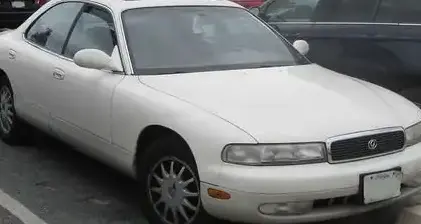
The Mazda Sentia HC, produced between 1991 and 1996, represented Mazda’s foray into the upper-midsize luxury sedan segment, primarily aimed at the Japanese domestic market (JDM). Positioned above the Mazda 929/Luce, the Sentia was intended to compete with established Japanese rivals like the Toyota Crown and Nissan Cedric. The 3.0 i V6 24V variant, equipped with a 3.0-liter V6 engine producing 200 horsepower, was a flagship model within the HC range, offering a blend of performance and refinement. It was a relatively short-lived model, discontinued as Mazda restructured its lineup in the mid-1990s.
Technical Specifications
| Brand | Mazda |
| Model | Sentia |
| Generation | Sentia (HC) |
| Type (Engine) | 3.0 i V6 24V (200 Hp) |
| Start of production | 1991 |
| End of production | 1996 |
| Powertrain Architecture | Internal Combustion engine |
| Body type | Sedan |
| Seats | 5 |
| Doors | 4 |
| Fuel Type | Petrol (Gasoline) |
| Maximum speed | 220 km/h (136.7 mph) |
| Weight-to-power ratio | 8.2 kg/Hp, 122 Hp/tonne |
| Weight-to-torque ratio | 6.3 kg/Nm, 158.5 Nm/tonne |
| Power | 200 Hp @ 6000 rpm |
| Power per litre | 67.7 Hp/l |
| Torque | 260 Nm @ 4500 rpm (191.77 lb.-ft. @ 4500 rpm) |
| Engine layout | Front, Longitudinal |
| Engine displacement | 2954 cm3 (180.26 cu. in.) |
| Number of cylinders | 6 |
| Engine configuration | V-engine |
| Cylinder Bore | 90 mm (3.54 in.) |
| Piston Stroke | 77.4 mm (3.05 in.) |
| Compression ratio | 9.5:1 |
| Number of valves per cylinder | 4 |
| Fuel injection system | Multi-port manifold injection |
| Engine aspiration | Naturally aspirated engine |
| Valvetrain | DOHC |
| Kerb Weight | 1640 kg (3615.58 lbs.) |
| Fuel tank capacity | 70 l (18.49 US gal | 15.4 UK gal) |
| Length | 4920 mm (193.7 in.) |
| Width | 1795 mm (70.67 in.) |
| Height | 1395 mm (54.92 in.) |
| Wheelbase | 2850 mm (112.2 in.) |
| Front track | 1510 mm (59.45 in.) |
| Rear (Back) track | 1520 mm (59.84 in.) |
| Drivetrain Architecture | The Internal combustion engine (ICE) drives the rear wheels of the vehicle. |
| Drive wheel | Rear wheel drive |
| Number of gears and type of gearbox | 4 gears, automatic transmission |
| Front suspension | Coil spring |
| Rear suspension | Double wishbone |
| Front brakes | Ventilated discs |
| Rear brakes | Disc |
| Assisting systems | ABS (Anti-lock braking system), Hydraulic Steering |
| Tires size | 205/65 R15 93 H |
| Wheel rims size | 6J x 15 ET 50 |
Powertrain & Engine Architecture
The heart of the Sentia 3.0 i V6 was the JE series 3.0-liter V6 engine. This engine, designated as the JE-ZE, featured a 60-degree V-angle and a dual overhead camshaft (DOHC) valvetrain operating four valves per cylinder. The multi-port fuel injection system delivered fuel directly to each intake port, optimizing combustion efficiency. The engine produced 200 horsepower at 6000 rpm and 260 Nm (191.77 lb-ft) of torque at 4500 rpm. The engine’s longitudinal mounting and rear-wheel-drive configuration were a deliberate choice, aiming for a more traditional, balanced driving experience. Paired with the engine was a four-speed automatic transmission, designed for smooth and comfortable shifts. This transmission wasn’t known for its sportiness, prioritizing refinement over rapid gear changes.
Driving Characteristics
The 3.0 i V6 Sentia offered a comfortable and refined driving experience. The automatic transmission, while not particularly quick-shifting, provided smooth transitions between gears. The engine delivered adequate power for effortless cruising and overtaking, but it wasn’t a particularly sporty performer. The rear-wheel-drive layout contributed to balanced handling, although the car’s weight (1640 kg / 3615.58 lbs) was noticeable in corners. Compared to potential manual transmission versions (which were rare), the automatic version sacrificed some responsiveness. The focus was clearly on providing a luxurious and relaxed driving experience, rather than engaging performance.
Equipment & Trim Levels
The 3.0 i V6 Sentia was the top-of-the-line model, and as such, came well-equipped. Standard features typically included power windows, power locks, air conditioning, a high-quality audio system, and velour upholstery. Higher trim levels offered options such as leather seats, woodgrain interior trim, and a sunroof. The interior design was generally conservative and focused on providing a comfortable and spacious cabin. The dashboard layout was functional and easy to use, with a clear instrument cluster.
Chassis & Braking
The Sentia HC utilized a traditional chassis layout with a coil spring independent suspension at the front and a double wishbone independent suspension at the rear. This setup aimed to provide a comfortable ride and stable handling. Braking duties were handled by ventilated discs at the front and solid discs at the rear. An Anti-lock Braking System (ABS) was standard, enhancing safety and control during hard braking. The power steering system was hydraulically assisted, providing light and easy steering effort.
Market Reception & Comparison
The Mazda Sentia, particularly the 3.0 i V6 variant, was generally well-received by Japanese automotive critics. It was praised for its comfortable ride, refined engine, and spacious interior. However, some critics noted that it lacked the sporty character of some of its European rivals. Compared to the lower-displacement Sentia models (such as the 2.0-liter versions), the 3.0 i V6 offered significantly more power and a more luxurious experience, but at a higher price point. Fuel economy was reasonable for a vehicle of its size and engine displacement, but it wasn’t a primary selling point. Reliability was generally good, typical of Mazda products of the era.
Legacy
The Mazda Sentia HC, while not a massive sales success, remains a fondly remembered vehicle among JDM enthusiasts. The 3.0 i V6 variant, in particular, is sought after for its smooth engine and luxurious appointments. The JE-ZE V6 engine proved to be a durable and reliable powerplant, and well-maintained examples continue to provide years of service. In the used car market, the Sentia 3.0 i V6 commands a premium over lower-spec models, reflecting its status as the flagship of the HC range. Its relative rarity and unique styling contribute to its appeal among collectors and enthusiasts seeking a distinctive and well-built Japanese luxury sedan.
