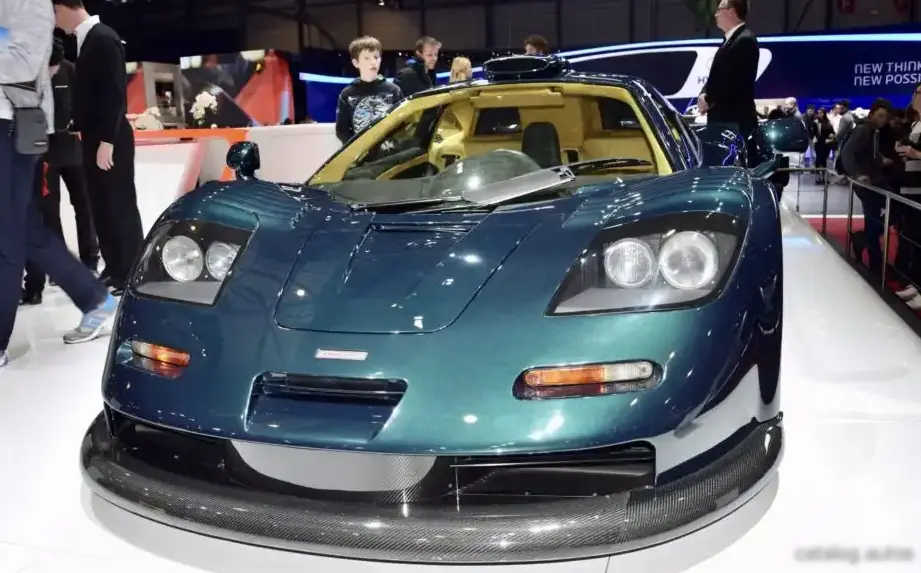
The McLaren F1 6.1 V12, produced from 1992 to 2000, represents a landmark achievement in automotive engineering. This iconic supercar, built by McLaren Automotive, was not merely a fast car, but a holistic design exercise prioritizing weight reduction, aerodynamic efficiency, and driver engagement. The 6.1-liter variant, delivering 627 horsepower, was the pinnacle of the F1 range, solidifying its reputation as the fastest production car of its time. The F1 was unique for its three-seat layout, with the driver centrally positioned and two passenger seats flanking them, and its use of exotic materials like carbon fiber throughout its construction. It was a limited-production vehicle, with only 106 examples built, including prototypes and the GTR racing variant.
Technical Specifications
| Brand | McLaren |
| Model | F1 |
| Generation | F1 |
| Type (Engine) | 6.1 V12 (627 Hp) |
| Start of production | 1992 |
| End of production | 2000 |
| Powertrain Architecture | Internal Combustion engine |
| Body type | Coupe |
| Seats | 3 |
| Doors | 2 |
| Fuel Type | Petrol (Gasoline) |
| Acceleration 0 – 60 mph | 3.2 sec |
| Maximum speed | 386 km/h (239.85 mph) |
| Weight-to-power ratio | 1.8 kg/Hp, 550 Hp/tonne |
| Weight-to-torque ratio | 1.8 kg/Nm, 571.1 Nm/tonne |
| Power | 627 Hp @ 7500 rpm |
| Power per litre | 103.4 Hp/l |
| Torque | 651 Nm @ 5600 rpm (480.15 lb.-ft. @ 5600 rpm) |
| Engine layout | Middle, Longitudinal |
| Engine Model/Code | S70/2 |
| Engine displacement | 6064 cm3 (370.05 cu. in.) |
| Number of cylinders | 12 |
| Engine configuration | V-engine |
| Cylinder Bore | 86 mm (3.39 in.) |
| Piston Stroke | 87 mm (3.43 in.) |
| Compression ratio | 11:1 |
| Number of valves per cylinder | 4 |
| Fuel injection system | Multi-port manifold injection |
| Engine aspiration | Naturally aspirated engine |
| Valvetrain | DOHC |
| Engine oil capacity | 6 l (6.34 US qt | 5.28 UK qt) |
| Kerb Weight | 1140 kg (2513.27 lbs.) |
| Trunk (boot) space – minimum | 227 l (8.02 cu. ft.) |
| Trunk (boot) space – maximum | 283 l (9.99 cu. ft.) |
| Fuel tank capacity | 90 l (23.78 US gal | 19.8 UK gal) |
| Length | 4287 mm (168.78 in.) |
| Width | 1820 mm (71.65 in.) |
| Height | 1140 mm (44.88 in.) |
| Wheelbase | 2718 mm (107.01 in.) |
| Front track | 1568 mm (61.73 in.) |
| Rear (Back) track | 1472 mm (57.95 in.) |
| Front overhang | 970 mm (38.19 in.) |
| Rear overhang | 599 mm (23.58 in.) |
| Ride height (ground clearance) | 120 mm (4.72 in.) |
| Drag coefficient (Cd) | 0.32 |
| Minimum turning circle (turning diameter) | 13 m (42.65 ft.) |
| Drivetrain Architecture | The Internal combustion engine (ICE) drives the rear wheels of the vehicle. |
| Drive wheel | Rear wheel drive |
| Number of gears and type of gearbox | 6 gears, manual transmission |
| Front suspension | Coil spring, Double wishbone, Transverse stabilizer |
| Rear suspension | Double wishbone, Coil spring |
| Front brakes | Ventilated discs, 332×32 mm |
| Rear brakes | Ventilated discs, 305×26 mm |
| Steering type | Steering rack and pinion |
| Tires size | Front wheel tires: 235/45 ZR17 Rear wheel tires: 315/45 ZR17 |
| Wheel rims size | Front wheel rims: 9J x 17 Rear wheel rims: 11.5J x 17 |
Powertrain & Engine Architecture
The heart of the McLaren F1 6.1 is the BMW S70/2 6.1-liter naturally aspirated V12 engine. This engine was specifically designed for the F1 by BMW’s motorsport division, M-Power, and is not found in any other production vehicle. It features a 60-degree V-angle, four valves per cylinder, and a sophisticated double overhead camshaft (DOHC) valvetrain. The engine utilizes multi-port fuel injection and a high 11:1 compression ratio. The engine’s construction incorporates a lightweight aluminum alloy block and cylinder heads. The S70/2 produced 627 horsepower at 7,500 rpm and 480 lb-ft of torque at 5,600 rpm. The engine is mounted longitudinally in a mid-engine configuration, contributing to the car’s exceptional balance. The sole transmission option was a 6-speed manual gearbox, renowned for its precise shift action and robust construction.
Driving Characteristics
The McLaren F1 6.1 delivers a driving experience unlike any other. The combination of the powerful V12 engine and the lightweight chassis results in breathtaking acceleration and handling. The 0-60 mph sprint is achieved in just 3.2 seconds, and the car can reach a top speed of 239.85 mph. The manual transmission requires a skilled driver to extract the most performance, but it provides a direct connection to the engine. The gear ratios are carefully chosen to maximize acceleration and top speed. The car’s steering is precise and communicative, providing excellent feedback to the driver. The suspension, featuring double wishbones and coil springs, offers a comfortable ride while maintaining exceptional control. The F1’s relatively low weight (2,513 lbs) contributes to its agility and responsiveness.
Equipment & Trim Levels
The McLaren F1 was not offered with traditional trim levels. It was a highly bespoke vehicle, with each car largely built to the customer’s specifications. However, all F1s shared a common set of features. The interior was minimalist and driver-focused, with a central driving position and two passenger seats. The cabin was trimmed in Connolly leather and featured a unique central instrument cluster. Standard equipment included power windows, air conditioning, and a high-end audio system. Customers could specify a wide range of options, including different leather colors, custom carpeting, and upgraded audio systems. A bespoke luggage set, designed to fit in the car’s front and rear storage compartments, was also available.
Chassis & Braking
The McLaren F1’s chassis is a carbon fiber monocoque, providing exceptional strength and rigidity while minimizing weight. This construction technique, borrowed from Formula 1 racing, was revolutionary for a production car. The suspension system utilizes double wishbones with coil springs and transverse stabilizers at both the front and rear. The braking system consists of ventilated discs with four-piston calipers at all four corners. The front brakes measure 332×32 mm, while the rear brakes are 305×26 mm. The F1’s braking performance is exceptional, providing ample stopping power even at high speeds.
Market Reception & Comparison
The McLaren F1 was universally praised by automotive critics upon its release. It was lauded for its performance, handling, and innovative design. The 6.1-liter variant was considered the ultimate expression of the F1’s capabilities. Compared to other supercars of the time, such as the Porsche 911 Turbo and the Ferrari F40, the F1 offered a significantly higher level of performance and sophistication. Its fuel economy, while not a primary concern for buyers, was surprisingly reasonable for a car of its caliber. Reliability was generally good, although the complex engine and electronics required specialized maintenance. The F1’s high price tag (around $1 million at the time of launch) limited its appeal to a select few.
Legacy
The McLaren F1 6.1 V12 remains a highly sought-after collector’s car. Its innovative design, exceptional performance, and limited production numbers have ensured its status as a true automotive icon. The S70/2 engine is considered a masterpiece of engineering, and the car’s carbon fiber chassis set a new standard for lightweight construction. Today, well-maintained F1s command prices well in excess of their original cost. The F1’s legacy extends beyond its performance figures; it demonstrated that a road car could incorporate technologies and design principles from the world of motorsport, creating a truly exceptional driving experience. The F1 paved the way for future McLaren supercars and continues to inspire automotive engineers and enthusiasts alike.