
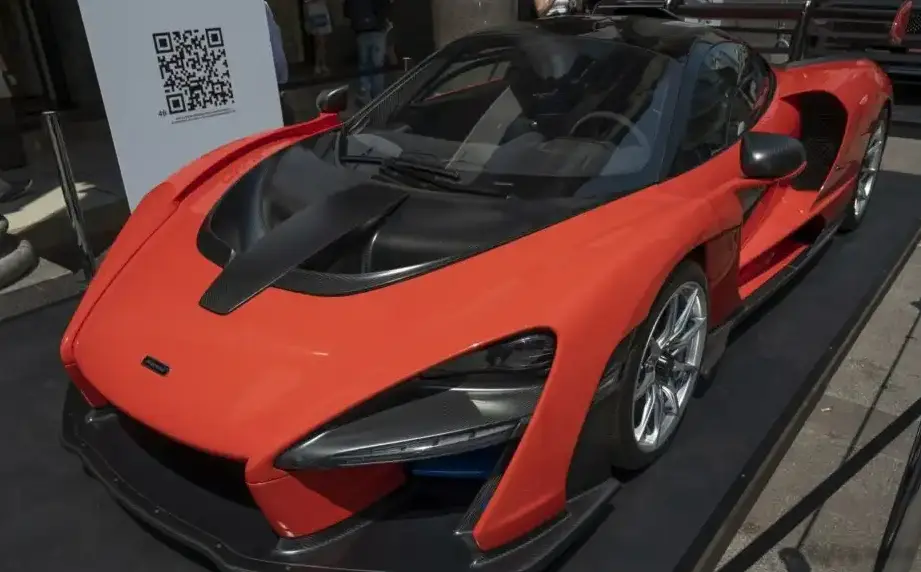
The McLaren Senna 4.0 V8 (800 Hp) Automatic, produced from 2018 onwards, represents a hypercar focused on ultimate track performance. Named in honor of Formula 1 legend Ayrton Senna, the Senna was the first model in McLaren’s “Ultimate Series,” a designation reserved for the most extreme and limited-production vehicles. It’s built around a carbon fiber monocoque chassis and designed with aerodynamics as its primary focus, resulting in a car that prioritizes downforce and handling above all else. The Senna occupies a unique position within McLaren’s lineup, sitting above the Sports Series and Super Series models in terms of price, performance, and exclusivity.
Technical Specifications
| Brand | McLaren |
| Model | Senna |
| Generation | Senna |
| Type (Engine) | 4.0 V8 (800 Hp) Automatic |
| Start of production | 2018 |
| Powertrain Architecture | Internal Combustion engine |
| Body type | Coupe |
| Seats | 2 |
| Doors | 2 |
| Fuel consumption (combined) | 12.4 l/100 km (19 US mpg, 22.8 UK mpg, 8.1 km/l) |
| CO2 emissions | 280 g/km |
| Fuel Type | Petrol (Gasoline) |
| Acceleration 0 – 100 km/h | 2.8 sec |
| Acceleration 0 – 62 mph | 2.8 sec |
| Acceleration 0 – 60 mph | 2.9 sec |
| Acceleration 0 – 200 km/h | 6.8 sec |
| Acceleration 0 – 300 km/h | 17.5 sec |
| Maximum speed | 335 km/h (208.16 mph) |
| Weight-to-power ratio | 1.5 kg/Hp, 667.8 Hp/tonne |
| Weight-to-torque ratio | 1.5 kg/Nm, 667.8 Nm/tonne |
| Power | 800 Hp @ 7250 rpm |
| Power per litre | 200.1 Hp/l |
| Torque | 800 Nm @ 5500-6700 rpm (590.05 lb.-ft. @ 5500-6700 rpm) |
| Engine Model/Code | M840TR |
| Engine displacement | 3999 cm3 (244.03 cu. in.) |
| Number of cylinders | 8 |
| Engine configuration | V-engine |
| Fuel injection system | Direct injection |
| Engine aspiration | Twin-Turbo, Intercooler |
| Valvetrain | DOHC |
| Engine oil capacity | 9 l (9.51 US qt | 7.92 UK qt) |
| Coolant | 25.2 l (26.63 US qt | 22.17 UK qt) |
| Kerb Weight | 1198 kg (2641.14 lbs.) |
| Length | 4744 mm (186.77 in.) |
| Width | 2153 mm (84.76 in.) |
| Height | 1195 mm (47.05 in.) |
| Drivetrain Architecture | Rear wheel drive, Internal Combustion engine (ICE) |
| Number of gears and type of gearbox | 7 gears, automatic transmission DCT |
| Front suspension | Double wishbone |
| Rear suspension | Double wishbone |
| Front brakes | Ventilated discs |
| Rear brakes | Ventilated discs |
| Assisting systems | ABS (Anti-lock braking system) |
| Tires size | 245/35 R19; 315/30 R20 |
| Wheel rims size | 8J x 19; 10J x 20 |
Powertrain & Engine Architecture
At the heart of the Senna lies McLaren’s M840TR 4.0-liter twin-turbocharged V8 engine. This engine is a heavily modified version of the unit found in other McLaren models, but with significant upgrades to handle the increased power output and stresses of track use. The engine utilizes direct fuel injection and a flat-plane crankshaft, contributing to its responsive nature and high-revving capability. The twin-turbochargers, with intercooling, provide substantial boost, delivering peak torque of 800 Nm (590 lb-ft) between 5,500 and 6,700 rpm. The engine is paired with a 7-speed dual-clutch transmission (DCT) optimized for rapid gear changes. This transmission is calibrated for performance, with quicker shift times than those found in McLaren’s Super Series cars. The DCT is crucial for maximizing acceleration and maintaining momentum on the track.
Driving Characteristics
The Senna’s driving experience is defined by its raw, unfiltered connection to the road. The combination of the 800 hp engine and the lightweight construction results in astonishing acceleration. The DCT transmission provides near-instantaneous shifts, allowing the driver to exploit the engine’s powerband effectively. Compared to a hypothetical manual version, the DCT offers faster shift speeds and consistency, particularly beneficial for lap times. While the power delivery is immense, the Senna is surprisingly manageable thanks to its sophisticated electronic stability control system and advanced aerodynamics. The car generates significant downforce, providing exceptional grip in corners. However, the stiff suspension and focused setup mean that the Senna is less comfortable on public roads than other McLaren models.
Equipment & Trim Levels
Given its positioning as an “Ultimate Series” model, the Senna was offered with a relatively limited range of options, focusing primarily on personalization and weight reduction. Standard features included a minimalist interior with carbon fiber seats, a digital instrument cluster, and a track-focused infotainment system. Customers could specify bespoke paint finishes, interior trim materials, and aerodynamic components. A significant option was the removal of carpeting and sound insulation to further reduce weight. The Senna was not designed for luxury; its interior is spartan and functional, prioritizing driver engagement and performance.
Chassis & Braking
The Senna’s chassis is a carbon fiber monocoque, providing exceptional rigidity and minimizing weight. The suspension utilizes a double wishbone setup at both the front and rear, with adaptive dampers and anti-roll bars. The suspension geometry is optimized for track use, prioritizing handling and stability. Braking is provided by ventilated discs at all four corners, with McLaren’s Senna-specific carbon ceramic discs offering superior stopping power and fade resistance. The braking system is assisted by ABS and electronic brake-force distribution. The car’s lightweight construction and powerful brakes contribute to its exceptional deceleration capabilities.
Market Reception & Comparison
The McLaren Senna received widespread acclaim from automotive journalists and enthusiasts. Critics praised its exceptional performance, handling, and aerodynamic capabilities. The Senna was often compared to other hypercars such as the Porsche 918 Spyder and the Ferrari LaFerrari. While the Senna’s focus on track performance made it less forgiving than some of its rivals, its raw speed and driver engagement were highly valued. Fuel economy, understandably, was not a priority, with a combined consumption of 12.4 l/100 km (19 US mpg). Reliability reports have been relatively limited due to the Senna’s low production volume, but McLaren’s reputation for engineering quality suggests that the Senna is a robust and dependable machine when maintained properly.
Legacy
The McLaren Senna has quickly become a highly sought-after collector’s item. Its limited production run and exceptional performance have driven up values in the used car market. The Senna represents a significant achievement in automotive engineering, demonstrating McLaren’s commitment to pushing the boundaries of performance. The technologies and design principles developed for the Senna have influenced subsequent McLaren models, including the Speedtail and the Elva. The Senna’s legacy extends beyond its technical specifications; it stands as a tribute to Ayrton Senna’s racing spirit and a testament to McLaren’s dedication to creating ultimate driving machines.
