
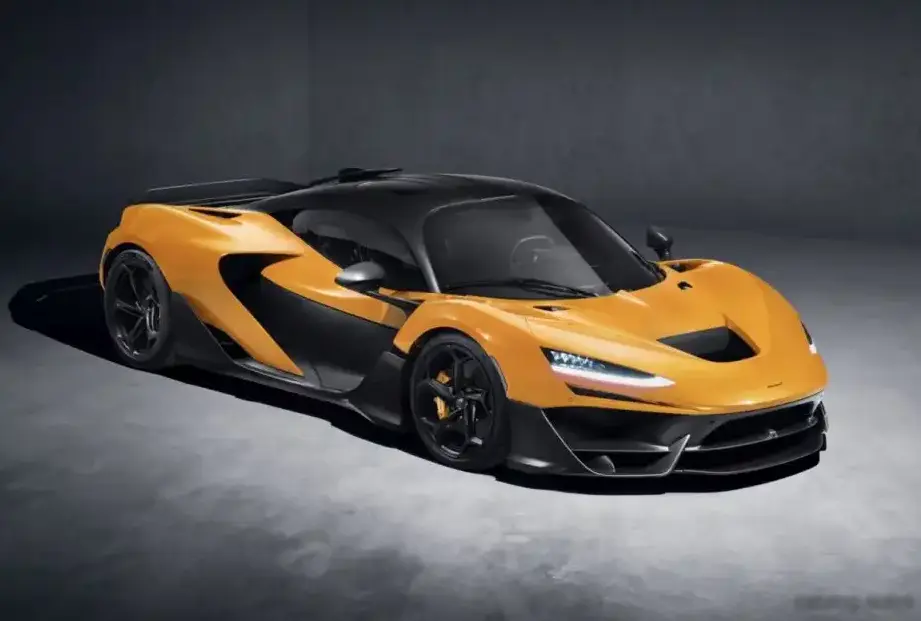
The McLaren W1, launched in 2025, represents the latest evolution in McLaren’s commitment to high-performance, hybrid technology. Positioned as a flagship model, the W1 is a two-seat, coupe designed to deliver exceptional speed and driving dynamics. It builds upon McLaren’s established expertise in carbon fiber construction and powertrain engineering, integrating a potent 4.0-liter V8 engine with a sophisticated plug-in hybrid system. The W1 is intended to compete with the highest-performing hybrid supercars on the market, offering a blend of electrifying acceleration and refined long-distance capability.
Technical Specifications
| Brand | McLaren |
| Model | W1 |
| Generation | W1 |
| Type (Engine) | 4.0 V8 (1275 Hp) Plug-in Hybrid DCT |
| Start of production | 2025 |
| Powertrain Architecture | PHEV (Plug-in Hybrid Electric Vehicle) |
| Body type | Coupe |
| Seats | 2 |
| Doors | 2 |
| CO2 emissions (WLTP) | 310 g/km |
| Fuel Type | Petrol / electricity |
| Acceleration 0 – 100 km/h | 2.7 sec |
| Acceleration 0 – 62 mph | 2.7 sec |
| Acceleration 0 – 60 mph | 2.7 sec |
| Acceleration 0 – 200 km/h | 5.8 sec |
| Acceleration 0 – 300 km/h | 12.7 sec |
| Maximum speed | 350 km/h (217.48 mph) |
| 100 km/h – 0 | 29 m |
| 200 km/h – 0 | 100 m |
| Weight-to-power ratio | 1.1 kg/Hp, 911.4 Hp/tonne |
| Weight-to-torque ratio | 1 kg/Nm, 957.8 Nm/tonne |
| Gross battery capacity | 1.384 kWh |
| Battery location | Below the floor |
| All-electric range | 2 km (1.24 mi) |
| Electric motor | 1 |
| Electric motor power | 347 Hp |
| Electric motor Torque | 440 Nm (324.53 lb.-ft.) |
| Maximum revolutions of the electric motor | 24000 rpm |
| Electric motor location | Rear axle, Longitudinal |
| System power | 1275 Hp |
| System torque | 1340 Nm (988.33 lb.-ft.) |
| Power | 928 Hp |
| Power per litre | 232.7 Hp/l |
| Torque | 900 Nm (663.81 lb.-ft.) |
| Maximum engine speed | 9200 rpm |
| Engine layout | Middle, Longitudinal |
| Engine Model/Code | MHP-8 |
| Engine displacement | 3988 cm3 (243.36 cu. in.) |
| Number of cylinders | 8 |
| Engine configuration | V-engine |
| Cylinder Bore | 92 mm (3.62 in.) |
| Piston Stroke | 75 mm (2.95 in.) |
| Number of valves per cylinder | 4 |
| Fuel injection system | Direct injection and Multi-port manifold injection |
| Engine aspiration | 2 x Twin-scroll turbo, Intercooler |
| Valvetrain | DOHC |
| Kerb Weight | 1399 kg (3084.27 lbs.) |
| Trunk (boot) space – minimum | 87 l (3.07 cu. ft.) |
| Fuel tank capacity | 62 l (16.38 US gal | 13.64 UK gal) |
| Length | 4635 mm (182.48 in.) |
| Width with mirrors folded | 2074 mm (81.65 in.) |
| Width including mirrors | 2191 mm (86.26 in.) |
| Height | 1182 mm (46.54 in.) |
| Wheelbase | 2680 mm (105.51 in.) |
| Front track | 1676 mm (65.98 in.) |
| Rear (Back) track | 1624 mm (63.94 in.) |
| Drive wheel | Rear wheel drive |
| Number of gears and type of gearbox | 8 gears, automatic transmission DCT |
| Front suspension | Double wishbone |
| Rear suspension | Double wishbone |
| Front brakes | Ventilated discs, 390 mm |
| Rear brakes | Ventilated discs, 390 mm |
| Assisting systems | ABS (Anti-lock braking system) |
| Steering type | Steering rack and pinion |
| Power steering | Electric Steering |
| Front wheel tires | 265/35 R19 |
| Rear wheel tires | 335/30 R20 |
| Front wheel rims | 9.5J x 19 |
| Rear wheel rims | 12J x 20 |
Powertrain & Engine Architecture
At the heart of the W1 lies a mid-mounted, longitudinally positioned 4.0-liter twin-turbocharged V8 engine, designated the MHP-8. This engine produces 928 horsepower and 900 Nm (663.81 lb-ft) of torque. The engine utilizes both direct injection and multi-port manifold injection to optimize combustion efficiency and power delivery. The twin-scroll turbochargers, coupled with an intercooler, minimize turbo lag and maximize boost across the rev range. The engine’s valvetrain employs a Double Overhead Camshaft (DOHC) configuration for precise valve control. Supplementing the V8 is a rear-mounted electric motor generating 347 horsepower and 440 Nm (324.53 lb-ft) of torque. The combined system output reaches an impressive 1275 horsepower and 1340 Nm (988.33 lb-ft) of torque. Power is delivered to the rear wheels via an 8-speed Dual Clutch Transmission (DCT), chosen for its rapid and seamless gear changes. The 1.384 kWh battery pack is located under the floor, contributing to a low center of gravity and optimized weight distribution.
Driving Characteristics
The McLaren W1 delivers breathtaking acceleration, achieving 0-60 mph in just 2.7 seconds and a top speed of 350 km/h (217.48 mph). The DCT transmission provides incredibly quick shifts, enhancing the car’s responsiveness. The electric motor provides instant torque, filling in any gaps in the V8’s power delivery and contributing to the car’s impressive launch performance. While the W1 offers a limited all-electric range of 2 km (1.24 mi), it’s primarily designed for high-performance driving. The suspension, featuring double wishbones at both the front and rear, is tuned for optimal handling and control. The steering is precise and communicative, providing the driver with a direct connection to the road.
Equipment & Trim Levels
The McLaren W1 is positioned as a premium offering, and as such, comes standard with a comprehensive suite of features. The interior is appointed with high-quality leather upholstery and carbon fiber trim. Standard equipment includes a digital instrument cluster, a touchscreen infotainment system, and a premium audio system. Available options include bespoke interior customization, lightweight wheels, and aerodynamic enhancements. The focus is on providing a driver-centric experience with a minimalist and functional cabin design.
Chassis & Braking
The W1 utilizes a lightweight carbon fiber chassis, a hallmark of McLaren engineering. This construction technique minimizes weight while maximizing structural rigidity. The car features ventilated disc brakes with 390mm rotors at all four corners, providing exceptional stopping power. An Anti-lock Braking System (ABS) is standard. The suspension geometry is carefully optimized to balance handling performance with ride comfort. The electric steering system provides precise and responsive control.
Market Reception & Comparison
The McLaren W1 is expected to face competition from other high-performance hybrid supercars, such as the Ferrari SF90 Stradale and the Lamborghini Revuelto. Initial reviews have praised the W1’s exceptional performance, handling, and advanced technology. The car’s relatively limited all-electric range is a potential drawback for some buyers, but its overall performance capabilities are widely regarded as class-leading. The W1’s CO2 emissions of 310 g/km are typical for a vehicle in this segment.
Legacy
The McLaren W1 represents a significant step forward in McLaren’s hybrid powertrain development. The MHP-8 engine and its integration with the electric motor showcase McLaren’s engineering prowess. The long-term reliability of the powertrain remains to be seen, but McLaren’s reputation for quality and durability suggests that the W1 will be a highly sought-after vehicle in the used car market. Its advanced technology and exhilarating performance are likely to cement its place as a modern classic.
