
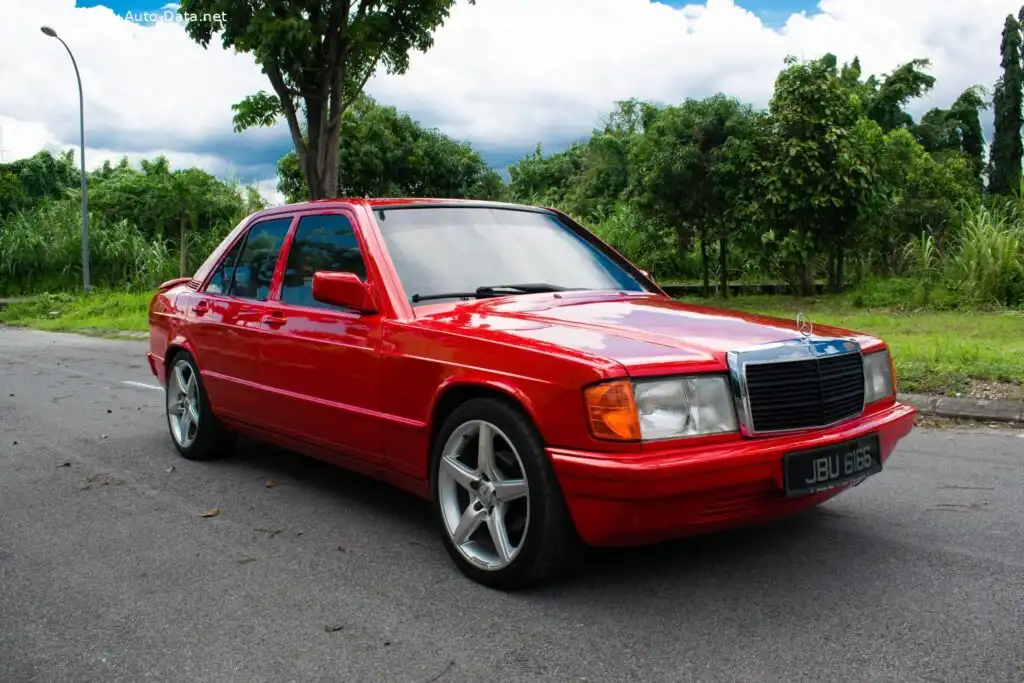
The Mercedes-Benz 190 (W201) series, affectionately nicknamed the Baby Benz, represents a pivotal moment in the history of the German automaker. Introduced in 1982, it was Mercedes-Benz’s first foray into the compact executive car segment, a market previously dominated by rivals like the BMW 3 Series. The W201 was engineered with the same meticulous attention to detail, quality, and durability as its larger stablemates, aiming to attract a new generation of buyers without diluting the brand’s prestigious image. Among the various models in this lineup, the Mercedes-Benz 190 D with its 2.0-liter diesel engine stands out as an emblem of economy and longevity. Produced from August 1982 to August 1988, this particular variant, officially designated the 190 D 2.0 (72 Hp), embodied the principles of sensible, reliable motoring, becoming a symbol of engineering endurance that continues to be respected decades later.
Development and Historical Context
The development of the W201 began in the mid-1970s, driven by the need to respond to the changing automotive landscape, particularly the aftermath of the 1973 oil crisis. Fuel efficiency became a critical consideration for consumers worldwide, and Mercedes-Benz recognized the opportunity to create a smaller, more economical vehicle that still upheld the company’s core values. The project, which reportedly cost over DM 1 billion (approximately $600 million at the time), was one of the most expensive and thoroughly engineered development programs in the company’s history.
The chief designer for the project was the legendary Bruno Sacco, whose design philosophy emphasized a modern, understated, and aerodynamically efficient form. The goal was to create a car that looked unmistakably like a Mercedes-Benz, yet was more compact and agile than the existing W123 and S-Class (W126) models. The result was a clean, wedge-shaped design with a drag coefficient of just 0.33—an exceptional figure for its time that contributed significantly to its fuel efficiency and high-speed stability.
The introduction of the W201 marked a strategic shift for Mercedes-Benz. It was a direct challenge to competitors in the compact class and served to broaden the brand’s customer base. The range included various petrol engines, but the diesel variants were crucial to its success, especially in Europe, where diesel fuel was often cheaper and highly taxed based on engine displacement. The Mercedes-Benz 190 D was the entry-level diesel model, designed for buyers who prized fuel economy and mechanical robustness above all else.
The OM601 Engine: Heart of the Mercedes-Benz 190 D
At the core of the 190 D 2.0 lies the OM601 D 20 (also known by its full code, 601.911) engine. This powerplant was a newly developed 2.0-liter (1997 cm³) inline-four, naturally aspirated diesel engine. It was part of a new family of lightweight, efficient diesel engines designed specifically for the W201 and the subsequent W124 E-Class.
The OM601 featured a single overhead camshaft (SOHC) design with two valves per cylinder. Its construction prioritized simplicity and durability. Key features included pre-combustion chamber injection, a technology Mercedes-Benz had long perfected. This system injects fuel into a small chamber connected to the main combustion chamber, allowing for a smoother, quieter, and more complete combustion process compared to direct injection engines of the era. The engine’s cylinder bore was 87 mm and the piston stroke was 84 mm, creating a nearly square configuration that balanced torque and rotational speed.
With a high compression ratio of 22:1, typical for naturally aspirated diesels, the OM601 produced a modest 72 horsepower (54 kW) at 4600 rpm and 123 Nm (91 lb-ft) of torque at a relatively low 2800 rpm. While these figures may seem underwhelming by modern standards, they were adequate for the vehicle’s intended purpose. The engine was not designed for spirited acceleration but for steady, efficient, and reliable power delivery. Its low-end torque made it tractable in city driving, while its efficient nature allowed for relaxed and economical long-distance cruising. The OM601 engine family gained a legendary reputation for its ability to cover exceptionally high mileage with only routine maintenance, often exceeding 500,000 kilometers (over 300,000 miles) without major overhauls.
Performance and Drivetrain
The performance of the Mercedes-Benz 190 D 2.0 was, by design, leisurely. The 72 horsepower had to propel a curb weight of 1110 kg (2447 lbs), resulting in a weight-to-power ratio of 15.4 kg/Hp. Acceleration from 0 to 100 km/h (62 mph) took a patient 18.1 seconds. The vehicle’s maximum speed was rated at 160 km/h (99 mph). These figures underscored the car’s role as a dependable workhorse rather than a performance sedan. Owners valued its predictable and unhurried nature, which encouraged a smooth and economical driving style.
The engine’s power was sent to the rear wheels, adhering to Mercedes-Benz’s traditional front-engine, rear-wheel-drive layout. This configuration provided balanced weight distribution and predictable handling characteristics. The standard transmission was a 5-speed manual gearbox, which allowed drivers to make the most of the engine’s limited powerband. An optional 4-speed automatic transmission was also available, offering greater convenience at the cost of slightly blunted performance and fuel economy.
The car’s true performance metric was its fuel efficiency. It achieved an impressive consumption figure of 7.9 l/100 km in urban driving and an even better 5.3 l/100 km on the extra-urban cycle. This economy, combined with a 55-liter fuel tank, gave the 190 D a substantial range, making it an ideal vehicle for commuters and long-distance travelers looking to minimize running costs.
Chassis, Suspension, and Handling
While the engine was built for economy, the W201’s chassis was a masterpiece of advanced engineering that set new standards for the compact class. The most significant innovation was its patented multi-link rear suspension. This sophisticated setup used five individual links to control wheel movement precisely, ensuring optimal tire contact with the road under various conditions, including cornering and braking. This design provided an exceptional combination of ride comfort, stability, and handling prowess, giving the Baby Benz the secure, planted feel of its larger siblings.
The front suspension consisted of damper struts with separate springs and triangular wishbones, complemented by an anti-roll bar. The steering was a recirculating ball system with hydraulic power assistance, which provided a solid, communicative feel without being overly heavy. The braking system featured disc brakes on all four wheels, offering reliable and consistent stopping power. Anti-lock brakes (ABS) were available as an option, further enhancing safety. This advanced chassis engineering ensured that even the base-model 190 D was a safe, comfortable, and confidence-inspiring car to drive.
Design, Interior, and Legacy
The exterior design of the W201 was a study in functional elegance. Bruno Sacco’s restrained lines, flush-mounted windows, and integrated bumpers were not just aesthetically pleasing but also aerodynamically effective. The car’s dimensions—4420 mm in length, 1678 mm in width, and 1383 mm in height—gave it a compact but substantial presence.
Inside, the 190 D was quintessentially Mercedes-Benz. The cabin was functional, ergonomic, and constructed from high-quality, durable materials. The dashboard layout was clear and logical, with large, easy-to-read instruments. While standard equipment was basic by today’s standards, the build quality was exceptional. The seats were firm and supportive, designed for long-distance comfort. The car officially offered seating for five, though the rear bench was more comfortable for two adults due to the prominent transmission tunnel. The trunk provided a practical 410 liters of cargo space.
The Mercedes-Benz 190 D 2.0, along with the entire W201 range, was a resounding success. It proved that Mercedes-Benz could build a smaller car that sacrificed none of the brand’s core attributes of quality, safety, and engineering excellence. It successfully attracted a younger demographic and established a strong foothold in the compact executive segment, paving the way for its successor, the C-Class, which would go on to become one of the brand’s best-selling models. Today, the Mercedes-Benz 190 D is celebrated by enthusiasts as a classic example of over-engineering and timeless design. Its legendary durability means many are still in use around the world, a testament to the vision and quality that defined the Baby Benz era.
Full Technical Specifications
| Category | Specification |
| ————————— | —————————————————————————————————————– |
| General Information | |
| Brand | Mercedes-Benz |
| Model | 190 |
| Generation | W201 |
| Engine | D 2.0 (72 Hp) |
| Body Type | Sedan |
| Doors | 4 |
| Seats | 5 |
| Production Start | August 1982 |
| Production End | August 1988 |
| Engine | |
| Engine Model/Code | OM 601 D 20 / 601.911 |
| Engine Layout | Front, Longitudinal |
| Displacement | 1997 cm³ (121.86 cu. in.) |
| Number of Cylinders | 4 |
| Configuration | Inline |
| Power | 72 Hp @ 4600 rpm |
| Torque | 123 Nm (90.72 lb-ft) @ 2800 rpm |
| Valvetrain | Single Overhead Camshaft (SOHC), 2 valves per cylinder |
| Aspiration | Naturally Aspirated |
| Fuel System | Pre-combustion Chamber Injection |
| Compression Ratio | 22:1 |
| Bore x Stroke | 87 mm x 84 mm (3.43 in. x 3.31 in.) |
| Engine Oil Capacity | 6.5 L (6.87 US qt) |
| Coolant Capacity | 8.5 L (8.98 US qt) |
| Performance | |
| Top Speed | 160 km/h (99.42 mph) |
| Acceleration 0-100 km/h | 18.1 seconds |
| Fuel Type | Diesel |
| Fuel Consumption (Urban) | 7.9 L/100 km (29.8 US mpg / 35.8 UK mpg) |
| Fuel Consumption (Extra-Urban) | 5.3 L/100 km (44.4 US mpg / 53.3 UK mpg) |
| Drivetrain | |
| Powertrain Architecture | Rear Wheel Drive (RWD) |
| Gearbox | 5-speed manual (standard), 4-speed automatic (optional) |
| Chassis & Suspension | |
| Front Suspension | Damper struts with wishbones |
| Rear Suspension | Independent multi-link suspension |
| Front Brakes | Disc |
| Rear Brakes | Disc |
| Steering | Recirculating ball with hydraulic power assistance |
| Tires | 170/70 R14 or 185/65 R15 |
| Rims | 5J x 14 or 6J x 15 |
| Dimensions & Weights | |
| Length | 4420 mm (174.02 in.) |
| Width | 1678 mm (
