
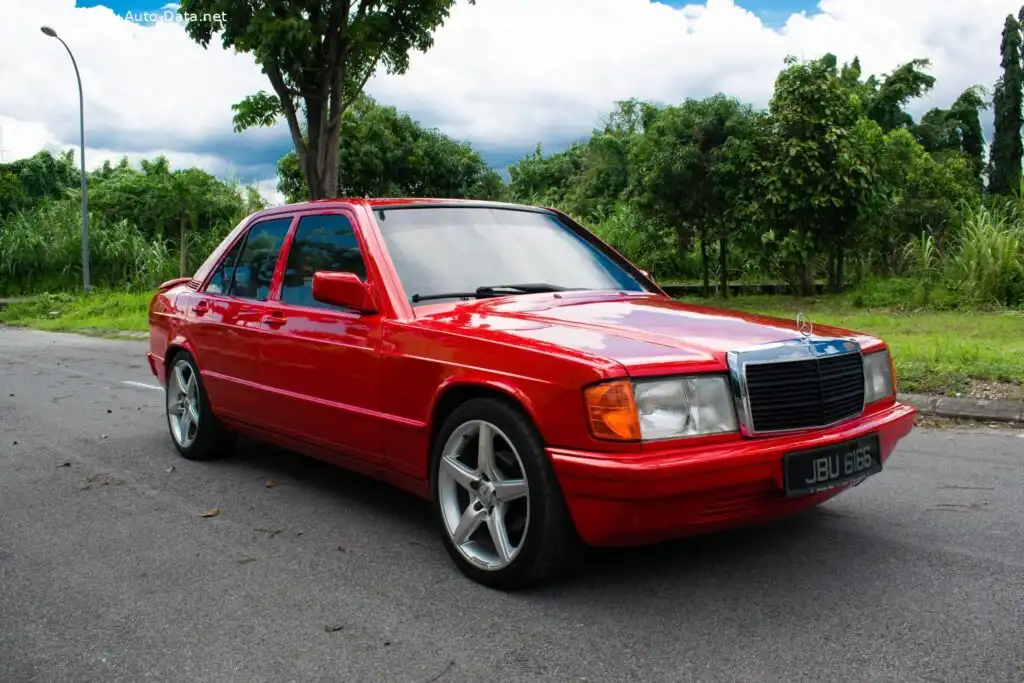
The Mercedes-Benz 190 (W201) series, affectionately known as the Baby Benz, represents a pivotal moment in the history of the German automaker. Launched in 1982, it was Mercedes-Benz’s first foray into the compact executive car segment, a move driven by the need to offer a more fuel-efficient and accessible model in the wake of the 1970s oil crises. Despite its smaller stature, the W201 was engineered with the same uncompromising commitment to quality, safety, and durability that defined its larger siblings. Among the various powerplants offered, the Mercedes-Benz 190 D 2.0 equipped with an automatic transmission stood out as a paragon of economy and longevity. Produced from August 1982 to August 1988, this particular variant embodied the brand’s reputation for creating reliable, over-engineered vehicles designed to last a lifetime.
Development and Historical Context
The development of the W201 began in the mid-1970s under the internal designation W201. The project’s primary goal was to create a smaller vehicle that could compete with the likes of the BMW 3 Series while upholding the core tenets of the Mercedes-Benz brand. This was a significant challenge, as it required downsizing without diluting the company’s established identity for luxury and robust engineering. The company reportedly invested over DM 2 billion (approximately £600 million) in the car’s research and development, a colossal sum for the era.
The design, penned by a team led by the legendary Bruno Sacco, was both modern and timeless. It featured a subtle wedge shape and clean lines that contributed to an excellent drag coefficient of 0.33, enhancing fuel efficiency and high-speed stability. A key engineering breakthrough of the W201 platform was its revolutionary multi-link rear suspension. This complex five-link setup provided superior ride comfort and handling precision, effectively eliminating the undesirable camber and toe changes common in semi-trailing arm designs used by competitors. This innovation set a new benchmark for chassis dynamics in the segment and would be adopted across future Mercedes-Benz models.
The diesel engine variants were central to the W201’s mission. Europe, particularly Germany, had a strong market for economical and durable diesel cars, often used for high-mileage applications such as taxi services. The Mercedes-Benz 190 D 2.0 was engineered to serve this exact purpose, offering a blend of frugality and mechanical fortitude that was almost unparalleled.
Engine and Powertrain Specifications
At the heart of the Mercedes-Benz 190 D 2.0 was the OM601 D 20 engine, specifically the OM601.911 variant. This naturally aspirated 2.0-liter (1997 cc) inline-four diesel engine was a masterpiece of durable engineering. It featured a robust cast-iron block, an aluminum alloy cylinder head, and a single overhead camshaft (SOHC) operating two valves per cylinder.
The engine’s design prioritized longevity and efficiency over outright performance. It utilized a pre-combustion chamber (or indirect) injection system, which was standard for passenger car diesels of the time. This system promoted a smoother, quieter combustion process compared to direct injection, contributing to the refined character expected of a Mercedes-Benz.
The power output was modest, rated at 72 horsepower (54 kW) at 4600 rpm, with a peak torque of 123 Newton-meters (90.7 lb-ft) available at a relatively low 2800 rpm. While these figures may seem low by modern standards, the engine’s strength lay in its accessible low-end torque and its incredibly robust nature. The power-to-weight ratio was 64.9 Hp per tonne, which underscored its focus on economy rather than acceleration. This engine was renowned for its ability to cover hundreds of thousands of kilometers with only routine maintenance, solidifying the W201’s reputation as a bulletproof vehicle.
Performance and Transmission of the Mercedes-Benz 190 D 2.0
Paired with the OM601 engine in this specific model was a 4-speed automatic transmission. This gearbox was engineered for smooth, unobtrusive shifts that complemented the relaxed nature of the diesel powerplant. It allowed for effortless driving in urban environments and comfortable cruising on the motorway.
Performance was leisurely, reflecting the car’s utilitarian and economic priorities. The acceleration from 0 to 100 km/h (62 mph) took approximately 18.6 seconds, and the vehicle would eventually reach a top speed of 156 km/h (97 mph). These figures were not intended to win drag races but were more than adequate for the driving conditions and customer expectations of the 1980s. The car’s true performance metric was its fuel efficiency. It achieved an impressive consumption rate of 7.6 l/100 km in urban driving and an even better 5.6 l/100 km on the highway. This frugality made the Mercedes-Benz 190 D 2.0 an extremely cost-effective vehicle for long-distance commuters and commercial operators.
The rear-wheel-drive layout, a hallmark of Mercedes-Benz engineering, ensured balanced handling and a traditional premium driving feel. The combination of the smooth automatic gearbox, the economical diesel engine, and the well-sorted chassis created a driving experience that was comfortable, stable, and reassuringly solid.
Chassis, Suspension, and Handling
The chassis of the W201 was a significant contributor to its success. Constructed using high-strength, low-alloy steel, the body shell was both rigid and lightweight for its time, providing a strong foundation for both safety and handling.
The suspension was the car’s standout feature. Up front, it used a damper strut design with anti-dive geometry to maintain composure under braking. However, the real innovation was the aforementioned multi-link rear suspension. This system, patented by Mercedes-Benz, used five individual links to precisely control wheel movement, ensuring the tire remained in optimal contact with the road surface under all conditions. This resulted in a unique combination of a comfortable, absorbent ride and secure, predictable handling, even when pushed near its limits.
The braking system consisted of disc brakes on all four wheels, providing reliable stopping power. Steering was a recirculating ball system with standard hydraulic power assistance, which offered a solid, weighty feel and excellent directional stability, particularly at higher speeds. This sophisticated chassis and suspension setup meant that even the base-model 190 D felt like a true Mercedes-Benz on the road—stable, comfortable, and safe.
Legacy and Impact
The Mercedes-Benz 190 D 2.0 and the wider W201 series had a profound impact on the automotive landscape. It successfully established Mercedes-Benz as a credible player in the compact executive class, paving the way for its successor, the C-Class, which would go on to become one of the brand’s best-selling models.
The 190 D’s reputation for unwavering reliability made it a legend, especially in the taxi industry across Europe and other parts of the world. It was common for these vehicles to exceed 500,000 or even 1,000,000 kilometers with their original engine and transmission. This remarkable longevity cemented the public’s perception of Mercedes-Benz as a builder of enduring, high-quality automobiles.
Today, the W201 is a celebrated modern classic. Its clean, functional design has aged gracefully, and its engineering integrity remains impressive. The Mercedes-Benz 190 D 2.0 Automatic, in particular, is remembered as a workhorse that perfectly balanced economy, comfort, and the unparalleled build quality of its era. It stands as a testament to a time when cars were built not to be replaced, but to last.
Full Technical Specifications: Mercedes-Benz 190 (W201) D 2.0 (72 Hp) Automatic
| Category | Specification |
| ————————- | ——————————————————————————————————— |
| General Information | |
| Brand | Mercedes-Benz |
| Model | 190 |
| Generation | W201 |
| Engine Variant | D 2.0 (72 Hp) Automatic |
| Body Type | Sedan |
| Doors | 4 |
| Seats | 5 |
| Production Start | August, 1982 |
| Production End | August, 1988 |
| Performance Specs | |
| Maximum Speed | 156 km/h (96.93 mph) |
| Acceleration 0-100 km/h | 18.6 seconds |
| Fuel Type | Diesel |
| Fuel Consumption (Urban) | 7.6 l/100 km (30.9 US mpg / 37.2 UK mpg) |
| Fuel Consumption (Extra-Urban) | 5.6 l/100 km (42 US mpg / 50.4 UK mpg) |
| Engine Specs | |
| Power | 72 Hp (54 kW) @ 4600 rpm |
| Torque | 123 Nm (90.72 lb-ft) @ 2800
