
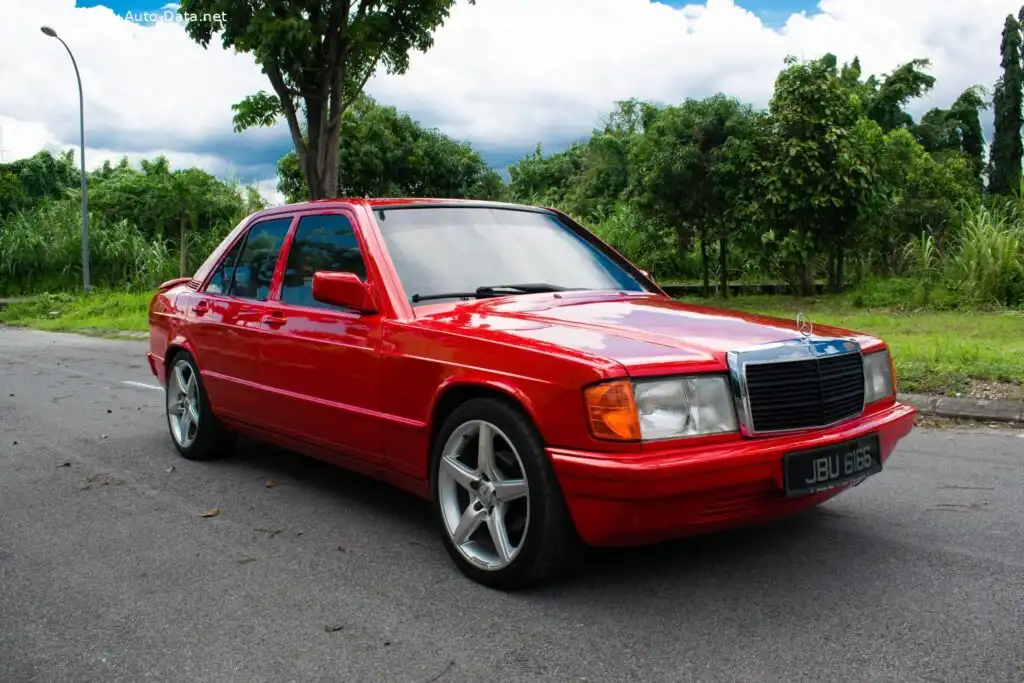
The Mercedes-Benz 190 (W201) D 2.5 is a diesel-powered compact executive sedan produced by the German automaker Mercedes-Benz. Manufactured between August 1984 and August 1988, this specific model was a key variant of the W201 series, which marked the brand’s first foray into the compact class. The W201, affectionately nicknamed the Baby Benz, was a pivotal model that successfully expanded the Mercedes-Benz lineup downwards to compete with established rivals like the BMW 3 Series. The 190 D 2.5, equipped with the robust OM602 five-cylinder diesel engine, became celebrated for its exceptional durability, fuel efficiency, and engineering quality, embodying the brand’s core values in a more accessible package.
Development and Historical Context
The impetus for the W201 project came from the 1973 oil crisis, which highlighted a growing market demand for smaller, more fuel-efficient premium vehicles. In response, Mercedes-Benz initiated development in 1974, investing over 600 million Deutschmarks in a project that would redefine the brand’s trajectory. The goal was to create a car that was unmistakably a Mercedes-Benz in terms of safety, quality, and comfort, but with smaller dimensions and improved economy.
Under the design leadership of Bruno Sacco, the W201 emerged with a clean, understated, and aerodynamically efficient wedge-shaped design (with a drag coefficient of 0.33) that would influence Mercedes-Benz styling for the next decade. The car was engineered without compromise, featuring several groundbreaking innovations. The most significant of these was the patented multi-link rear suspension, a complex five-link setup that provided superior ride quality, stability, and handling precision compared to the semi-trailing arm suspensions common in the era. This design allowed engineers to precisely control wheel movement under various loads, minimizing camber and toe changes during cornering and braking.
The W201 platform was also a pioneer in safety, incorporating front and rear crumple zones, a rigid passenger cell, and the option of an anti-lock braking system (ABS) and a driver’s side airbag—features typically reserved for larger luxury cars. The first models were launched in 1982, and the diesel variants soon followed, building on Mercedes-Benz’s long-standing reputation for producing reliable diesel engines. The introduction of the `Mercedes-Benz 190 (W201) D 2.5` in 1985 (for the 1986 model year in some markets) offered a significant step up in performance from the initial 2.0-liter four-cylinder diesel, providing more power and torque without a major fuel economy penalty.
Engine and Powertrain of the Mercedes-Benz 190 (W201) D 2.5
At the heart of the `Mercedes-Benz 190 (W201) D 2.5` is the OM602.911 diesel engine. This 2.5-liter (2497 cm³) naturally aspirated inline five-cylinder engine is a member of the legendary OM60x family, widely regarded as one of the most reliable passenger car diesel engines ever produced. The five-cylinder configuration was chosen to provide a smoother power delivery and better refinement than a four-cylinder unit, while being more compact and economical than a six-cylinder.
The engine features a cast iron block and an aluminum alloy cylinder head with a single overhead camshaft (SOHC) operating two valves per cylinder. It utilizes a pre-combustion chamber injection system with a Bosch inline injection pump, a durable and proven technology that, while less direct than modern systems, was instrumental in the engine’s longevity. This setup produced 90 horsepower (67 kW) at 4600 rpm and a solid torque figure of 158 Nm (117 lb-ft) at a low 2600 rpm.
While these output figures are modest by today’s standards, they were competitive for a non-turbo diesel of the era. The engine was designed not for outright speed but for effortless cruising and uncompromising durability. It propelled the 1250 kg (2756 lbs) sedan from 0 to 100 km/h (62 mph) in a leisurely 15.1 seconds, with a top speed of 174 km/h (108 mph). The power-to-weight ratio stood at 72 Hp/tonne. Its true strength lay in its fuel efficiency and mechanical robustness, with many examples known to exceed 500,000 miles (over 800,000 km) with regular maintenance.
Power was sent to the rear wheels through a standard five-speed manual gearbox, which offered precise shifting and allowed the driver to make the most of the engine’s powerband. A four-speed automatic transmission was also available as an option, providing smoother, more relaxed driving at the cost of slightly blunted acceleration and fuel economy.
Chassis, Suspension, and Handling
The W201’s chassis was a masterpiece of 1980s engineering, setting a new benchmark for ride and handling in the compact executive class. The front suspension consisted of a MacPherson strut design with anti-dive geometry, which prevented the nose from dipping excessively under hard braking.
The rear suspension, however, was the car’s standout feature. The innovative multi-link independent setup, with five individual links controlling each rear wheel’s movement, offered an unparalleled combination of comfort on rough surfaces and stability during aggressive maneuvers. It effectively decoupled the forces acting on the wheel, ensuring the tire remained in optimal contact with the road. This design was so successful that it became a staple of Mercedes-Benz chassis design for decades to come.
The braking system comprised disc brakes on all four wheels, providing consistent and reliable stopping power. An anti-lock braking system (ABS) was an optional but highly recommended feature that significantly enhanced safety in emergency situations. The power steering was a hydraulically assisted recirculating ball system, offering a classic Mercedes-Benz feel: light at low speeds for easy maneuverability and firm and stable at highway speeds. The standard tire size was 185/65 R15, fitted to steel or optional alloy wheels.
Legacy and Impact
The `Mercedes-Benz 190 (W201) D 2.5` played a crucial role in establishing the brand’s reputation in the compact premium segment. It proved that a smaller Mercedes could deliver the same core attributes of quality, safety, and longevity as its larger S-Class and E-Class siblings. Its robust diesel engine made it a popular choice for high-mileage drivers, taxi fleets, and families across Europe and beyond.
The W201 series as a whole was a resounding success, with nearly 1.9 million units produced between 1982 and 1993. It successfully attracted a younger demographic to the brand and laid the foundation for its direct successor, the C-Class (W202), which continues to be a cornerstone of the Mercedes-Benz lineup. Today, the 190 D 2.5 is cherished by classic car enthusiasts for its over-engineered build quality, mechanical simplicity, and timeless design. It stands as a testament to an era when Mercedes-Benz prioritized durability and engineering excellence above all else, creating a car that was truly built to last.
Full Technical Specifications: Mercedes-Benz 190 (W201) D 2.5 (90 Hp)
| Category | Specification |
| ————————- | ————————————————————————– |
| General Information | |
| Brand | Mercedes-Benz |
| Model | 190 |
| Generation | 190 (W201) |
| Engine Variant | D 2.5 |
| Body Type | Sedan |
| Start of Production | August, 1984 |
| End of Production | August, 1988 |
| Seats | 5 |
| Doors | 4 |
| Engine Specifications | |
| Engine Model | OM 602.911 |
| Engine Type | Internal Combustion Engine (Diesel) |
| Engine Layout | Front, Longitudinal |
| Displacement | 2497 cm³ (152.4 cu. in.) |
| Number of Cylinders | 5 |
| Cylinder Configuration | Inline |
| Cylinder Bore | 87 mm (3.43 in.) |
| Piston Stroke | 84 mm (3.31 in.) |
| Compression Ratio | 22:1 |
| Valves per Cylinder | 2 (10 total) |
| Aspiration | Naturally Aspirated |
| Fuel System | Pre-combustion Chamber Injection |
| Power Output | 90 Hp @ 4600 rpm |
| Torque Output | 158 Nm (116.5 lb.-ft.) @ 2600 rpm |
| Power per Litre | 36 Hp/l |
| Performance | |
| Maximum Speed | 174 km/h (108.1 mph) |
| Acceleration 0-100 km/h | 15.1 seconds |
| Acceleration 0-60 mph | 14.3 seconds (estimated) |
| Fuel Economy | |
| Fuel Type | Diesel |
| Consumption – Urban | 8.6 l/100 km (27.4 US mpg / 32.8 UK mpg) |
| Consumption – Extra Urban | 5.5 l/100 km (42.8 US mpg / 51.4 UK mpg) |
| Consumption – Combined | 7.1 l/100 km (33.1 US mpg / 39.8 UK mpg) |
| Fuel Tank Capacity | 55 liters (14.5 US gal / 12.1 UK gal) |
| Drivetrain & Brakes | |
| Drive Wheel | Rear Wheel Drive |
| Gearbox | 5-speed manual transmission (standard) |
| Front Brakes | Disc |
| Rear Brakes | Disc |
| Assisting Systems | Hydraulic Power Steering, ABS (optional) |
| Suspension | |
| Front Suspension | Damper Struts (MacPherson) |
| Rear Suspension | Multi-link independent |
| Dimensions & Weights | |
| Length | 4450 mm (175.2 in.) |
| Width | 1690 mm (66.5 in.) |
| Height | 1375 mm (54.1 in.) |
| Wheelbase | 2665 mm (104.9 in.) |
| Front Track | 1440 mm (56.7 in.) |
| Rear Track | 1420 mm (55.9 in.) |
| Kerb Weight | 1250 kg (2756 lbs) |
| Max. Permissible Weight | 1750 kg (3858 lbs) |
| Max. Load Capacity | 500 kg (1102 lbs) |
| Trunk (Boot) Space | 410 liters (14.5 cu. ft.) |
| Ratios | |
| Weight-to-Power Ratio | 13.9 kg/Hp |
| Weight-to-Torque Ratio | 7.9 kg/Nm |
