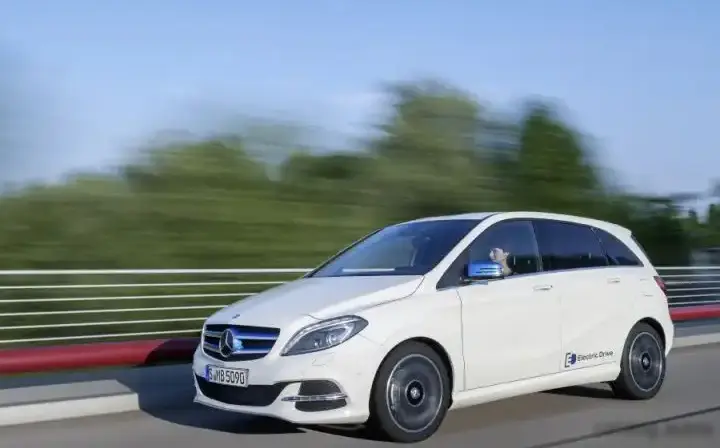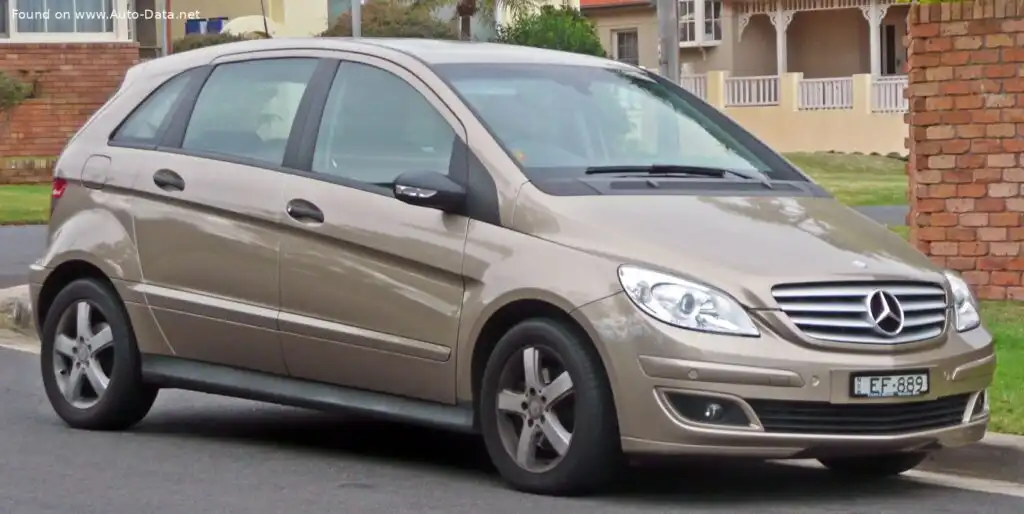
The Mercedes-Benz B 170, produced between April 2005 and April 2008, was a front-wheel-drive compact multi-purpose vehicle (MPV) based on the W245 B-Class platform. Positioned as the entry-level variant of the second-generation B-Class, the B 170 aimed to provide an affordable and practical option within the premium compact segment. It served as a gateway into the Mercedes-Benz brand, appealing to buyers prioritizing fuel efficiency and interior space over outright performance. The B 170 competed with vehicles like the Volkswagen Touran, Opel Zafira, and Renault Scenic in the European market, offering a more upscale alternative with Mercedes-Benz’s reputation for build quality and refinement.
Technical Specifications
| Brand | Mercedes-Benz |
| Model | B-class |
| Generation | B-class (W245) |
| Type (Engine) | B 170 (116 Hp) |
| Start of production | April, 2005 |
| End of production | April, 2008 |
| Powertrain Architecture | Internal Combustion engine |
| Body type | MPV |
| Seats | 5 |
| Doors | 5 |
| Fuel consumption (economy) – urban (NEDC) | 8.6-9 l/100 km (27.4 – 26.1 US mpg, 32.8 – 31.4 UK mpg, 11.6 – 11.1 km/l) |
| Fuel consumption (economy) – extra urban (NEDC) | 5.8-6 l/100 km (40.6 – 39.2 US mpg, 48.7 – 47.1 UK mpg, 17.2 – 16.7 km/l) |
| Fuel consumption (economy) – combined (NEDC) | 6.8-7.1 l/100 km (34.6 – 33.1 US mpg, 41.5 – 39.8 UK mpg, 14.7 – 14.1 km/l) |
| CO2 emissions (NEDC) | 163-171 g/km |
| Fuel Type | Petrol (Gasoline) |
| Acceleration 0 – 100 km/h | 11.3 sec |
| Acceleration 0 – 62 mph | 11.3 sec |
| Acceleration 0 – 60 mph | 10.7 sec |
| Maximum speed | 184 km/h (114.33 mph) |
| Emission standard | Euro 4 |
| Weight-to-power ratio | 10.6 kg/Hp, 93.9 Hp/tonne |
| Weight-to-torque ratio | 8 kg/Nm, 125.5 Nm/tonne |
| Power | 116 Hp @ 5500 rpm |
| Power per litre | 68.3 Hp/l |
| Torque | 155 Nm @ 3500-4000 rpm (114.32 lb.-ft. @ 3500-4000 rpm) |
| Engine layout | Front, Transverse |
| Engine Model/Code | M 266.940 |
| Engine displacement | 1699 cm3 (103.68 cu. in.) |
| Number of cylinders | 4 |
| Engine configuration | Inline |
| Cylinder Bore | 83 mm (3.27 in.) |
| Piston Stroke | 78.5 mm (3.09 in.) |
| Compression ratio | 11:1 |
| Number of valves per cylinder | 2 |
| Fuel injection system | Multi-port manifold injection |
| Engine aspiration | Naturally aspirated engine |
| Valvetrain | SOHC |
| Engine oil capacity | 5 l (5.28 US qt | 4.4 UK qt) |
| Coolant | 6.3 l (6.66 US qt | 5.54 UK qt) |
| Kerb Weight | 1235 kg (2722.71 lbs.) |
| Max. weight | 1830 kg (4034.46 lbs.) |
| Max load | 595 kg (1311.75 lbs.) |
| Trunk (boot) space – minimum | 544 l (19.21 cu. ft.) |
| Trunk (boot) space – maximum | 2245 l (79.28 cu. ft.) |
| Fuel tank capacity | 54 l (14.27 US gal | 11.88 UK gal) |
| Max. roof load | 75 kg (165.35 lbs.) |
| Permitted trailer load with brakes (12%) | 1300 kg (2866.01 lbs.) |
| Permitted trailer load without brakes | 645 kg (1421.98 lbs.) |
| Permitted towbar download | 75 kg (165.35 lbs.) |
| Length | 4270 mm (168.11 in.) |
| Width | 1777 mm (69.96 in.) |
| Width including mirrors | 1975 mm (77.76 in.) |
| Height | 1603 mm (63.11 in.) |
| Wheelbase | 2778 mm (109.37 in.) |
| Front track | 1556 mm (61.26 in.) |
| Rear (Back) track | 1551 mm (61.06 in.) |
| Drag coefficient (Cd) | 0.30 |
| Minimum turning circle (turning diameter) | 11.95 m (39.21 ft.) |
| Drivetrain Architecture | The Internal combustion engine (ICE) drives the front wheels of the vehicle. |
| Drive wheel | Front wheel drive |
| Number of gears and type of gearbox | 5 gears, manual transmission |
| Front suspension | Independent type McPherson, Transverse stabilizer |
| Rear suspension | Transverse stabilizer, Coil spring |
| Front brakes | Ventilated discs, 276×22 mm |
| Rear brakes | Disc, 258×8 mm |
| Assisting systems | ABS (Anti-lock braking system) |
| Steering type | Steering rack and pinion |
| Power steering | Electric Steering |
| Tires size | 195/65 R15 |
| Wheel rims size | 6J x 15 |
Powertrain & Engine Architecture
The B 170 was powered by the Mercedes-Benz M 266.940 engine, a 1.7-liter inline-four cylinder gasoline engine. This engine, part of the M 266 family, featured a single overhead camshaft (SOHC) valvetrain with two valves per cylinder. Fuel delivery was managed by a multi-port fuel injection system. The engine produced 116 horsepower at 5500 rpm and 155 Nm (114.32 lb.-ft.) of torque between 3500 and 4000 rpm. The engine’s relatively modest output was intended to prioritize fuel economy rather than outright performance. The B 170 was typically equipped with a five-speed manual transmission, although an optional continuously variable transmission (CVT) was also available in some markets. The CVT aimed to improve fuel efficiency and provide smoother acceleration, but was often criticized for its less engaging driving experience.
Driving Characteristics
The B 170’s driving experience was characterized by its comfort and ease of use. Acceleration was adequate for everyday driving, with a 0-60 mph time of around 10.7 seconds. However, it was noticeably slower than higher-powered B-Class variants like the B 200. The five-speed manual transmission offered a reasonable level of control, but the gear ratios were spaced to favor fuel efficiency over spirited driving. The optional CVT further emphasized smoothness and economy, but at the expense of responsiveness. The B 170’s front-wheel-drive configuration provided predictable handling, but lacked the dynamic capabilities of all-wheel-drive models. The suspension was tuned for comfort, absorbing bumps and imperfections in the road effectively, making it a pleasant vehicle for long journeys.
Equipment & Trim Levels
The B 170 typically came standard with features such as air conditioning, power windows, central locking, and an audio system. Safety features included ABS brakes, front airbags, and side airbags. Interior upholstery was typically cloth, with options for upgraded materials available. Optional extras included alloy wheels, a sunroof, a multi-function steering wheel, and a more advanced audio system. The dashboard layout was functional and straightforward, with a focus on ergonomics. The B 170’s trim level was generally considered the base model, offering a more affordable entry point into the B-Class range.
Chassis & Braking
The W245 B-Class utilized an independent McPherson strut suspension at the front and a semi-independent torsion beam suspension at the rear. The front suspension incorporated a transverse stabilizer bar to reduce body roll. Braking duties were handled by ventilated discs at the front and solid discs at the rear. ABS (Anti-lock Braking System) was standard equipment. The B 170’s suspension and braking systems were designed to provide a comfortable and safe driving experience, prioritizing stability and control over sporty handling.
Market Reception & Comparison
The B 170 received mixed reviews from automotive critics. While praised for its practicality, spacious interior, and fuel efficiency, it was often criticized for its lack of performance and somewhat uninspiring driving dynamics. Compared to the B 200, which featured a more powerful 2.0-liter engine, the B 170 felt noticeably underpowered. The B 170’s fuel economy was competitive within its class, offering around 34.6-33.1 US mpg in combined driving. Reliability was generally good, although some owners reported issues with the CVT transmission. The B 170 appealed to buyers seeking a practical and affordable MPV, while those prioritizing performance or a more engaging driving experience often opted for higher-trim models.
Legacy
The B 170, while not the most exciting variant of the W245 B-Class, remains a relatively affordable and practical option in the used car market. The M 266.940 engine is generally considered reliable, although regular maintenance is essential. The availability of spare parts is good, and the B 170’s simple mechanical design makes it relatively easy to repair. Today, the B 170 is often seen as a sensible choice for budget-conscious buyers seeking a spacious and comfortable MPV for family use. Its enduring appeal lies in its practicality and the Mercedes-Benz badge, offering a touch of premium quality at an accessible price point.