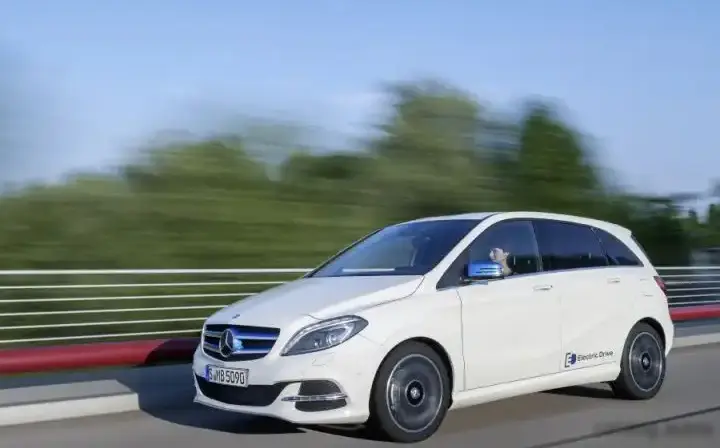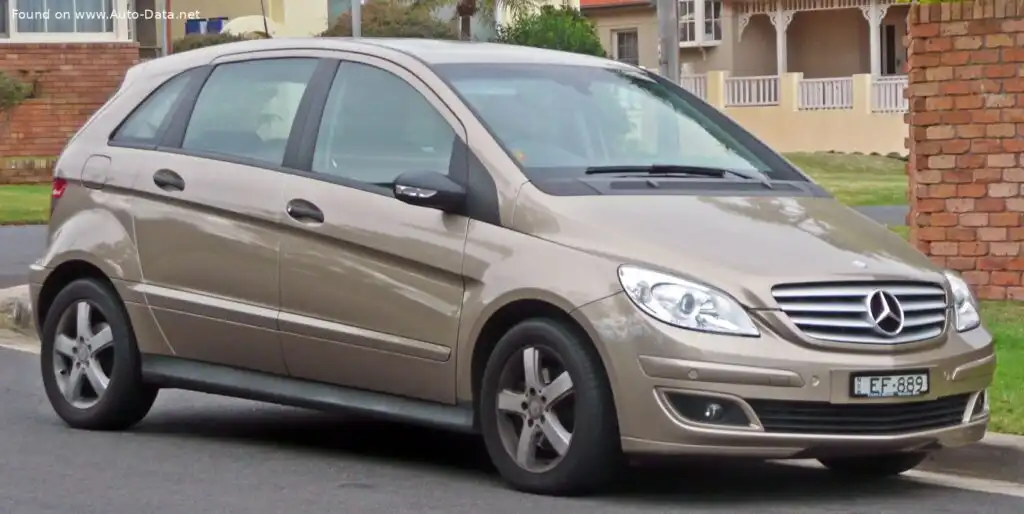
The Mercedes-Benz B-Class (W245) B 200, produced from April 2005 to April 2008, represents a key iteration of Mercedes-Benz’s foray into the compact multi-purpose vehicle (MPV) segment. Positioned as a mid-range offering within the W245 series, the B 200 aimed to provide a practical and comfortable alternative to traditional hatchbacks, emphasizing space and versatility. Built on the A-Class (W169) platform – internally designated as the 1HX0 – the B-Class distinguished itself with a taller roofline and a more upright seating position, enhancing headroom and cargo capacity. The B 200 specifically targeted buyers seeking a balance between fuel efficiency, reasonable performance, and the prestige associated with the Mercedes-Benz brand.
Technical Specifications
| Brand | Mercedes-Benz |
| Model | B-class |
| Generation | B-class (W245) |
| Type (Engine) | B 200 (136 Hp) |
| Start of production | April, 2005 |
| End of production | April, 2008 |
| Powertrain Architecture | Internal Combustion engine |
| Body type | MPV |
| Seats | 5 |
| Doors | 5 |
| Fuel consumption (urban) | 9.3-9.6 l/100 km (25.3 – 24.5 US mpg) |
| Fuel consumption (extra urban) | 6-6.3 l/100 km (39.2 – 37.3 US mpg) |
| Fuel consumption (combined) | 7.2-7.5 l/100 km (32.7 – 31.4 US mpg) |
| CO2 emissions | 173-180 g/km |
| Fuel Type | Petrol (Gasoline) |
| Acceleration 0 – 100 km/h | 10.1 sec |
| Acceleration 0 – 62 mph | 10.1 sec |
| Acceleration 0 – 60 mph | 9.6 sec |
| Maximum speed | 196 km/h (121.79 mph) |
| Emission standard | Euro 4 |
| Weight-to-power ratio | 9.3 kg/Hp |
| Weight-to-torque ratio | 6.9 kg/Nm |
| Power | 136 Hp @ 5750 rpm |
| Torque | 185 Nm @ 3500-4000 rpm (136.45 lb.-ft. @ 3500-4000 rpm) |
| Engine layout | Front, Transverse |
| Engine Model/Code | M 266.960 |
| Engine displacement | 2034 cm3 (124.12 cu. in.) |
| Number of cylinders | 4 |
| Engine configuration | Inline |
| Cylinder Bore | 83 mm (3.27 in.) |
| Piston Stroke | 94 mm (3.7 in.) |
| Compression ratio | 11:1 |
| Number of valves per cylinder | 2 |
| Fuel injection system | Multi-port manifold injection |
| Engine aspiration | Naturally aspirated engine |
| Valvetrain | SOHC |
| Engine oil capacity | 5 l (5.28 US qt | 4.4 UK qt) |
| Coolant capacity | 6.6 l (6.97 US qt | 5.81 UK qt) |
| Kerb Weight | 1270 kg (2799.87 lbs.) |
| Max. weight | 1880 kg (4144.69 lbs.) |
| Max load | 610 kg (1344.82 lbs.) |
| Trunk (boot) space – minimum | 544 l (19.21 cu. ft.) |
| Trunk (boot) space – maximum | 2245 l (79.28 cu. ft.) |
| Fuel tank capacity | 54 l (14.27 US gal | 11.88 UK gal) |
| Max. roof load | 75 kg (165.35 lbs.) |
| Permitted trailer load with brakes (12%) | 1500 kg (3306.93 lbs.) |
| Permitted trailer load without brakes | 645 kg (1421.98 lbs.) |
| Permitted towbar download | 75 kg (165.35 lbs.) |
| Length | 4270 mm (168.11 in.) |
| Width | 1777 mm (69.96 in.) |
| Width including mirrors | 1975 mm (77.76 in.) |
| Height | 1604 mm (63.15 in.) |
| Wheelbase | 2778 mm (109.37 in.) |
| Front track | 1552 mm (61.1 in.) |
| Rear track | 1547 mm (60.91 in.) |
| Drag coefficient (Cd) | 0.31 |
| Minimum turning circle | 11.95 m (39.21 ft.) |
| Drivetrain | Front wheel drive |
| Number of gears | 5 |
| Gearbox type | manual transmission |
| Front suspension | Independent type McPherson, Transverse stabilizer |
| Rear suspension | Transverse stabilizer, Coil spring |
| Front brakes | Ventilated discs, 276×22 mm |
| Rear brakes | Disc, 258×8 mm |
| Assisting systems | ABS (Anti-lock braking system) |
| Steering type | Steering rack and pinion |
| Power steering | Electric Steering |
| Tires size | 205/55 R16 |
| Wheel rims size | 6J x 16 |
Powertrain & Engine Architecture
The B 200 is powered by the M 266.960, a 2.0-liter inline-four cylinder gasoline engine. This engine, a mainstay in several Mercedes-Benz compact models of the era, features a single overhead camshaft (SOHC) valvetrain with two valves per cylinder. Fuel delivery is managed by a multi-port fuel injection system, providing a balance between efficiency and performance. The engine produces 136 horsepower at 5750 rpm and 185 Nm (136.45 lb-ft) of torque between 3500 and 4000 rpm. The engine’s relatively high compression ratio of 11:1 contributes to its efficiency. The B 200 was exclusively offered with a five-speed manual transmission, designed to optimize fuel economy and provide adequate acceleration for everyday driving. This transmission was chosen to keep the cost down and appeal to a broader market segment.
Driving Characteristics
The B 200, with its 136 hp and five-speed manual gearbox, delivers a competent, if not exhilarating, driving experience. Acceleration from 0 to 60 mph takes approximately 9.6 seconds, and the top speed is 196 km/h (121.79 mph). The engine feels responsive enough for typical urban and highway driving, but it lacks the punch of higher-output variants like the B 230. The five-speed transmission is well-matched to the engine’s torque curve, providing smooth shifts and adequate gear spacing. Compared to the more powerful B 230, the B 200 prioritizes fuel economy over outright performance. The manual transmission allows for greater driver control, but it doesn’t offer the effortless cruising experience of an automatic.
Equipment & Trim Levels
The B 200 typically came standard with features such as air conditioning, power windows, central locking, and an audio system. Interior upholstery was generally cloth, with options for leather upgrades. Dashboard trim could be specified in various finishes, including wood or aluminum. Optional extras included a sunroof, upgraded audio systems, and parking sensors. Safety features, such as ABS and airbags, were standard equipment. The B 200 represented a good value proposition, offering a reasonable level of equipment for its price point.
Chassis & Braking
The W245 B-Class utilizes an independent McPherson strut suspension at the front and a semi-independent torsion beam suspension at the rear. This setup provides a comfortable ride quality, suitable for everyday driving. The front brakes are ventilated discs measuring 276×22 mm, while the rear brakes are solid discs measuring 258×8 mm. ABS (Anti-lock Braking System) is standard, enhancing braking performance and stability. The suspension tuning is geared towards comfort rather than sporty handling, prioritizing a smooth and predictable ride.
Market Reception & Comparison
The B 200 received generally positive reviews for its practicality, spaciousness, and fuel efficiency. Critics praised its comfortable ride and well-appointed interior. However, some reviewers noted that the engine lacked the power of its competitors and that the handling was not particularly engaging. Compared to the B 230, the B 200 offered lower running costs but sacrificed performance. The B 200’s fuel economy figures of 7.2-7.5 l/100 km (32.7 – 31.4 US mpg) were competitive for its class. Its reliability was generally considered good, typical of Mercedes-Benz vehicles of the era.
Legacy
The B 200, while not the most powerful or dynamically exciting variant of the W245 B-Class, remains a popular choice in the used car market due to its affordability, practicality, and relatively low maintenance costs. The M 266.960 engine is known for its durability, and with proper maintenance, it can provide many years of reliable service. The B 200’s simple mechanical design makes it relatively easy and inexpensive to repair. Today, it represents a sensible and economical option for buyers seeking a compact MPV with the prestige of the Mercedes-Benz badge.