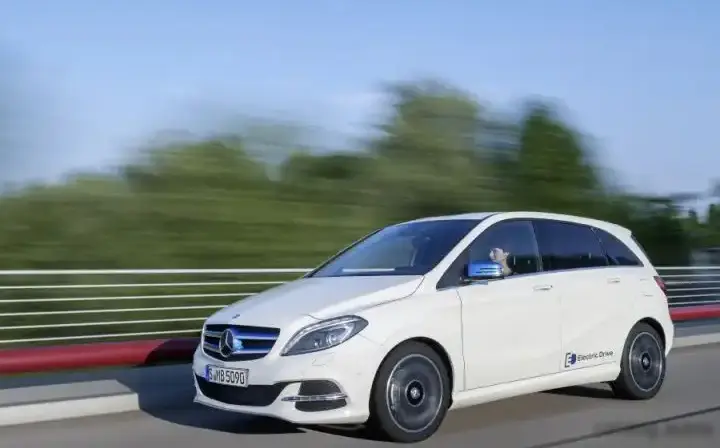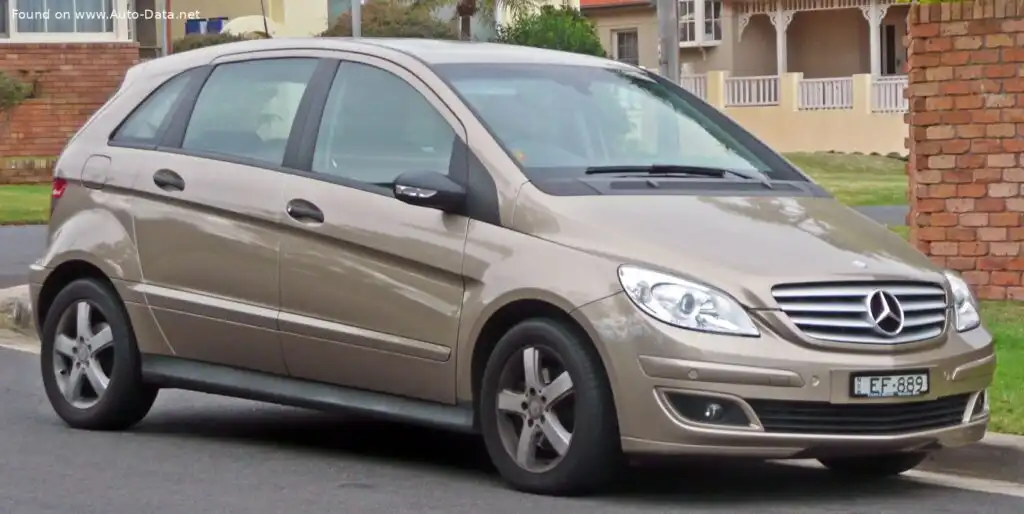
The Mercedes-Benz B-Class (W245) B 200 Turbo, produced from April 2005 to April 2008, represented a significant entry into the compact multi-purpose vehicle (MPV) segment for the German automaker. Positioned as a mid-range offering within the W245 series, the B 200 Turbo aimed to blend practicality with a degree of performance not typically found in this class of vehicle. It was primarily marketed in Europe, offering a more premium alternative to traditional hatchback and small van options. The W245 B-Class, as a whole, was the first model to incorporate a front-wheel drive platform, marking a departure from Mercedes-Benz’s traditionally rear-wheel drive focus, and utilized the A-Class (W169) platform, internally designated as the 1HX0.
Technical Specifications
| Brand | Mercedes-Benz |
| Model | B-class |
| Generation | B-class (W245) |
| Type (Engine) | B 200 Turbo (193 Hp) |
| Start of production | April, 2005 |
| End of production | April, 2008 |
| Powertrain Architecture | Internal Combustion engine |
| Body type | MPV |
| Seats | 5 |
| Doors | 5 |
| Fuel consumption (economy) – urban (NEDC) | 10.5-11 l/100 km (22.4 – 21.4 US mpg, 26.9 – 25.7 UK mpg, 9.5 – 9.1 km/l) |
| Fuel consumption (economy) – extra urban (NEDC) | 6.4-6.6 l/100 km (36.8 – 35.6 US mpg, 44.1 – 42.8 UK mpg, 15.6 – 15.2 km/l) |
| Fuel consumption (economy) – combined (NEDC) | 7.9-8.1 l/100 km (29.8 – 29 US mpg, 35.8 – 34.9 UK mpg, 12.7 – 12.3 km/l) |
| CO2 emissions (NEDC) | 190-195 g/km |
| Fuel Type | Petrol (Gasoline) |
| Acceleration 0 – 100 km/h | 7.6 sec |
| Acceleration 0 – 62 mph | 7.6 sec |
| Acceleration 0 – 60 mph | 7.2 sec |
| Maximum speed | 225 km/h (139.81 mph) |
| Emission standard | Euro 4 |
| Weight-to-power ratio | 6.7 kg/Hp, 149 Hp/tonne |
| Weight-to-torque ratio | 4.6 kg/Nm, 216.2 Nm/tonne |
| Power | 193 Hp @ 5000 rpm |
| Power per litre | 94.9 Hp/l |
| Torque | 280 Nm @ 1800-4850 rpm (206.52 lb.-ft. @ 1800-4850 rpm) |
| Engine layout | Front, Transverse |
| Engine Model/Code | M 266.980 |
| Engine displacement | 2034 cm3 (124.12 cu. in.) |
| Number of cylinders | 4 |
| Engine configuration | Inline |
| Cylinder Bore | 83 mm (3.27 in.) |
| Piston Stroke | 94 mm (3.7 in.) |
| Compression ratio | 9:1 |
| Number of valves per cylinder | 2 |
| Fuel injection system | Multi-port manifold injection |
| Engine aspiration | Turbocharger, Intercooler |
| Valvetrain | SOHC |
| Engine oil capacity | 5 l (5.28 US qt | 4.4 UK qt) |
| Coolant | 8.5 l (8.98 US qt | 7.48 UK qt) |
| Kerb Weight | 1295 kg (2854.99 lbs.) |
| Max. weight | 1880 kg (4144.69 lbs.) |
| Max load | 585 kg (1289.7 lbs.) |
| Trunk (boot) space – minimum | 544 l (19.21 cu. ft.) |
| Trunk (boot) space – maximum | 2245 l (79.28 cu. ft.) |
| Fuel tank capacity | 54 l (14.27 US gal | 11.88 UK gal) |
| Max. roof load | 75 kg (165.35 lbs.) |
| Permitted trailer load with brakes (12%) | 1500 kg (3306.93 lbs.) |
| Permitted trailer load without brakes | 645 kg (1421.98 lbs.) |
| Permitted towbar download | 75 kg (165.35 lbs.) |
| Length | 4270 mm (168.11 in.) |
| Width | 1777 mm (69.96 in.) |
| Width including mirrors | 1975 mm (77.76 in.) |
| Height | 1604 mm (63.15 in.) |
| Wheelbase | 2778 mm (109.37 in.) |
| Front track | 1552 mm (61.1 in.) |
| Rear (Back) track | 1547 mm (60.91 in.) |
| Drag coefficient (Cd) | 0.31 |
| Minimum turning circle (turning diameter) | 11.95 m (39.21 ft.) |
| Drivetrain Architecture | The Internal combustion engine (ICE) drives the front wheels of the vehicle. |
| Drive wheel | Front wheel drive |
| Number of gears and type of gearbox | 6 gears, manual transmission |
| Front suspension | Independent type McPherson, Transverse stabilizer |
| Rear suspension | Transverse stabilizer, Coil spring |
| Front brakes | Ventilated discs, 288×25 mm |
| Rear brakes | Disc, 258×8 mm |
| Assisting systems | ABS (Anti-lock braking system) |
| Steering type | Steering rack and pinion |
| Power steering | Electric Steering |
| Tires size | 205/55 R16 |
| Wheel rims size | 6J x 16 |
Powertrain & Engine Architecture
The B 200 Turbo was powered by the M 266.980, a 2.0-liter inline-four cylinder gasoline engine. This engine was a key component of Mercedes-Benz’s efforts to improve fuel efficiency and reduce emissions while still providing adequate performance. The engine featured a turbocharger with an intercooler, boosting output to 193 horsepower at 5000 rpm and 280 Nm (206.52 lb-ft) of torque between 1800 and 4850 rpm. Fuel was delivered via a multi-port fuel injection system. The engine utilized a single overhead camshaft (SOHC) valvetrain with two valves per cylinder. The engine’s 9:1 compression ratio was a compromise between performance and the ability to run on readily available fuel grades. The B 200 Turbo was typically paired with a six-speed manual transmission, although a continuously variable transmission (CVT) was also offered as an option. The CVT aimed to maximize fuel economy by keeping the engine in its optimal power band.
Driving Characteristics
The B 200 Turbo offered a reasonably engaging driving experience for a compact MPV. The turbocharger provided a noticeable boost in power, allowing for brisk acceleration – 0 to 60 mph in approximately 7.2 seconds. However, the front-wheel drive configuration and relatively modest power output meant it wasn’t a particularly sporty vehicle. The six-speed manual transmission allowed drivers to maintain control over the engine’s power delivery, while the optional CVT prioritized smoothness and fuel efficiency. Compared to the base B 180 models, the B 200 Turbo offered a significant performance upgrade. It also provided a more refined driving experience than the diesel-powered B 200 CDI, which, while offering excellent fuel economy, lacked the responsiveness of the turbocharged gasoline engine.
Equipment & Trim Levels
The B 200 Turbo typically came equipped with a respectable level of standard features, including air conditioning, power windows, power mirrors, and a basic audio system. Higher trim levels offered options such as leather upholstery, a panoramic sunroof, and a more advanced infotainment system. Safety features included ABS, airbags, and electronic stability control. The interior design was functional and modern, with a focus on maximizing space and practicality. The rear seats could be folded down to create a larger cargo area, enhancing the vehicle’s versatility.
Chassis & Braking
The W245 B-Class utilized an independent McPherson strut suspension at the front and a semi-independent torsion beam suspension at the rear. This setup provided a comfortable ride quality, although it wasn’t particularly sporty. The front brakes were ventilated discs, while the rear brakes were solid discs. ABS (Anti-lock Braking System) was standard, providing enhanced stopping power and control. The B 200 Turbo, being a mid-range model, generally featured slightly upgraded suspension components compared to the base models, offering improved handling and stability.
Market Reception & Comparison
The B 200 Turbo was generally well-received by automotive critics, who praised its blend of practicality, performance, and fuel efficiency. It was seen as a viable alternative to traditional hatchbacks and small vans, offering a more premium and refined experience. However, some critics noted that the front-wheel drive configuration didn’t provide the same level of driving engagement as rear-wheel drive vehicles. Compared to the B 200 CDI, the B 200 Turbo offered superior performance but lower fuel economy. The B 200 Turbo also represented a step up in price compared to the base B 180 models.
Legacy
The M 266.980 engine, while not without its quirks, proved to be a relatively reliable powerplant when properly maintained. Common issues included turbocharger wear and occasional problems with the fuel injection system. However, these issues were generally not catastrophic and could be addressed with routine maintenance and repairs. Today, the W245 B 200 Turbo can be found on the used car market at relatively affordable prices. It remains a practical and versatile option for those seeking a compact MPV with a degree of performance and refinement. Its front-wheel drive layout and relatively simple mechanicals make it a reasonably accessible vehicle for DIY mechanics.