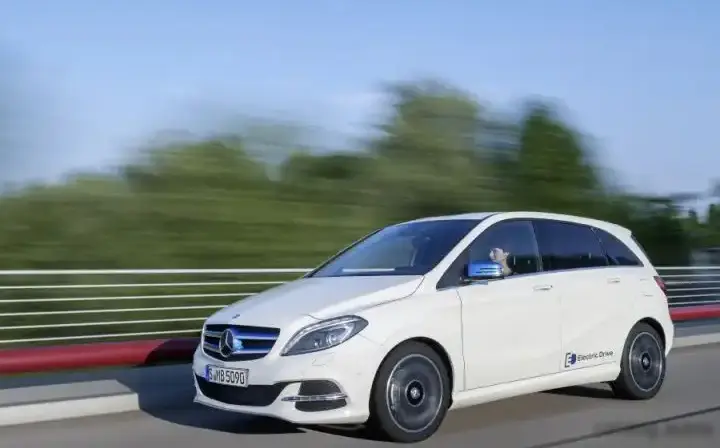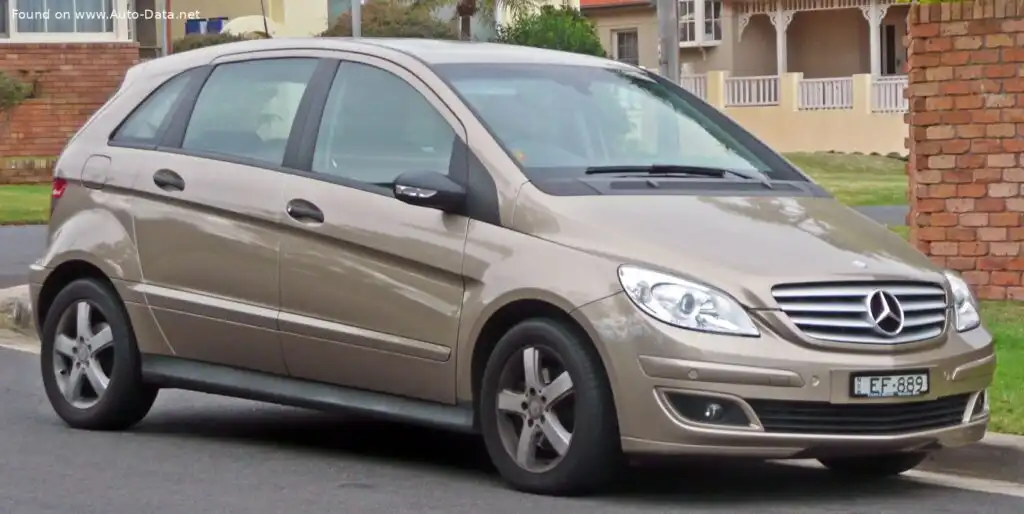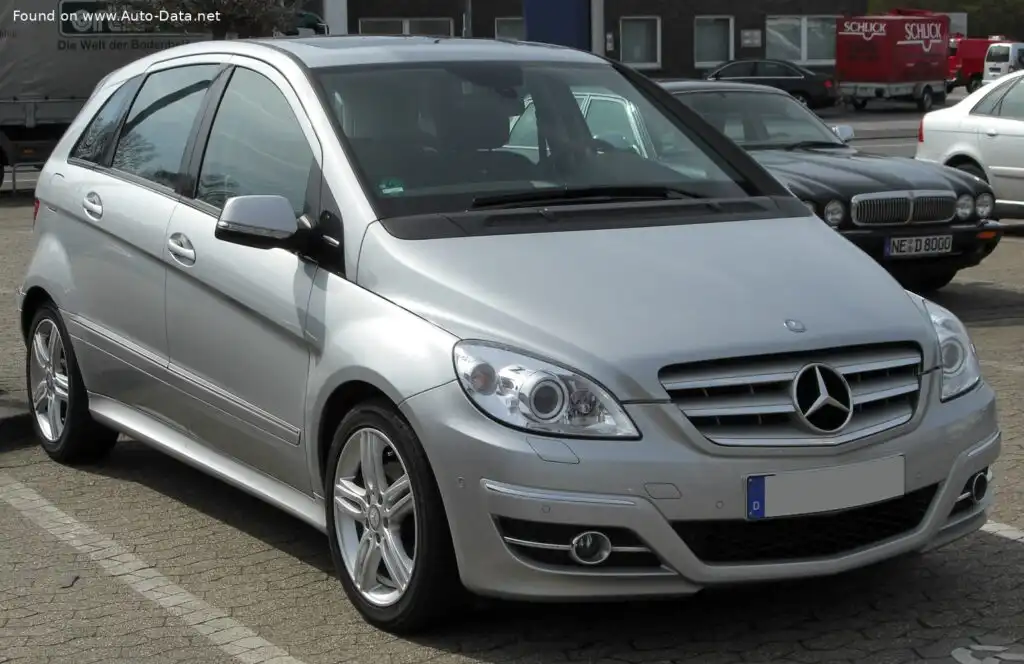
The Mercedes-Benz B 180 CDI, specifically the variant produced from April 2008 to April 2010 as part of the W245 facelift, represented an entry-level diesel option within the second-generation B-Class range. Positioned as a fuel-efficient and practical compact MPV (Multi-Purpose Vehicle), it aimed to appeal to buyers seeking a versatile vehicle for urban commuting and family transport. This model utilized a 2.0-liter turbocharged diesel engine paired with Mercedes-Benz’s Autotronic continuously variable transmission (CVT). It was a key offering in the European market, where compact MPVs were highly popular, offering a blend of space, economy, and the prestige of the Mercedes-Benz brand.
Technical Specifications
| Brand | Mercedes-Benz |
| Model | B-class |
| Generation | B-class (W245 facelift 2008) |
| Type (Engine) | B 180 CDI (109 Hp) Autotronic |
| Start of production | April, 2008 |
| End of production | April, 2010 |
| Powertrain Architecture | Internal Combustion engine |
| Body type | MPV |
| Seats | 5 |
| Doors | 5 |
| Fuel consumption (urban) | 6.9-7.3 l/100 km (34.1 – 32.2 US mpg, 40.9 – 38.7 UK mpg, 14.5 – 13.7 km/l) |
| Fuel consumption (extra urban) | 4.9-5.3 l/100 km (48 – 44.4 US mpg, 57.6 – 53.3 UK mpg, 20.4 – 18.9 km/l) |
| Fuel consumption (combined) | 5.6-6 l/100 km (42 – 39.2 US mpg, 50.4 – 47.1 UK mpg, 17.9 – 16.7 km/l) |
| CO2 emissions | 148-158 g/km |
| Fuel Type | Diesel |
| Acceleration 0 – 100 km/h | 11.8 sec |
| Acceleration 0 – 62 mph | 11.8 sec |
| Acceleration 0 – 60 mph | 11.2 sec |
| Maximum speed | 178 km/h (110.6 mph) |
| Emission standard | Euro 4 |
| Weight-to-power ratio | 12.8 kg/Hp, 78.1 Hp/tonne |
| Weight-to-torque ratio | 5.6 kg/Nm, 179.2 Nm/tonne |
| Power | 109 Hp @ 4200 rpm |
| Power per litre | 54.7 Hp/l |
| Torque | 250 Nm @ 1600-2600 rpm (184.39 lb.-ft. @ 1600-2600 rpm) |
| Engine layout | Front, Transverse |
| Engine Model/Code | OM 640.940 |
| Engine displacement | 1991 cm3 (121.5 cu. in.) |
| Number of cylinders | 4 |
| Engine configuration | Inline |
| Cylinder Bore | 83 mm (3.27 in.) |
| Piston Stroke | 92 mm (3.62 in.) |
| Compression ratio | 18:1 |
| Number of valves per cylinder | 4 |
| Fuel injection system | Diesel Commonrail |
| Engine aspiration | Turbocharger, Intercooler |
| Valvetrain | DOHC |
| Engine oil capacity | 5.4 l (5.71 US qt | 4.75 UK qt) |
| Coolant | 8 l (8.45 US qt | 7.04 UK qt) |
| Kerb Weight | 1395 kg (3075.45 lbs.) |
| Max. weight | 1880 kg (4144.69 lbs.) |
| Max load | 485 kg (1069.24 lbs.) |
| Trunk (boot) space – minimum | 544 l (19.21 cu. ft.) |
| Trunk (boot) space – maximum | 2245 l (79.28 cu. ft.) |
| Fuel tank capacity | 54 l (14.27 US gal | 11.88 UK gal) |
| Max. roof load | 75 kg (165.35 lbs.) |
| Permitted trailer load with brakes (12%) | 1500 kg (3306.93 lbs.) |
| Permitted trailer load without brakes | 715 kg (1576.31 lbs.) |
| Permitted towbar download | 75 kg (165.35 lbs.) |
| Length | 4273 mm (168.23 in.) |
| Width | 1777 mm (69.96 in.) |
| Width including mirrors | 2035 mm (80.12 in.) |
| Height | 1604 mm (63.15 in.) |
| Wheelbase | 2778 mm (109.37 in.) |
| Front track | 1552 mm (61.1 in.) |
| Rear track | 1547 mm (60.91 in.) |
| Drag coefficient (Cd) | 0.30 |
| Minimum turning circle | 11.95 m (39.21 ft.) |
| Drivetrain Architecture | Front wheel drive |
| Number of gears and type of gearbox | automatic transmission Autotronic |
| Front suspension | Independent type McPherson, Transverse stabilizer |
| Rear suspension | Transverse stabilizer, Coil spring |
| Front brakes | Ventilated discs |
| Rear brakes | Disc |
| Assisting systems | ABS (Anti-lock braking system) |
| Steering type | Steering rack and pinion |
| Power steering | Electric Steering |
| Tires size | 205/55 R16 |
| Wheel rims size | 6J x 16 |
INTRODUCTION
The W245 B-Class, launched in 2005 and facelifted in 2008, was Mercedes-Benz’s attempt to enter the burgeoning compact MPV segment. The 2008 facelift brought revised styling, improved interior materials, and updated engine options. The B 180 CDI, powered by the OM640.940 engine, was a key variant, offering a balance between affordability and the fuel efficiency expected of a diesel engine. It slotted into the range below the more powerful B 200 CDI and B 220 CDI models, targeting buyers who prioritized economy over outright performance. The B-Class, unlike many of its competitors, maintained a more premium feel and driving experience, aligning with Mercedes-Benz’s brand identity.
Powertrain & Engine Architecture
The heart of the B 180 CDI is the OM640.940, a 2.0-liter inline-four cylinder diesel engine. This engine utilizes a common rail direct injection system, delivering fuel at extremely high pressure for improved combustion efficiency and reduced emissions. A turbocharger with an intercooler further enhances performance by forcing more air into the cylinders. The engine produces 109 horsepower at 4200 rpm and 250 Nm (184 lb-ft) of torque between 1600 and 2600 rpm. The Autotronic transmission, a continuously variable transmission (CVT), was specifically chosen for its smooth operation and fuel efficiency. Unlike traditional automatic transmissions with fixed gear ratios, the Autotronic uses a belt and pulley system to provide an infinite number of ratios within its operating range. This allows the engine to operate at its most efficient point more often.
Driving Characteristics
The B 180 CDI with the Autotronic transmission offered a comfortable, if not particularly sporty, driving experience. Acceleration from 0 to 62 mph (0-100 km/h) took around 11.8 seconds, and the top speed was 178 km/h (110.6 mph). The Autotronic transmission, while smooth, could sometimes feel sluggish during quick acceleration, as it lacked the immediate response of a traditional automatic or manual gearbox. The engine’s torque delivery was strong from low revs, making it well-suited for everyday driving and overtaking maneuvers. However, compared to the more powerful CDI variants, the B 180 CDI felt noticeably less responsive, especially when fully loaded. The CVT’s tendency to hold the engine at a constant RPM during acceleration could also result in a somewhat monotonous engine note.
Equipment & Trim Levels
The B 180 CDI typically came equipped with a reasonable level of standard features, including air conditioning, power windows, central locking, and an audio system. Safety features such as ABS (Anti-lock Braking System) and front airbags were also standard. Interior upholstery was typically cloth, although leather options were available as upgrades. Optional extras included a panoramic sunroof, parking sensors, upgraded audio systems, and navigation. Trim levels varied slightly depending on the market, but generally, the B 180 CDI represented the entry point to the B-Class range, with more luxurious features reserved for the higher-spec models.
Chassis & Braking
The W245 B-Class utilized a McPherson strut front suspension and a multi-link rear suspension, providing a comfortable ride quality. A transverse stabilizer bar was fitted to both axles to reduce body roll during cornering. Braking was handled by ventilated discs at the front and solid discs at the rear. The ABS system helped to maintain steering control during emergency braking. The B 180 CDI, being one of the lighter variants, generally offered a more agile handling experience compared to the heavier, more powerful models. The suspension was tuned for comfort rather than outright sportiness, prioritizing a smooth ride over sharp handling.
Market Reception & Comparison
The B 180 CDI was generally well-received by critics as a practical and economical MPV. Its fuel efficiency was a major selling point, and the Autotronic transmission was praised for its smoothness. However, some reviewers criticized the engine’s lack of outright power and the CVT’s sometimes sluggish response. Compared to the B 200 CDI and B 220 CDI, the B 180 CDI offered lower running costs but sacrificed performance. Against competitors like the Renault Scenic and Citroën C4 Picasso, the B-Class offered a more premium interior and a more refined driving experience, but at a higher price point.
Legacy
The OM640 engine family, including the OM640.940 found in the B 180 CDI, is generally considered to be a reliable unit, although regular maintenance is crucial. Common issues include injector problems and turbocharger wear, particularly on higher-mileage examples. The Autotronic transmission, while smooth, can be prone to failure if not properly maintained, with fluid changes being essential. Today, the W245 B 180 CDI can be found as an affordable used car, appealing to buyers seeking a practical and economical MPV. Its relatively simple mechanicals and readily available parts make it a relatively easy vehicle to maintain, but potential buyers should be aware of the potential issues with the transmission and injectors.