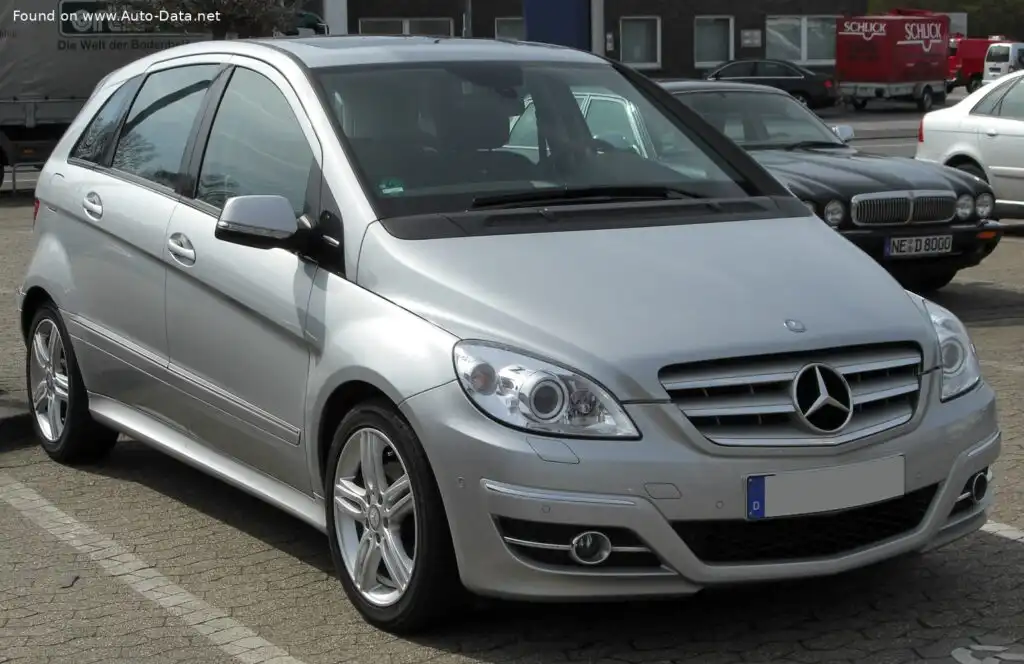
The Mercedes-Benz B-Class W245 facelift, specifically the B 200 CDI variant with 140 horsepower, was produced from April 2008 to April 2010. This model represented a mid-cycle refresh of the first-generation B-Class (W245), offering a more refined and efficient package within the compact multi-purpose vehicle (MPV) segment. Positioned as a mid-range offering, the B 200 CDI aimed to balance fuel economy with respectable performance, appealing to buyers seeking a practical and comfortable family vehicle. It was primarily marketed in Europe, where the compact MPV class enjoyed significant popularity.
Technical Specifications
| Brand | Mercedes-Benz |
| Model | B-Class |
| Generation | B-Class (W245 facelift 2008) |
| Type (Engine) | B 200 CDI (140 Hp) |
| Start of production | April, 2008 |
| End of production | April, 2010 |
| Powertrain Architecture | Internal Combustion engine |
| Body type | MPV |
| Seats | 5 |
| Doors | 5 |
| Fuel consumption (urban) | 6.8-7.1 l/100 km (34.6 – 33.1 US mpg, 41.5 – 39.8 UK mpg, 14.7 – 14.1 km/l) |
| Fuel consumption (extra urban) | 4.5-4.6 l/100 km (52.3 – 51.1 US mpg, 62.8 – 61.4 UK mpg, 22.2 – 21.7 km/l) |
| Fuel consumption (combined) | 5.4-5.6 l/100 km (43.6 – 42 US mpg, 52.3 – 50.4 UK mpg, 18.5 – 17.9 km/l) |
| CO2 emissions | 140-148 g/km |
| Fuel Type | Diesel |
| Acceleration 0 – 100 km/h | 9.6 sec |
| Acceleration 0 – 62 mph | 9.6 sec |
| Acceleration 0 – 60 mph | 9.1 sec |
| Maximum speed | 200 km/h (124.27 mph) |
| Emission standard | Euro 4 |
| Weight-to-power ratio | 9.7 kg/Hp, 102.9 Hp/tonne |
| Weight-to-torque ratio | 4.5 kg/Nm, 220.6 Nm/tonne |
| Power | 140 Hp @ 4200 rpm |
| Power per litre | 70.3 Hp/l |
| Torque | 300 Nm @ 1600-3000 rpm (221.27 lb.-ft. @ 1600-3000 rpm) |
| Engine layout | Front, Transverse |
| Engine Model/Code | OM 640.941 |
| Engine displacement | 1991 cm3 (121.5 cu. in.) |
| Number of cylinders | 4 |
| Engine configuration | Inline |
| Cylinder Bore | 83 mm (3.27 in.) |
| Piston Stroke | 92 mm (3.62 in.) |
| Compression ratio | 18:1 |
| Number of valves per cylinder | 4 |
| Fuel injection system | Diesel Commonrail |
| Engine aspiration | Turbocharger, Intercooler |
| Valvetrain | DOHC |
| Engine oil capacity | 5.4 l (5.71 US qt | 4.75 UK qt) |
| Coolant capacity | 9.7 l (10.25 US qt | 8.53 UK qt) |
| Kerb Weight | 1360 kg (2998.29 lbs.) |
| Max. weight | 1880 kg (4144.69 lbs.) |
| Max load | 520 kg (1146.4 lbs.) |
| Trunk (boot) space – minimum | 544 l (19.21 cu. ft.) |
| Trunk (boot) space – maximum | 2245 l (79.28 cu. ft.) |
| Fuel tank capacity | 54 l (14.27 US gal | 11.88 UK gal) |
| Max. roof load | 75 kg (165.35 lbs.) |
| Permitted trailer load with brakes (12%) | 1500 kg (3306.93 lbs.) |
| Permitted trailer load without brakes | 715 kg (1576.31 lbs.) |
| Permitted towbar download | 75 kg (165.35 lbs.) |
| Length | 4273 mm (168.23 in.) |
| Width | 1777 mm (69.96 in.) |
| Width including mirrors | 2035 mm (80.12 in.) |
| Height | 1604 mm (63.15 in.) |
| Wheelbase | 2778 mm (109.37 in.) |
| Front track | 1552 mm (61.1 in.) |
| Rear track | 1547 mm (60.91 in.) |
| Drag coefficient (Cd) | 0.31 |
| Minimum turning circle | 11.95 m (39.21 ft.) |
| Drivetrain | Front wheel drive |
| Number of gears | 6 |
| Gearbox type | Manual transmission |
| Front suspension | Independent type McPherson, Transverse stabilizer |
| Rear suspension | Transverse stabilizer, Coil spring |
| Front brakes | Ventilated discs |
| Rear brakes | Disc |
| Assisting systems | ABS (Anti-lock braking system) |
| Steering type | Steering rack and pinion |
| Power steering | Electric Steering |
| Tires size | 205/55 R16 |
| Wheel rims size | 6J x 16 |
Powertrain & Engine Architecture
The B 200 CDI was powered by the OM 640.941, a 2.0-liter inline-four cylinder diesel engine. This engine was a mainstay in the Mercedes-Benz lineup during this period, known for its robust construction and relatively good fuel efficiency. The engine featured a common rail direct injection system, delivering fuel at extremely high pressure for optimized combustion. A turbocharger with an intercooler further enhanced performance, boosting power output to 140 horsepower at 4200 rpm and generating 300 Nm (221 lb-ft) of torque between 1600 and 3000 rpm. The engine utilized a double overhead camshaft (DOHC) valvetrain with four valves per cylinder, contributing to its efficient operation. The 6-speed manual transmission was standard, providing a balance between fuel economy and driver control.
Driving Characteristics
The B 200 CDI offered a comfortable and practical driving experience. While not particularly sporty, the engine provided adequate power for everyday driving and highway cruising. Acceleration from 0 to 100 km/h (0-62 mph) took approximately 9.6 seconds, and the car had a top speed of 200 km/h (124 mph). The manual transmission allowed for precise gear selection, but the relatively long gearing prioritized fuel economy over outright acceleration. Compared to higher-output versions of the B-Class, such as the B 200 Turbo, the CDI model felt less responsive, but it compensated with significantly better fuel economy. The suspension was tuned for comfort, absorbing bumps and providing a stable ride, although it wasn’t particularly engaging for enthusiastic drivers.
Equipment & Trim Levels
The B 200 CDI typically came equipped with a reasonable level of standard features. These included air conditioning, power windows, central locking, and an audio system. Interior upholstery was generally cloth, with options for leather upgrades. The dashboard layout was functional and straightforward, with easy-to-read gauges and controls. Optional extras included a panoramic sunroof, navigation system, and upgraded audio systems. Safety features such as ABS, airbags, and electronic stability control were standard.
Chassis & Braking
The B-Class W245 utilized a McPherson strut front suspension and a multi-link rear suspension, providing a comfortable ride and decent handling. The front brakes were ventilated discs, while the rear brakes were solid discs. The steering was power-assisted, offering light and precise control. The car’s relatively high center of gravity and front-wheel-drive configuration meant that it wasn’t a particularly sporty handler, but it provided a secure and predictable driving experience.
Market Reception & Comparison
The B 200 CDI was generally well-received by critics as a practical and fuel-efficient MPV. It was praised for its spacious interior, comfortable ride, and economical diesel engine. However, some reviewers noted that the engine lacked the refinement and performance of some of its competitors. Compared to other trims in the B-Class lineup, the B 200 CDI offered the best fuel economy, making it an attractive option for drivers who prioritized efficiency. Its reliability was generally considered good, although diesel engines can be more prone to certain issues, such as injector problems and turbocharger wear.
Legacy
The Mercedes-Benz B-Class W245, including the B 200 CDI variant, established a foothold for Mercedes-Benz in the compact MPV segment. The OM 640 engine proved to be a durable and reliable powerplant, and many examples are still on the road today. In the used car market, the B 200 CDI remains a popular choice for buyers seeking a practical, fuel-efficient, and relatively affordable family vehicle. However, potential buyers should be aware of the potential for age-related issues, such as wear and tear on the suspension components and the possibility of diesel particulate filter problems.