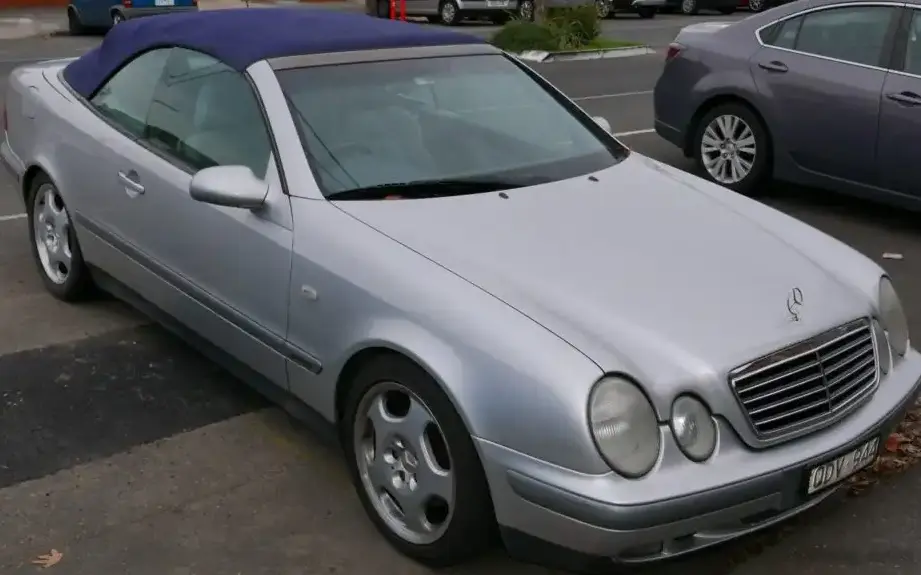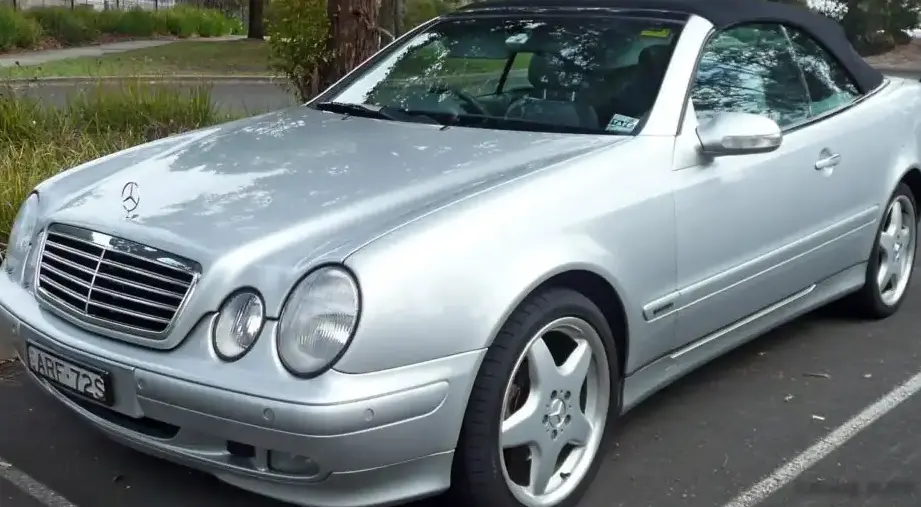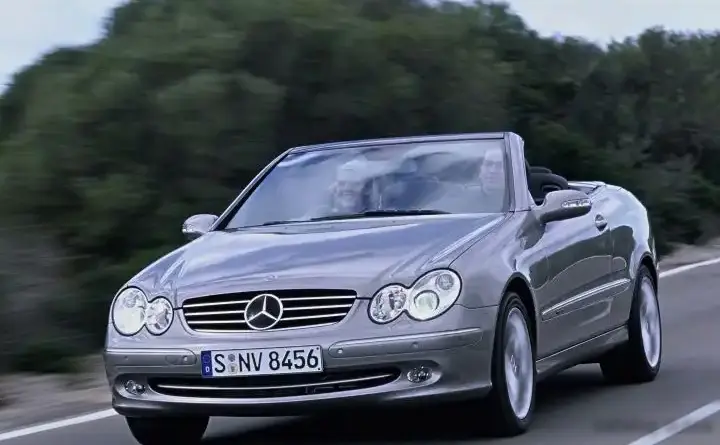
The Mercedes-Benz CLK 200 CGI, produced between February 2002 and February 2003, represents a specific iteration within the A209 CLK generation. This variant, a two-door cabriolet, occupied a mid-range position in the CLK lineup, offering a blend of performance and relative affordability. It was positioned below the more powerful CLK 320 and CLK 500 models, and above any base-level offerings. The CLK A209 series itself was a significant model for Mercedes-Benz, continuing the CLK lineage with updated styling and technology, and serving as a key competitor in the premium mid-size convertible market.
Technical Specifications
| Brand | Mercedes-Benz |
| Model | CLK |
| Generation | CLK (A209) |
| Type (Engine) | CLK 200 CGI (170 Hp) |
| Start of production | February, 2002 |
| End of production | February, 2003 |
| Powertrain Architecture | Internal Combustion engine |
| Body type | Cabriolet |
| Seats | 4 |
| Doors | 2 |
| Fuel consumption (economy) – urban (NEDC) | 11.7 l/100 km (20.1 US mpg, 24.1 UK mpg, 8.5 km/l) |
| Fuel consumption (economy) – extra urban (NEDC) | 6.1 l/100 km (38.6 US mpg, 46.3 UK mpg, 16.4 km/l) |
| Fuel consumption (economy) – combined (NEDC) | 8.1 l/100 km (29 US mpg, 34.9 UK mpg, 12.3 km/l) |
| CO2 emissions (NEDC) | 194 g/km |
| Fuel Type | Petrol (Gasoline) |
| Acceleration 0 – 100 km/h | 9.2 sec |
| Acceleration 0 – 62 mph | 9.2 sec |
| Acceleration 0 – 60 mph | 8.7 sec |
| Maximum speed | 231 km/h (143.54 mph) |
| Emission standard | Euro 4 |
| Weight-to-power ratio | 8.7 kg/Hp, 115.3 Hp/tonne |
| Weight-to-torque ratio | 5.9 kg/Nm, 169.5 Nm/tonne |
| Power | 170 Hp @ 5300 rpm |
| Power per litre | 94.7 Hp/l |
| Torque | 250 Nm @ 3000 rpm (184.39 lb.-ft. @ 3000 rpm) |
| Engine layout | Front, Longitudinal |
| Engine Model/Code | M 271.942 |
| Engine displacement | 1796 cm3 (109.6 cu. in.) |
| Number of cylinders | 4 |
| Engine configuration | Inline |
| Cylinder Bore | 82 mm (3.23 in.) |
| Piston Stroke | 85 mm (3.35 in.) |
| Compression ratio | 10.5:1 |
| Number of valves per cylinder | 4 |
| Fuel injection system | Direct injection |
| Engine aspiration | Supercharger, Intercooler |
| Valvetrain | DOHC |
| Engine oil capacity | 5.5 l (5.81 US qt | 4.84 UK qt) |
| Coolant | 8 l (8.45 US qt | 7.04 UK qt) |
| Kerb Weight | 1475 kg (3251.82 lbs.) |
| Max. weight | 2020 kg (4453.34 lbs.) |
| Max load | 545 kg (1201.52 lbs.) |
| Trunk (boot) space – minimum | 276 l (9.75 cu. ft.) |
| Trunk (boot) space – maximum | 390 l (13.77 cu. ft.) |
| Fuel tank capacity | 62 l (16.38 US gal | 13.64 UK gal) |
| Permitted trailer load with brakes (12%) | 1500 kg (3306.93 lbs.) |
| Permitted trailer load without brakes | 750 kg (1653.47 lbs.) |
| Length | 4638 mm (182.6 in.) |
| Width | 1740 mm (68.5 in.) |
| Width including mirrors | 1991 mm (78.39 in.) |
| Height | 1413 mm (55.63 in.) |
| Wheelbase | 2715 mm (106.89 in.) |
| Front track | 1493 mm (58.78 in.) |
| Rear (Back) track | 1474 mm (58.03 in.) |
| Front overhang | 840 mm (33.07 in.) |
| Rear overhang | 1083 mm (42.64 in.) |
| Drag coefficient (Cd) | 0.30 |
| Minimum turning circle (turning diameter) | 10.76 m (35.3 ft.) |
| Drivetrain Architecture | The Internal combustion engine (ICE) drives the rear wheels of the vehicle. |
| Drive wheel | Rear wheel drive |
| Number of gears and type of gearbox | 6 gears, manual transmission |
| Front suspension | Independent type McPherson, Transverse stabilizer |
| Rear suspension | Independent multi-link suspension, Transverse stabilizer |
| Front brakes | Ventilated discs, 288×25 mm |
| Rear brakes | Disc, 278×9 mm |
| Assisting systems | ABS (Anti-lock braking system) |
| Steering type | Steering rack and pinion |
| Power steering | Hydraulic Steering |
| Tires size | Front wheel tires: 205/55 R16 Rear wheel tires: 225/50 R16 |
| Wheel rims size | Front wheel rims: 7J x 16 Rear wheel rims: 8J x 16 |
Powertrain & Engine Architecture
The CLK 200 CGI is powered by the M271.942 engine, a 1.8-liter inline-four cylinder powerplant. This engine is notable for its use of direct fuel injection and a supercharger, a configuration Mercedes-Benz termed “CGI” (Charged Gasoline Injection). The supercharger, unlike a turbocharger, provides boost across a wider RPM range, resulting in more immediate throttle response. The engine produces 170 horsepower at 5300 rpm and 250 Nm (184 lb-ft) of torque at 3000 rpm. The engine features a double overhead camshaft (DOHC) valvetrain with four valves per cylinder. The engine is longitudinally mounted in the front of the vehicle, driving the rear wheels. The transmission is a 6-speed manual gearbox, offering precise control and a more engaging driving experience.
Driving Characteristics
The CLK 200 CGI with the manual transmission delivers a respectable, though not overtly sporty, driving experience. Acceleration from 0 to 60 mph takes approximately 8.7 seconds, and the car has a top speed of 143.54 mph. The supercharger provides good low-end and mid-range torque, making the car feel responsive in everyday driving situations. Compared to the more powerful CLK 320 or CLK 500, the 200 CGI lacks the outright acceleration and high-speed performance. However, it offers a more balanced and fuel-efficient driving experience. The manual transmission allows for greater driver involvement, while the relatively lightweight construction of the inline-four engine contributes to nimble handling. The gear ratios are tuned for a balance of acceleration and fuel economy, with a relatively tall sixth gear for comfortable highway cruising.
Equipment & Trim Levels
The CLK 200 CGI typically came equipped with a reasonable level of standard features, befitting a premium Mercedes-Benz. Standard equipment included automatic climate control, power windows and locks, a multi-function steering wheel, and a basic audio system. Upholstery was typically cloth, though leather was available as an option. Optional extras included a premium sound system, navigation system, heated seats, and a sunroof. The exterior styling was consistent with other CLK models, featuring the elegant coupe/convertible design language of the A209 generation.
Chassis & Braking
The CLK 200 CGI utilizes an independent suspension system at all four wheels. The front suspension is a McPherson strut design with a transverse stabilizer bar, while the rear suspension is a multi-link setup, also with a stabilizer bar. This suspension configuration provides a comfortable ride and good handling characteristics. The braking system consists of ventilated discs at the front and solid discs at the rear. Anti-lock brakes (ABS) are standard. The steering is a rack-and-pinion system with hydraulic power assistance, providing precise and responsive steering feel.
Market Reception & Comparison
The CLK 200 CGI was generally well-received by automotive critics as a capable and refined entry-level CLK model. It was praised for its comfortable ride, responsive engine, and stylish design. However, some critics noted that the engine lacked the outright power of its larger siblings. Fuel economy was considered reasonable for a premium convertible, with combined fuel consumption of around 29 US mpg. Compared to other trims in the CLK lineup, the 200 CGI offered a more affordable entry point into the CLK range, making it attractive to buyers who prioritized fuel efficiency and comfort over outright performance.
Legacy
The M271 engine family, including the 1.8-liter supercharged version found in the CLK 200 CGI, has proven to be relatively reliable over the long term. However, like any complex engine, it is susceptible to certain issues, such as oil leaks and timing chain wear. The CLK A209 generation as a whole has maintained a strong following among enthusiasts, and well-maintained examples of the 200 CGI can still be found on the used car market today. The combination of Mercedes-Benz build quality, stylish design, and the unique supercharged engine makes this variant a desirable option for those seeking a classic premium convertible.