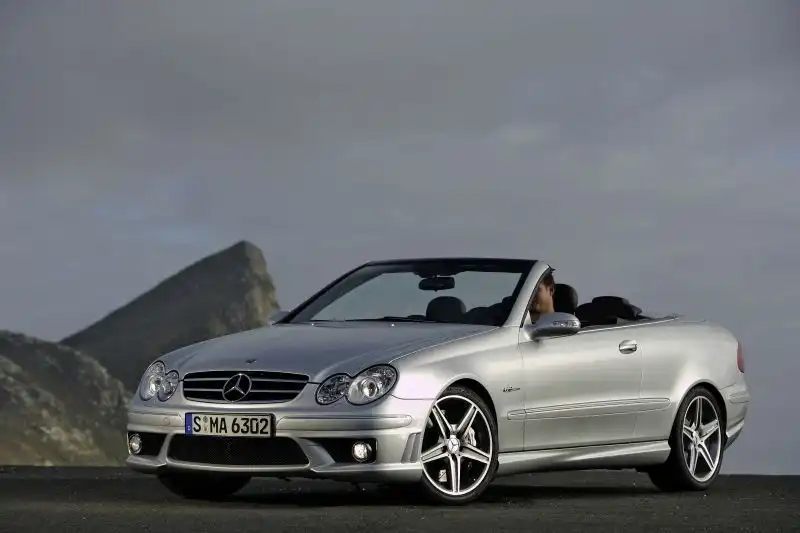
The Mercedes-Benz CLK 200 Kompressor, produced from December 2006 to August 2009, was a key variant within the A209 facelift generation of the CLK-Class. Positioned as a mid-range offering, it aimed to balance performance and fuel efficiency within the luxury coupe and convertible lineup. This model, distinguished by its supercharged 1.8-liter engine, served as a popular alternative to the more powerful CLK 350 and the diesel-powered CLK 220 CDI, particularly in European markets where fuel costs were a significant consideration. The A209 facelift brought revised styling, improved interior appointments, and updated technology compared to the pre-facelift models.
Technical Specifications
| Brand | Mercedes-Benz |
| Model | CLK |
| Generation | CLK (A209, facelift 2005) |
| Type (Engine) | CLK 200 Kompressor (184 Hp) |
| Start of production | December, 2006 |
| End of production | August, 2009 |
| Powertrain Architecture | Internal Combustion engine |
| Body type | Cabriolet |
| Seats | 4 |
| Doors | 2 |
| Fuel consumption (urban) | 12.2-12.4 l/100 km (19.3 – 19 US mpg, 23.2 – 22.8 UK mpg, 8.2 – 8.1 km/l) |
| Fuel consumption (extra urban) | 6.5-6.8 l/100 km (36.2 – 34.6 US mpg, 43.5 – 41.5 UK mpg, 15.4 – 14.7 km/l) |
| Fuel consumption (combined) | 8.6-8.9 l/100 km (27.4 – 26.4 US mpg, 32.8 – 31.7 UK mpg, 11.6 – 11.2 km/l) |
| CO2 emissions | 212 g/km |
| Fuel Type | Petrol (Gasoline) |
| Acceleration 0 – 100 km/h | 9.3 sec |
| Acceleration 0 – 62 mph | 9.3 sec |
| Acceleration 0 – 60 mph | 8.8 sec |
| Maximum speed | 231 km/h (143.54 mph) |
| Emission standard | Euro 4 |
| Weight-to-power ratio | 9.1 kg/Hp, 109.9 Hp/tonne |
| Weight-to-torque ratio | 6.7 kg/Nm, 149.3 Nm/tonne |
| Power | 184 Hp @ 5500 rpm |
| Power per litre | 102.4 Hp/l |
| Torque | 250 Nm @ 2800-5000 rpm (184.39 lb.-ft. @ 2800-5000 rpm) |
| Engine layout | Front, Longitudinal |
| Engine Model/Code | M 271.950 |
| Engine displacement | 1796 cm3 (109.6 cu. in.) |
| Number of cylinders | 4 |
| Engine configuration | Inline |
| Cylinder Bore | 82 mm (3.23 in.) |
| Piston Stroke | 85 mm (3.35 in.) |
| Compression ratio | 9.5:1 |
| Number of valves per cylinder | 4 |
| Fuel injection system | Multi-port manifold injection |
| Engine aspiration | Supercharger, Intercooler |
| Valvetrain | DOHC |
| Engine oil capacity | 5.5 l (5.81 US qt | 4.84 UK qt) |
| Coolant | 8 l (8.45 US qt | 7.04 UK qt) |
| Kerb Weight | 1675 kg (3692.74 lbs.) |
| Max. weight | 2145 kg (4728.92 lbs.) |
| Max load | 470 kg (1036.17 lbs.) |
| Trunk (boot) space – minimum | 390 l (13.77 cu. ft.) |
| Fuel tank capacity | 62 l (16.38 US gal | 13.64 UK gal) |
| Permitted trailer load with brakes (12%) | 1500 kg (3306.93 lbs.) |
| Permitted trailer load without brakes | 750 kg (1653.47 lbs.) |
| Permitted towbar download | 75 kg (165.35 lbs.) |
| Length | 4652 mm (183.15 in.) |
| Width | 1740 mm (68.5 in.) |
| Width including mirrors | 1991 mm (78.39 in.) |
| Height | 1413 mm (55.63 in.) |
| Wheelbase | 2715 mm (106.89 in.) |
| Front track | 1493 mm (58.78 in.) |
| Rear (Back) track | 1474 mm (58.03 in.) |
| Drag coefficient (Cd) | 0.30 |
| Minimum turning circle | 10.76 m (35.3 ft.) |
| Drivetrain Architecture | Rear wheel drive |
| Drive wheel | Rear wheel drive |
| Number of gears and type of gearbox | 6 gears, manual transmission |
| Front suspension | Independent type McPherson, Transverse stabilizer |
| Rear suspension | Independent multi-link suspension, Transverse stabilizer |
| Front brakes | Ventilated discs |
| Rear brakes | Disc |
| Assisting systems | ABS (Anti-lock braking system) |
| Steering type | Steering rack and pinion |
| Power steering | Hydraulic Steering |
| Tires size (Front) | 205/55 R 16; 225/45 R 17 |
| Tires size (Rear) | 225/50 R 16; 245/40 R 17 |
| Wheel rims size (Front) | 7 J x 16; 7.5 J x 17 |
| Wheel rims size (Rear) | 8 J x 16; 8.5 J x 17 |
INTRODUCTION
The CLK 200 Kompressor, introduced as part of the A209 facelift in late 2006, represented a significant update to Mercedes-Benz’s mid-size coupe and convertible. Built on the W209 platform, the A209 revision brought a more modern aesthetic, refined interior, and technological enhancements. The 200 Kompressor variant specifically targeted buyers seeking a blend of luxury, reasonable performance, and improved fuel economy compared to the larger-displacement engines available in the CLK range. It was primarily sold in Europe and other markets where smaller, turbocharged engines were favored due to tax regulations and fuel prices.
Powertrain & Engine Architecture
At the heart of the CLK 200 Kompressor lies the M271.950 1.8-liter inline-four cylinder engine. This engine is characterized by its supercharger, which provides increased torque at lower engine speeds, enhancing drivability. The “Kompressor” designation refers to the mechanically driven supercharger, unlike some competitors who utilized turbochargers. The M271 engine features multi-port fuel injection and a double overhead camshaft (DOHC) valvetrain with four valves per cylinder. This configuration optimizes airflow and combustion efficiency. The engine produces 184 horsepower at 5500 rpm and 250 Nm (184 lb-ft) of torque between 2800 and 5000 rpm. The engine is longitudinally mounted, driving the rear wheels. The transmission offered was typically a 6-speed manual, although a 5-speed automatic transmission was also available, impacting acceleration and fuel economy slightly.
Driving Characteristics
The CLK 200 Kompressor offered a comfortable and refined driving experience. While not overtly sporty, the supercharger provided adequate power for everyday driving and overtaking maneuvers. The 0-60 mph acceleration time of around 8.8 seconds (with the manual transmission) was respectable for its class. The automatic transmission, while smooth, did slightly diminish acceleration times and felt less engaging than the manual option. The gear ratios were tuned for a balance between fuel efficiency and responsiveness. Compared to the CLK 350, the 200 Kompressor felt noticeably less powerful, but it offered better fuel economy and a lighter front-end feel, contributing to more balanced handling. The manual transmission provided a more connected driving experience, allowing drivers to fully utilize the engine’s torque band.
Equipment & Trim Levels
The CLK 200 Kompressor typically came equipped with a generous array of standard features, reflecting its position as a mid-range luxury vehicle. These included automatic climate control, power windows and mirrors, a multi-function steering wheel, and a premium audio system. Interior upholstery was generally a combination of fabric and leatherette, with full leather options available as an upgrade. Optional extras included a sunroof, navigation system, heated seats, and a more advanced audio system. The A209 facelift also introduced updated interior trim options and improved materials, enhancing the overall sense of luxury.
Chassis & Braking
The CLK 200 Kompressor utilized an independent suspension system, with McPherson struts at the front and a multi-link setup at the rear. This configuration provided a comfortable ride and good handling characteristics. Stabilizer bars were fitted to both axles to reduce body roll during cornering. The braking system consisted of ventilated discs at the front and solid discs at the rear, providing adequate stopping power. Anti-lock braking system (ABS) was standard. The suspension was tuned to prioritize comfort over outright sportiness, making it well-suited for long-distance cruising.
Market Reception & Comparison
The CLK 200 Kompressor was generally well-received by automotive critics, who praised its blend of luxury, fuel efficiency, and reasonable performance. It was seen as a sensible alternative to the more expensive and less fuel-efficient CLK 350. Compared to the diesel-powered CLK 220 CDI, the 200 Kompressor offered a more refined engine note and a slightly more engaging driving experience, although the diesel variant provided superior fuel economy. Some critics noted that the engine could feel strained at higher speeds, and the automatic transmission lacked the responsiveness of some competitors.
Legacy
The M271 engine, found in the CLK 200 Kompressor, has proven to be relatively reliable, although regular maintenance is crucial. Common issues include oil leaks and occasional problems with the supercharger clutch. The A209 CLK-Class, in general, is known for its build quality and comfortable ride. Today, the CLK 200 Kompressor represents an affordable entry point into the Mercedes-Benz luxury coupe/convertible market. Well-maintained examples are sought after by enthusiasts who appreciate their classic styling and relatively low running costs. The combination of a supercharged engine and a comfortable chassis makes it a compelling option for those seeking a stylish and refined grand tourer.