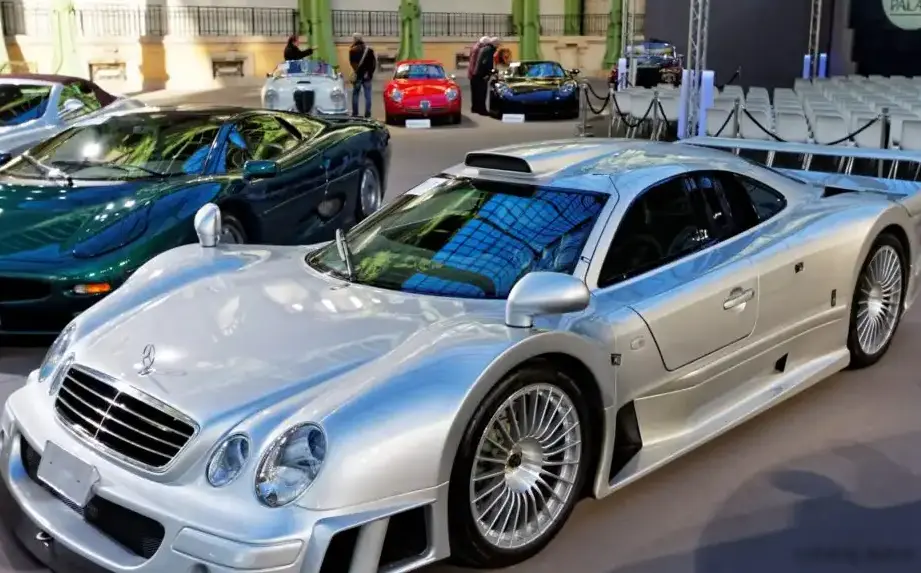
The Mercedes-Benz CLK GTR Coupe (W297) represents a pinnacle of late-1990s motorsport engineering, specifically designed to homologate the car for FIA GT Championship competition. Produced in extremely limited numbers between 1998 and 1999, the CLK GTR was a direct response to Porsche’s dominance with the 911 GT1. The road-going version, of which approximately 25 examples were built, offered a visceral driving experience and showcased Mercedes-Benz’s technological prowess. This article focuses on the most potent variant: the 6.9-liter V12 producing 612 horsepower.
Technical Specifications
| Brand | Mercedes-Benz |
| Model | CLK GTR |
| Generation | CLK GTR Coupe (W297) |
| Type (Engine) | 6.9 V12 (612 Hp) |
| Start of production | 1998 |
| End of production | 1999 |
| Powertrain Architecture | Internal Combustion engine |
| Body type | Coupe |
| Seats | 2 |
| Doors | 2 |
| Fuel consumption (economy) – urban | 31.8 l/100 km (7.4 US mpg, 8.9 UK mpg, 3.1 km/l) |
| Fuel consumption (economy) – extra urban | 14.7 l/100 km (16 US mpg, 19.2 UK mpg, 6.8 km/l) |
| Fuel consumption (economy) – combined | 21.6 l/100 km (10.9 US mpg, 13.1 UK mpg, 4.6 km/l) |
| Fuel Type | Petrol (Gasoline) |
| Acceleration 0 – 100 km/h | 3.8 sec |
| Acceleration 0 – 62 mph | 3.8 sec |
| Acceleration 0 – 60 mph | 3.6 sec |
| Acceleration 0 – 200 km/h | 9.9 sec |
| Maximum speed | 320 km/h (198.84 mph) |
| Weight-to-power ratio | 2.4 kg/Hp, 425 Hp/tonne |
| Weight-to-torque ratio | 1.9 kg/Nm, 538.2 Nm/tonne |
| Power | 612 Hp @ 6800 rpm |
| Power per litre | 88.7 Hp/l |
| Torque | 775 Nm @ 5250 rpm (571.61 lb.-ft. @ 5250 rpm) |
| Maximum engine speed | 7200 rpm |
| Engine layout | Middle, Longitudinal |
| Engine Model/Code | M297 E69 |
| Engine displacement | 6896 cm3 (420.82 cu. in.) |
| Number of cylinders | 12 |
| Engine configuration | V-engine |
| Cylinder Bore | 89 mm (3.5 in.) |
| Piston Stroke | 92.4 mm (3.64 in.) |
| Compression ratio | 10.5:1 |
| Number of valves per cylinder | 4 |
| Fuel injection system | Multi-port manifold injection |
| Engine aspiration | Naturally aspirated engine |
| Valvetrain | DOHC |
| Engine oil capacity | 9.5 l (10.04 US qt, 8.36 UK qt) |
| Coolant | 18.5 l (19.55 US qt, 16.28 UK qt) |
| Kerb Weight | 1440 kg (3174.66 lbs.) |
| Max. weight | 1630 kg (3593.53 lbs.) |
| Max load | 190 kg (418.88 lbs.) |
| Trunk (boot) space – minimum | 153 l (5.4 cu. ft.) |
| Fuel tank capacity | 90 l (23.78 US gal, 19.8 UK gal) |
| Length | 4855 mm (191.14 in.) |
| Width | 1950 mm (76.77 in.) |
| Height | 1164 mm (45.83 in.) |
| Wheelbase | 2670 mm (105.12 in.) |
| Front track | 1665 mm (65.55 in.) |
| Rear (Back) track | 1594 mm (62.76 in.) |
| Minimum turning circle | 15 m (49.21 ft.) |
| Drivetrain Architecture | Rear wheel drive |
| Drive wheel | Rear wheel drive |
| Number of gears and type of gearbox | 6 gears, manual transmission |
| Front suspension | Double wishbone, Transverse stabilizer |
| Rear suspension | Double wishbone, Transverse stabilizer |
| Front brakes | Ventilated discs |
| Rear brakes | Ventilated discs |
| Assisting systems | ABS (Anti-lock braking system) |
| Steering type | Steering rack and pinion |
| Power steering | Hydraulic Steering |
| Tires size | Front: 295/35 R18, Rear: 345/35 R18 |
| Wheel rims size | Front: 10.5J x 18, Rear: 12.5J x 18 |
INTRODUCTION
The Mercedes-Benz CLK GTR was born out of necessity. In 1996, the FIA announced new regulations for the GT Championship, requiring manufacturers to produce a minimum of 25 road-going versions of their race cars to qualify for competition. Mercedes-Benz, eager to challenge Porsche’s dominance, embarked on a project to create a homologation special based on the W202-series C-Class platform, ultimately resulting in the CLK GTR. The W297 chassis, while visually reminiscent of the C-Class coupe, was almost entirely bespoke, sharing very little with its production counterpart. The 6.9-liter V12 variant represented the ultimate expression of this project, offering unparalleled performance for the era.
Powertrain & Engine Architecture
The heart of the CLK GTR is the M297 E69 6.9-liter naturally aspirated V12 engine. This engine, derived from the M120 V12 used in the SL73 AMG, was extensively modified for racing purposes. Key changes included a larger displacement, reinforced internals, and a revised cylinder head design with four valves per cylinder operated by a double overhead camshaft (DOHC) valvetrain. Fuel delivery was handled by a multi-port fuel injection system. The engine produced a staggering 612 horsepower at 6800 rpm and 775 Nm (571.61 lb-ft) of torque at 5250 rpm. Power was sent to the rear wheels via a six-speed manual transmission. The engine’s longitudinal layout and mid-engine placement contributed to the car’s exceptional balance.
Driving Characteristics
The CLK GTR’s driving experience was defined by its raw power and uncompromising nature. The 6.9-liter V12 delivered a surge of torque throughout the rev range, providing exhilarating acceleration. The 0-60 mph sprint was dispatched in approximately 3.6 seconds, and the car could reach a top speed of 320 km/h (198.84 mph). The manual transmission demanded precise shifts, and the lack of electronic driver aids meant that the CLK GTR required a skilled driver to fully exploit its potential. Compared to potential future iterations with smaller engines, the V12 offered a more visceral and powerful experience, albeit with significantly higher fuel consumption.
Equipment & Trim Levels
Given its limited production run and racing origins, the CLK GTR was sparsely equipped by modern standards. The interior focused on functionality rather than luxury. It featured racing-style bucket seats, a minimalist dashboard, and limited sound insulation. Air conditioning and a basic audio system were typically included, but options were limited. The interior trim was primarily leather and carbon fiber, reflecting the car’s performance-oriented character. The focus was on reducing weight and maximizing driver feedback.
Chassis & Braking
The CLK GTR’s chassis was a space frame constructed from carbon fiber, providing exceptional rigidity and lightness. The suspension utilized double wishbones with transverse stabilizers at both the front and rear, optimized for track performance. Braking duties were handled by ventilated discs on all four wheels, equipped with an Anti-lock Braking System (ABS). The car’s wide track and low center of gravity contributed to its impressive handling capabilities. The tires were specially developed by Pirelli, measuring 295/35 R18 at the front and 345/35 R18 at the rear, mounted on 10.5J and 12.5J wheels respectively.
Market Reception & Comparison
The CLK GTR was universally praised by automotive journalists for its breathtaking performance and engineering excellence. However, its extreme nature and high price tag (approximately $1.5 million at the time) limited its appeal to a select few. Compared to other high-performance cars of the era, the CLK GTR stood out for its uncompromising focus on track performance. While its fuel economy was abysmal (21.6 l/100 km combined), this was considered a minor drawback given the car’s capabilities. Its rarity and racing pedigree have made it a highly sought-after collector’s item.
Legacy
The Mercedes-Benz CLK GTR remains a legendary example of late-1990s supercar engineering. Its innovative chassis construction, powerful V12 engine, and uncompromising performance have cemented its place in automotive history. Today, the CLK GTR is one of the most valuable and collectible Mercedes-Benz models ever produced. The powertrain, while demanding in terms of maintenance, has proven to be relatively reliable when properly cared for. The CLK GTR serves as a reminder of a time when manufacturers were willing to push the boundaries of automotive technology to achieve racing success, and build some of the most incredible road cars in the process.