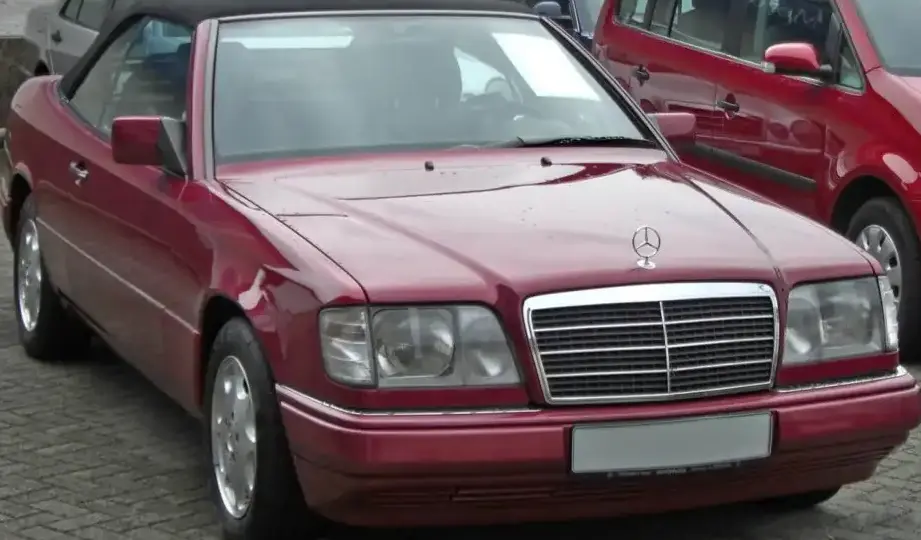
The Mercedes-Benz E-Class Cabriolet (A124) E 320, produced between July 1992 and June 1997, represented a sophisticated blend of open-air motoring and luxury performance within the W124 series. Positioned as a premium offering within the Cabriolet range, the E 320 featured a larger, more powerful engine than the base E 220 and E 280 models, while offering a more refined experience than the later E 36 AMG variants. It was a key model in Mercedes-Benz’s strategy to appeal to buyers seeking a comfortable and stylish convertible with the prestige of the three-pointed star. The A124 chassis, known for its robust build quality, provided a solid foundation for the open-top design.
Technical Specifications
| Brand | Mercedes-Benz |
| Model | E-class |
| Generation | E-class Cabrio (A124) |
| Type (Engine) | E 320 (220 Hp) Automatic |
| Start of production | July, 1992 |
| End of production | June, 1997 |
| Powertrain Architecture | Internal Combustion engine |
| Body type | Cabriolet |
| Seats | 4 |
| Doors | 2 |
| Fuel consumption (urban) | 14.7 l/100 km (16 US mpg, 19.2 UK mpg) |
| Fuel consumption (extra urban) | 9 l/100 km (26.1 US mpg, 31.4 UK mpg) |
| Fuel Type | Petrol (Gasoline) |
| Acceleration 0 – 100 km/h | 8.5 sec |
| Acceleration 0 – 62 mph | 8.5 sec |
| Acceleration 0 – 60 mph | 8.1 sec |
| Maximum speed | 230 km/h (142.92 mph) |
| Weight-to-power ratio | 7.8 kg/Hp |
| Weight-to-torque ratio | 5.4 kg/Nm |
| Power | 220 Hp @ 5500 rpm |
| Power per litre | 68.8 Hp/l |
| Torque | 315 Nm @ 3850 rpm (232.33 lb.-ft. @ 3850 rpm) |
| Engine layout | Front, Longitudinal |
| Engine Model/Code | M 104 E 32 / 104.992 |
| Engine displacement | 3199 cm3 (195.21 cu. in.) |
| Number of cylinders | 6 |
| Engine configuration | Inline |
| Cylinder Bore | 89.9 mm (3.54 in.) |
| Piston Stroke | 84 mm (3.31 in.) |
| Compression ratio | 10:1 |
| Number of valves per cylinder | 4 |
| Fuel injection system | Multi-port manifold injection |
| Engine aspiration | Naturally aspirated engine |
| Valvetrain | DOHC |
| Engine oil capacity | 7.5 l (7.93 US qt | 6.6 UK qt) |
| Coolant | 9 l (9.51 US qt | 7.92 UK qt) |
| Kerb Weight | 1710 kg (3769.9 lbs.) |
| Max. weight | 2200 kg (4850.17 lbs.) |
| Max load | 490 kg (1080.27 lbs.) |
| Trunk (boot) space – minimum | 300 l (10.59 cu. ft.) |
| Fuel tank capacity | 70 l (18.49 US gal | 15.4 UK gal) |
| Length | 4655 mm (183.27 in.) |
| Width | 1740 mm (68.5 in.) |
| Height | 1371 mm (53.98 in.) |
| Wheelbase | 2715 mm (106.89 in.) |
| Front track | 1501 mm (59.09 in.) |
| Rear (Back) track | 1491 mm (58.7 in.) |
| Drivetrain Architecture | Rear wheel drive |
| Number of gears and type of gearbox | 4 gears, automatic transmission |
| Front suspension | Wishbone |
| Rear suspension | Independent multi-link suspension |
| Front brakes | Ventilated discs |
| Rear brakes | Disc |
| Assisting systems | ABS (Anti-lock braking system) |
| Steering type | Cone worm with recirculation balls |
| Power steering | Hydraulic Steering |
| Tires size | Front wheel tires: 195/65 R15Rear wheel tires: 195/65 R15 |
| Wheel rims size | Front wheel rims: 6.5J x 15Rear wheel rims: 6.5J x 15 |
Powertrain & Engine Architecture
The heart of the E 320 Cabriolet was the M104.992 3.2-liter inline-six engine. This engine, a descendant of Mercedes-Benz’s long-running M104 family, was renowned for its smoothness and durability. It featured a cast iron block with aluminum cylinder heads, dual overhead camshafts (DOHC), and four valves per cylinder. The engine utilized Bosch Motronic fuel injection, delivering precise fuel metering for optimal performance and efficiency. The 3.2-liter displacement provided a significant increase in power and torque compared to the smaller engines offered in the E-Class Cabriolet range. Paired with the engine was a four-speed automatic transmission (typically the 722.3), chosen for its smooth operation and suitability for the luxury-oriented nature of the vehicle. This transmission, while not offering the latest in gear count, was known for its reliability and comfortable shift characteristics.
Driving Characteristics
The E 320 Automatic offered a refined and comfortable driving experience. While not a sports car, the 220 horsepower and 232 lb-ft of torque provided ample power for confident cruising and overtaking. The automatic transmission, while smooth, did result in some power loss compared to the available five-speed manual transmission. Acceleration from 0-60 mph took approximately 8.1 seconds, respectable for a luxury convertible of the era. The gear ratios were tuned for relaxed cruising, prioritizing comfort over outright performance. The rear-wheel drive configuration provided balanced handling, although the relatively heavy weight of the vehicle (around 3770 lbs) meant it wasn’t particularly agile. The suspension, tuned for comfort, absorbed bumps and imperfections in the road effectively, making it a pleasant vehicle for long journeys.
Equipment & Trim Levels
The E 320 Cabriolet was well-equipped as standard, reflecting its position as a premium model. Standard features typically included leather upholstery, power windows, power locks, a premium sound system, and automatic climate control. The interior featured wood trim and a generally upscale ambiance. Optional extras included heated seats, a sunroof, upgraded sound systems, and various cosmetic enhancements. The Cabriolet also featured a fully automatic, insulated soft top, designed for quiet operation and weather protection. Trim levels were relatively simple, with most options being added individually rather than packaged into distinct tiers.
Chassis & Braking
The A124 Cabriolet chassis was extensively reinforced compared to the coupe and sedan versions to compensate for the lack of a fixed roof. This reinforcement added weight but significantly improved structural rigidity. The suspension utilized independent wishbones at the front and an independent multi-link setup at the rear, providing a comfortable and controlled ride. Braking duties were handled by ventilated discs at the front and solid discs at the rear, assisted by an Anti-lock Braking System (ABS). The steering was a recirculating ball system with hydraulic power assistance, offering a good balance of feel and ease of use.
Market Reception & Comparison
The E 320 Cabriolet was generally well-received by automotive critics. It was praised for its comfortable ride, refined engine, and luxurious interior. However, some critics noted that the automatic transmission dulled the engine’s performance somewhat, and the car’s weight limited its handling agility. Compared to the E 220 and E 280 Cabriolets, the E 320 offered a significant performance upgrade, justifying its higher price tag. Compared to the later E 36 AMG Cabriolet, the E 320 offered a more balanced blend of performance and comfort, appealing to a wider range of buyers. Fuel economy was typical for a vehicle of its class, averaging around 16 mpg in the city and 26 mpg on the highway.
Legacy
The Mercedes-Benz E 320 Cabriolet (A124) has proven to be a durable and reliable vehicle. The M104 engine is known for its longevity, and many examples are still on the road today. The A124 chassis is also well-regarded for its build quality. However, like all older Mercedes-Benz models, regular maintenance is crucial to prevent issues. Common maintenance items include checking for oil leaks, maintaining the cooling system, and addressing any wear and tear in the suspension components. On the used car market, the E 320 Cabriolet is sought after by enthusiasts who appreciate its classic styling, comfortable ride, and reliable powertrain. Values have been steadily increasing in recent years, reflecting its growing status as a modern classic.