Technical Specifications
| Brand | Mercedes-Benz |
| Model | E-Class |
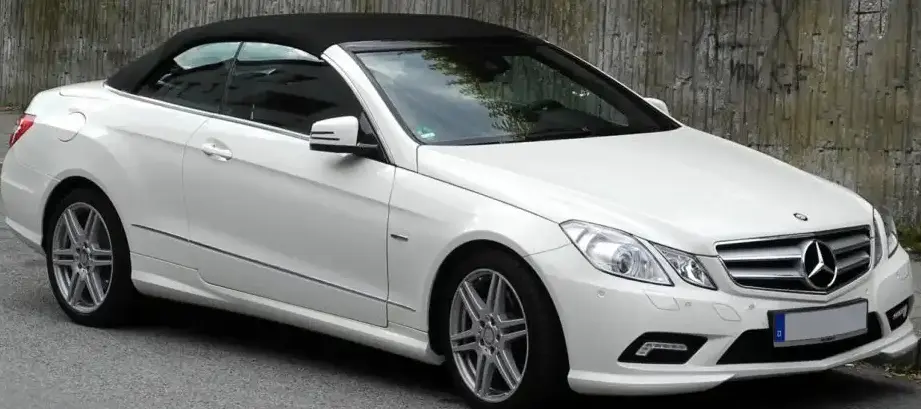
| Generation | E-Class Cabrio (A207) |
| Type (Engine) | E 250 CDI BlueEFFICIENCY (204 Hp) |
| Start of production | March, 2010 |
| End of production | April, 2011 |
| Powertrain Architecture | Internal Combustion engine |
| Body type | Cabriolet |
| Seats | 4 |
| Doors | 2 |
| Fuel consumption (urban) | 7.3-7.4 l/100 km (32.2 – 31.8 US mpg) |
| Fuel consumption (extra urban) | 4.7-4.9 l/100 km (50 – 48 US mpg) |
| Fuel consumption (combined) | 5.6-5.8 l/100 km (42 – 40.6 US mpg) |
| CO2 emissions | 148-153 g/km |
| Fuel Type | Diesel |
| Acceleration 0 – 100 km/h | 7.8 sec |
| Acceleration 0 – 62 mph | 7.8 sec |
| Acceleration 0 – 60 mph | 7.4 sec |
| Maximum speed | 245 km/h (152.24 mph) |
| Emission standard | Euro 5 |
| Weight-to-power ratio | 8.5 kg/Hp |
| Weight-to-torque ratio | 3.5 kg/Nm |
| Power | 204 Hp @ 4200 rpm |
| Torque | 500 Nm @ 1600-1800 rpm (368.78 lb.-ft. @ 1600-1800 rpm) |
| Engine layout | Front, Longitudinal |
| Engine Model/Code | OM 651.911 |
| Engine displacement | 2143 cm3 (130.77 cu. in.) |
| Number of cylinders | 4 |
| Engine configuration | Inline |
| Cylinder Bore | 83 mm (3.27 in.) |
| Piston Stroke | 99 mm (3.9 in.) |
| Compression ratio | 16.2:1 |
| Number of valves per cylinder | 4 |
| Fuel injection system | Diesel Commonrail |
| Engine aspiration | BiTurbo, Intercooler |
| Valvetrain | DOHC |
| Engine oil capacity | 6.5 l (6.87 US qt | 5.72 UK qt) |
| Kerb Weight | 1740 kg (3836.04 lbs.) |
| Max. weight | 2285 kg (5037.56 lbs.) |
| Max load | 545 kg (1201.52 lbs.) |
| Trunk (boot) space – minimum | 300 l (10.59 cu. ft.) |
| Trunk (boot) space – maximum | 390 l (13.77 cu. ft.) |
| Fuel tank capacity | 66 l (17.44 US gal | 14.52 UK gal) |
| Permitted trailer load with brakes (12%) | 1800 kg (3968.32 lbs.) |
| Permitted trailer load without brakes | 750 kg (1653.47 lbs.) |
| Permitted towbar download | 75 kg (165.35 lbs.) |
| Length | 4698 mm (184.96 in.) |
| Width | 1786 mm (70.31 in.) |
| Width including mirrors | 2015 mm (79.33 in.) |
| Height | 1398 mm (55.04 in.) |
| Wheelbase | 2760 mm (108.66 in.) |
| Front track | 1538 mm (60.55 in.) |
| Rear track | 1544 mm (60.79 in.) |
| Front overhang | 855 mm (33.66 in.) |
| Rear overhang | 1083 mm (42.64 in.) |
| Drag coefficient (Cd) | 0.29 |
| Minimum turning circle | 11 m (36.09 ft.) |
| Drivetrain | Rear wheel drive |
| Number of gears | 6 gears, manual transmission |
| Front suspension | Coil spring, Independent multi-link suspension, Transverse stabilizer |
| Rear suspension | Independent multi-link spring suspension with stabilizer |
| Front brakes | Ventilated discs, 295 mm |
| Rear brakes | Disc, 300 mm |
| Assisting systems | ABS (Anti-lock braking system) |
| Steering type | Steering rack and pinion |
| Power steering | Hydraulic Steering |
| Front tires | 235/45 R17; 235/40 R18; 235/35 R19 |
| Rear tires | 235/45 R17; 255/40 R17; 255/35 R18; 255/30 R19 |
| Front wheel rims | 7.5J x 17; 8J x 18; 8J x 19; 8.5J x 19 |
| Rear wheel rims | 7.5J x 17; 8.5J x 17; 8.5J x 18; 8.5J x 19 |
The Mercedes-Benz E 250 CDI BlueEFFICIENCY Cabriolet was introduced as part of the A207 E-Class Cabriolet facelift in March 2010, remaining in production until April 2011. Built on the W207 platform, it aimed to provide a more economical and environmentally friendly option within the luxury convertible segment. The “BlueEFFICIENCY” designation signified Mercedes-Benz’s efforts to improve fuel economy through various technologies. This variant occupied a middle ground in the Cabriolet lineup, offering a balance between performance and running costs, appealing to buyers who prioritized efficiency without sacrificing the prestige of the E-Class brand. It was positioned below the more powerful E 350 and E 500 models.
Powertrain & Engine Architecture
The E 250 CDI BlueEFFICIENCY was powered by the OM651.911 2.1-liter inline-four diesel engine. This engine was a cornerstone of Mercedes-Benz’s diesel offerings, known for its robust construction and efficiency. The OM651 featured a common rail direct injection system, delivering fuel at extremely high pressures for optimized combustion. A sophisticated bi-turbocharger system, utilizing a small and a large turbocharger, minimized turbo lag and provided a broad torque curve. The engine also incorporated a diesel particulate filter (DPF) to reduce emissions, complying with Euro 5 standards. The engine produced 204 horsepower at 4200 rpm and a substantial 368 lb-ft of torque between 1600 and 1800 rpm. The standard transmission was a 6-speed manual gearbox, offering precise control and contributing to the car’s fuel efficiency. While an automatic transmission was available as an option on other E-Class models, the E 250 CDI was primarily offered with the manual.
Driving Characteristics
The E 250 CDI Cabriolet offered a surprisingly refined driving experience. While not as overtly sporty as its gasoline-powered siblings, the abundant torque from the diesel engine provided strong acceleration, particularly in the mid-range. The 0-60 mph sprint took approximately 7.4 seconds, and the car could reach a top speed of 152 mph. The manual transmission allowed for engaging gear changes, and the well-tuned suspension provided a comfortable ride, even on less-than-perfect road surfaces. The gear ratios were optimized for fuel efficiency, with taller gearing in higher gears to reduce engine speed at cruising speeds. Compared to the E 350 Cabriolet, the E 250 CDI offered less outright power, but its superior torque made it feel responsive in everyday driving situations. The manual transmission, while engaging, required more driver involvement than the optional automatic found in other E-Class models.
Equipment & Trim Levels
The E 250 CDI BlueEFFICIENCY Cabriolet came standard with a comprehensive array of features befitting a luxury vehicle. These included leather upholstery, automatic climate control, a premium audio system, and power-adjustable seats. Standard safety features included ABS, traction control, and multiple airbags. Optional extras included a wind deflector (to reduce wind buffeting with the top down), a navigation system, heated seats, and a panoramic sunroof. Interior trim options allowed for personalization, with a range of wood and aluminum finishes available. The dashboard layout was typical of the A207 E-Class, featuring a clean and elegant design with intuitive controls.
Chassis & Braking
The A207 E-Class Cabriolet utilized a robust chassis designed to provide both rigidity and comfort. The front suspension featured a multi-link independent setup with a transverse stabilizer bar, while the rear suspension employed a similar multi-link design. This configuration minimized body roll and provided a stable platform for handling. The braking system consisted of ventilated discs at the front and solid discs at the rear, providing ample stopping power. ABS (Anti-lock Braking System) was standard, enhancing safety in emergency braking situations. The steering was a hydraulic rack-and-pinion system, offering precise and responsive control.
Market Reception & Comparison
The E 250 CDI BlueEFFICIENCY Cabriolet was generally well-received by automotive critics. It was praised for its fuel efficiency, comfortable ride, and refined engine. However, some reviewers noted that the diesel engine lacked the sporty character of the gasoline alternatives. Compared to the E 350 Cabriolet, the E 250 CDI offered significantly better fuel economy – around 42 mpg combined versus 28 mpg for the E 350 – but with a noticeable reduction in horsepower. The E 250 CDI appealed to buyers who prioritized economy and long-distance comfort, while the E 350 catered to those seeking a more performance-oriented driving experience. Reliability reports suggest the OM651 engine is generally robust, but the DPF system can require maintenance over time.
Legacy
The E 250 CDI BlueEFFICIENCY Cabriolet represents a significant chapter in Mercedes-Benz’s diesel history. The OM651 engine proved to be a durable and efficient powerplant, and the A207 E-Class Cabriolet remains a desirable used car today. The combination of luxury, fuel economy, and open-top driving enjoyment continues to appeal to a wide range of buyers. While diesel vehicles have faced increased scrutiny in recent years due to emissions concerns, the E 250 CDI, when properly maintained, offers a compelling blend of attributes that make it a worthwhile consideration in the used car market. The availability of parts and a relatively strong owner community contribute to its continued appeal.