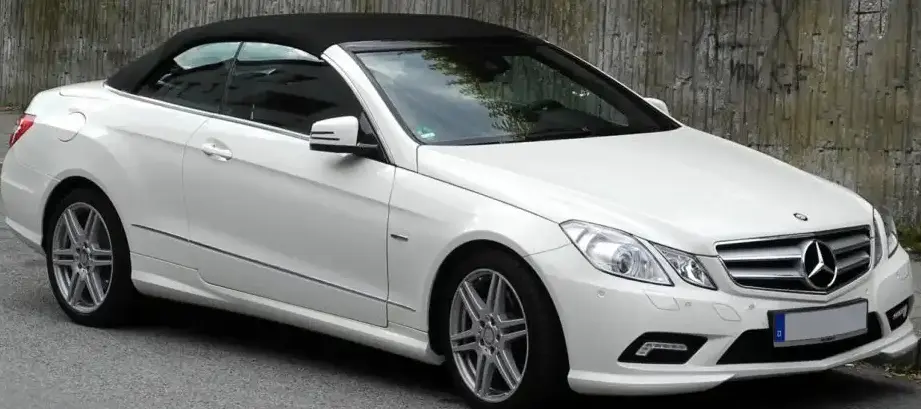
The Mercedes-Benz E-Class Cabriolet (A207) E 350 CDI BlueEFFICIENCY, produced from March 2010 to April 2011, represented a compelling blend of luxury, performance, and fuel efficiency within the E-Class convertible range. Positioned as a mid-to-upper tier offering, it catered to buyers seeking a refined open-top experience with the added benefit of a diesel powertrain. This variant utilized the advanced 7G-TRONIC automatic transmission and was part of the A207 generation, which benefited from updates to the preceding W207 coupe and sedan models. It was designed to appeal to a market increasingly focused on both driving pleasure and reduced environmental impact.
Technical Specifications
| Brand | Mercedes-Benz |
| Model | E-Class |
| Generation | E-Class Cabrio (A207) |
| Type (Engine) | E 350 CDI BlueEFFICIENCY V6 (231 Hp) 7G-TRONIC |
| Start of production | March, 2010 |
| End of production | April, 2011 |
| Powertrain Architecture | Internal Combustion engine |
| Body type | Cabriolet |
| Seats | 4 |
| Doors | 2 |
| Fuel consumption (economy) – urban (NEDC) | 9.1 l/100 km (25.8 US mpg, 31 UK mpg, 11 km/l) |
| Fuel consumption (economy) – extra urban (NEDC) | 5.9-6.1 l/100 km (39.9 – 38.6 US mpg, 47.9 – 46.3 UK mpg, 16.9 – 16.4 km/l) |
| Fuel consumption (economy) – combined (NEDC) | 7-7.2 l/100 km (33.6 – 32.7 US mpg, 40.4 – 39.2 UK mpg, 14.3 – 13.9 km/l) |
| CO2 emissions (NEDC) | 185-189 g/km |
| Fuel Type | Diesel |
| Acceleration 0 – 100 km/h | 6.9 sec |
| Acceleration 0 – 62 mph | 6.9 sec |
| Acceleration 0 – 60 mph | 6.6 sec |
| Maximum speed | 250 km/h (155.34 mph) – Electronically limited |
| Emission standard | Euro 5 |
| Weight-to-power ratio | 7.7 kg/Hp, 130.5 Hp/tonne |
| Weight-to-torque ratio | 3.3 kg/Nm, 305.1 Nm/tonne |
| Power | 231 Hp @ 3800 rpm |
| Torque | 540 Nm @ 1600-2400 rpm (398.28 lb.-ft. @ 1600-2400 rpm) |
| Engine layout | Front, Longitudinal |
| Engine Model/Code | OM 642.836 |
| Engine displacement | 2987 cm3 (182.28 cu. in.) |
| Number of cylinders | 6 |
| Engine configuration | V-engine |
| Cylinder Bore | 83 mm (3.27 in.) |
| Piston Stroke | 92 mm (3.62 in.) |
| Compression ratio | 15.5:1 |
| Number of valves per cylinder | 4 |
| Fuel injection system | Diesel Commonrail |
| Engine aspiration | Turbocharger, Intercooler |
| Valvetrain | DOHC |
| Engine oil capacity | 8 l (8.45 US qt | 7.04 UK qt) |
| Kerb Weight | 1770 kg (3902.18 lbs.) |
| Max. weight | 2295 kg (5059.61 lbs.) |
| Max load | 525 kg (1157.43 lbs.) |
| Trunk (boot) space – minimum | 300 l (10.59 cu. ft.) |
| Trunk (boot) space – maximum | 390 l (13.77 cu. ft.) |
| Fuel tank capacity | 66 l (17.44 US gal | 14.52 UK gal) |
| Permitted trailer load with brakes (12%) | 1800 kg (3968.32 lbs.) |
| Permitted trailer load without brakes | 750 kg (1653.47 lbs.) |
| Permitted towbar download | 75 kg (165.35 lbs.) |
| Length | 4698 mm (184.96 in.) |
| Width | 1786 mm (70.31 in.) |
| Width including mirrors | 2015 mm (79.33 in.) |
| Height | 1398 mm (55.04 in.) |
| Wheelbase | 2760 mm (108.66 in.) |
| Front track | 1538 mm (60.55 in.) |
| Rear (Back) track | 1544 mm (60.79 in.) |
| Front overhang | 855 mm (33.66 in.) |
| Rear overhang | 1083 mm (42.64 in.) |
| Drag coefficient (Cd) | 0.29 |
| Minimum turning circle (turning diameter) | 11 m (36.09 ft.) |
| Drivetrain Architecture | The Internal combustion engine (ICE) drives the rear wheels of the vehicle. |
| Drive wheel | Rear wheel drive |
| Number of gears and type of gearbox | 7 gears, automatic transmission G-TRONIC |
| Front suspension | Coil spring, Independent multi-link suspension, Transverse stabilizer |
| Rear suspension | Independent multi-link spring suspension with stabilizer |
| Front brakes | Ventilated discs, 322 mm |
| Rear brakes | Ventilated discs, 300 mm |
| Assisting systems | ABS (Anti-lock braking system) |
| Steering type | Steering rack and pinion |
| Power steering | Hydraulic Steering |
| Tires size | Front wheel tires: 235/45 R17; 235/40 R18; 235/35 R19Rear wheel tires: 235/45 R17; 255/40 R17; 255/35 R18; 255/30 R19 |
| Wheel rims size | Front wheel rims: 7.5J x 17; 8J x 18; 8J x 19; 8.5J x 19Rear wheel rims: 7.5J x 17; 8.5J x 17; 8.5J x 18; 8.5J x 19 |
Powertrain & Engine Architecture
The heart of the E 350 CDI BlueEFFICIENCY Cabriolet was the OM 642.836 3.0-liter V6 diesel engine. This engine was a cornerstone of Mercedes-Benz’s diesel offerings, known for its robust construction and refined operation. It featured a common rail direct injection system, delivering fuel at extremely high pressures for optimized combustion. The engine employed a variable geometry turbocharger (VGT) and an intercooler to maximize power and torque while maintaining efficiency. The DOHC valvetrain, with four valves per cylinder, further enhanced breathing and performance. The 7G-TRONIC automatic transmission, a seven-speed unit, was specifically tuned to complement the engine’s torque characteristics. This transmission offered smooth and responsive shifts, contributing to both driving comfort and fuel economy. The transmission’s gear ratios were optimized for both acceleration and highway cruising.
Driving Characteristics
The E 350 CDI BlueEFFICIENCY Cabriolet provided a relaxed and refined driving experience. The 540 Nm (398 lb-ft) of torque, available from a low 1600 rpm, provided strong acceleration in everyday driving situations. While not as overtly sporty as some of its gasoline-powered siblings, the diesel offered ample power for confident overtaking and effortless cruising. The 7G-TRONIC transmission contributed to a seamless power delivery, minimizing shift shock and maximizing efficiency. Compared to the E 350 gasoline variant, the CDI offered superior fuel economy and a broader torque curve, making it a more practical choice for long-distance travel. However, it lacked the higher-revving excitement of the gasoline engine. Compared to the E 250 CDI, the E 350 CDI offered a noticeable performance upgrade, justifying its higher price point.
Equipment & Trim Levels
The E 350 CDI BlueEFFICIENCY Cabriolet came standard with a comprehensive array of luxury features. These included leather upholstery, automatic climate control, a premium sound system, and power-adjustable seats. Standard safety features included ABS, ESP, and multiple airbags. Optional extras included features like the AIRCAP system (reducing turbulence in the cabin at higher speeds), the AIRSCARF system (neck-level heating), and various driver assistance systems such as adaptive cruise control and lane keeping assist. Interior trim options included a variety of wood and aluminum finishes, allowing buyers to personalize their vehicle. The dashboard layout was typical of the A207 E-Class, with a focus on elegant design and intuitive controls.
Chassis & Braking
The A207 E-Class Cabriolet featured a robust chassis designed to provide both comfort and handling. The front suspension utilized a multi-link setup with coil springs and a transverse stabilizer bar, while the rear suspension employed an independent multi-link spring suspension with a stabilizer bar. This configuration provided a comfortable ride while minimizing body roll during cornering. The braking system consisted of ventilated discs on all four wheels, providing ample stopping power. ABS (Anti-lock Braking System) was standard, enhancing safety in emergency braking situations. The steering was a rack-and-pinion system with hydraulic power assistance, offering precise and responsive steering feel.
Market Reception & Comparison
The E 350 CDI BlueEFFICIENCY Cabriolet was generally well-received by automotive critics. It was praised for its refined engine, comfortable ride, and luxurious interior. The diesel engine’s fuel efficiency was a significant selling point, particularly in Europe where diesel fuel was more prevalent and often less expensive than gasoline. Compared to the E 350 gasoline variant, the CDI offered better fuel economy but slightly less outright performance. The E 350 CDI was positioned above the E 250 CDI in terms of price and performance, appealing to buyers who prioritized refinement and power. Reliability reports generally indicated good long-term reliability, although diesel particulate filter (DPF) maintenance was a consideration.
Legacy
The OM 642 engine family, including the OM 642.836 found in the E 350 CDI, has proven to be remarkably durable. Properly maintained examples continue to provide reliable service today. The 7G-TRONIC transmission is also known for its longevity. In the used car market, the E 350 CDI Cabriolet represents a compelling value proposition, offering a luxurious and well-equipped convertible at a relatively affordable price. However, potential buyers should be aware of the potential maintenance costs associated with diesel engines, particularly the DPF and fuel injection system. The A207 E-Class Cabriolet, and specifically the E 350 CDI variant, remains a desirable choice for those seeking a sophisticated and fuel-efficient open-top driving experience.