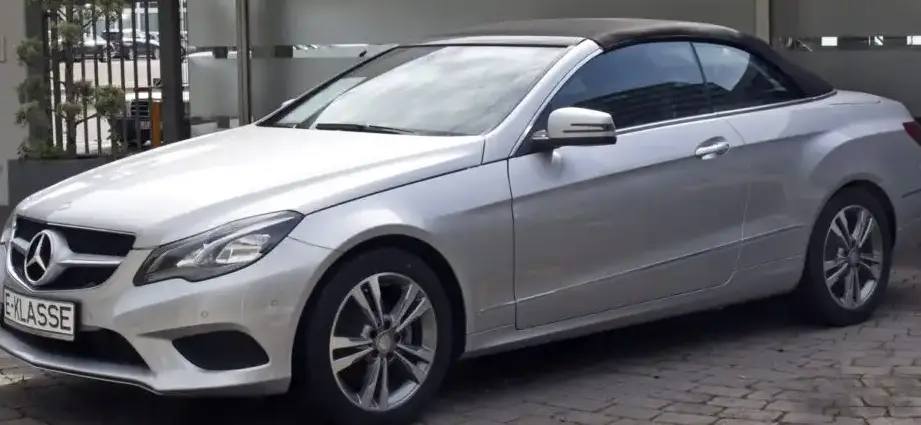
The Mercedes-Benz E-Class Cabriolet (A207) facelift, produced from 2013 to 2016, represented a sophisticated blend of luxury, performance, and open-air driving enjoyment. The E 320 V6 variant, equipped with the 7G-TRONIC PLUS automatic transmission, occupied a strong mid-range position within the lineup, offering a compelling balance between power and efficiency. This model aimed to provide a more refined experience than the base E 250, while remaining more accessible than the high-performance E 550.
Technical Specifications
| Brand | Mercedes-Benz |
| Model | E-Class |
| Generation | E-Class Cabrio (A207, facelift 2013) |
| Type (Engine) | E 320 V6 (272 Hp) 7G-TRONIC PLUS |
| Start of production | 2014 |
| End of production | 2016 |
| Powertrain Architecture | Internal Combustion engine |
| Body type | Cabriolet |
| Seats | 4 |
| Doors | 2 |
| Fuel consumption (urban) | 10.6-11 l/100 km (22.2 – 21.4 US mpg) |
| Fuel consumption (extra urban) | 5.8-6.1 l/100 km (40.6 – 38.6 US mpg) |
| Fuel consumption (combined) | 7.6-7.9 l/100 km (30.9 – 29.8 US mpg) |
| CO2 emissions | 178-185 g/km |
| Fuel Type | Petrol (Gasoline) |
| Acceleration 0 – 100 km/h | 6.9 sec |
| Acceleration 0 – 60 mph | 6.6 sec |
| Maximum speed | 250 km/h (155.34 mph) |
| Emission standard | Euro 6 |
| Weight-to-power ratio | 6.5 kg/Hp |
| Weight-to-torque ratio | 4.4 kg/Nm |
| Power | 272 Hp @ 5000-6000 rpm |
| Torque | 400 Nm @ 1300-4500 rpm (295.02 lb.-ft.) |
| Engine layout | Front, Longitudinal |
| Engine Model/Code | M 276.820 |
| Engine displacement | 2996 cm3 (182.83 cu. in.) |
| Number of cylinders | 6 |
| Engine configuration | V-engine |
| Cylinder Bore | 88 mm (3.46 in.) |
| Piston Stroke | 82.1 mm (3.23 in.) |
| Number of valves per cylinder | 4 |
| Fuel injection system | Direct injection |
| Engine aspiration | BiTurbo, Intercooler |
| Valvetrain | DOHC |
| Engine oil capacity | 6.5 l (6.87 US qt | 5.72 UK qt) |
| Kerb Weight | 1770 kg (3902.18 lbs.) |
| Max. weight | 2315 kg (5103.7 lbs.) |
| Max load | 545 kg (1201.52 lbs.) |
| Trunk (boot) space – minimum | 300 l (10.59 cu. ft.) |
| Trunk (boot) space – maximum | 390 l (13.77 cu. ft.) |
| Fuel tank capacity | 66 l (17.44 US gal | 14.52 UK gal) |
| Permitted trailer load with brakes (12%) | 1800 kg (3968.32 lbs.) |
| Permitted trailer load without brakes | 750 kg (1653.47 lbs.) |
| Permitted towbar download | 75 kg (165.35 lbs.) |
| Length | 4703 mm (185.16 in.) |
| Width | 1786 mm (70.31 in.) |
| Width including mirrors | 2016 mm (79.37 in.) |
| Height | 1398 mm (55.04 in.) |
| Wheelbase | 2760 mm (108.66 in.) |
| Front track | 1538 mm (60.55 in.) |
| Rear track | 1541 mm (60.67 in.) |
| Front overhang | 862 mm (33.94 in.) |
| Rear overhang | 1081 mm (42.56 in.) |
| Minimum turning circle | 11.15 m (36.58 ft.) |
| Drivetrain Architecture | Rear wheel drive |
| Number of gears | 7 |
| Gearbox type | Automatic transmission G-TRONIC PLUS |
| Front suspension | Coil spring, Independent multi-link suspension, Transverse stabilizer |
| Rear suspension | Independent multi-link spring suspension with stabilizer |
| Front brakes | Ventilated discs |
| Rear brakes | Ventilated discs |
| Assisting systems | ABS (Anti-lock braking system) |
| Steering type | Steering rack and pinion |
| Power steering | Electric Steering |
| Front tires | 235/45 R17; 235/40 R18; 235/35 R19 |
| Rear tires | 235/45 R17; 255/35 R18; 255/30 R19 |
| Front wheel rims | 7.5J x 17; 8J x 18; 8J x 19; 8.5J x 19 |
| Rear wheel rims | 7.5J x 17; 8.5J x 18; 8.5J x 19 |
INTRODUCTION
The A207 E-Class Cabriolet, particularly the facelifted models from 2013 onwards, represented Mercedes-Benz’s commitment to luxurious open-top motoring. The E 320 V6, introduced in 2014, was a key variant, positioned as a sweet spot in the range. Built on the W207 platform, it offered a more accessible entry point into the E-Class Cabriolet experience than the more powerful E 550, while still delivering a refined and capable driving experience. It was sold primarily in Europe and other international markets, with limited availability in the United States.
Powertrain & Engine Architecture
At the heart of the E 320 V6 lay the M276.820 3.0-liter V6 engine. This engine was a significant departure from the older naturally aspirated designs, employing twin-turbocharging and direct fuel injection to deliver both power and efficiency. The engine utilized a sophisticated third-generation direct injection system, injecting fuel directly into the combustion chamber for improved atomization and combustion efficiency. The valvetrain featured Dual Overhead Camshafts (DOHC) with four valves per cylinder, optimizing airflow for increased power output. The 7G-TRONIC PLUS automatic transmission, a seven-speed unit, was specifically tuned to complement the engine’s characteristics. This transmission offered smooth and responsive shifts, contributing to both performance and fuel economy. It featured a torque converter lock-up clutch to minimize slippage and improve efficiency at cruising speeds.
Driving Characteristics
The E 320 V6 Cabriolet offered a refined and comfortable driving experience. While not as overtly sporty as some of its competitors, the 272 horsepower and 400 Nm (295 lb-ft) of torque provided ample power for both city driving and highway cruising. The 7G-TRONIC PLUS transmission was well-matched to the engine, providing smooth and seamless gear changes. Acceleration from 0-60 mph was achieved in approximately 6.6 seconds, and the electronically limited top speed of 250 km/h (155 mph) was more than sufficient for most drivers. Compared to the E 250, the E 320 offered a noticeable improvement in performance, particularly in overtaking situations. However, it lacked the outright punch of the E 550. The suspension was tuned for comfort, providing a smooth ride even on less-than-perfect road surfaces. The Cabriolet’s chassis was reinforced to minimize scuttle shake, a common issue in convertible vehicles.
Equipment & Trim Levels
The E 320 V6 Cabriolet came standard with a generous array of features, befitting its luxury positioning. Standard equipment typically included leather upholstery, automatic climate control, a premium sound system, and a power-operated soft top. Optional extras included features such as the AIRMATIC suspension system, which offered adjustable ride height and damping, a panoramic sunroof, and a suite of advanced driver-assistance systems, including lane keeping assist and adaptive cruise control. Interior trim options included various wood veneers and aluminum accents. The standard dashboard configuration featured a central display screen for infotainment and vehicle settings.
Chassis & Braking
The E 320 V6 Cabriolet utilized a sophisticated suspension system designed to provide both comfort and handling. The front suspension featured coil springs and an independent multi-link setup with a transverse stabilizer bar. The rear suspension also employed an independent multi-link design with a stabilizer bar. Braking duties were handled by ventilated discs on all four wheels, providing ample stopping power. The car was equipped with ABS (Anti-lock Braking System) and electronic brake-force distribution to enhance safety and stability. Steering was power-assisted, utilizing an electric steering system for precise and responsive control.
Market Reception & Comparison
The E 320 V6 Cabriolet was generally well-received by automotive critics. It was praised for its refined engine, comfortable ride, and luxurious interior. Critics noted that it offered a good balance between performance and fuel economy, making it a practical choice for everyday driving. Compared to the E 250, the E 320 was considered a worthwhile upgrade for those seeking more power and refinement. However, some critics felt that it lacked the dynamic flair of some of its competitors, such as the BMW 4 Series Convertible. Fuel economy figures were respectable for a vehicle of its size and performance, averaging around 7.6-7.9 l/100 km (30.9-29.8 US mpg) in combined driving.
Legacy
The M276 engine family, including the one found in the E 320 V6, has proven to be relatively reliable, although preventative maintenance is crucial. Common issues include potential oil leaks and occasional problems with the turbochargers. The 7G-TRONIC PLUS transmission is also generally reliable, but regular fluid changes are essential to ensure smooth operation. In the used car market, the E 320 V6 Cabriolet represents a good value proposition for those seeking a luxurious and well-equipped convertible. Its combination of performance, comfort, and style continues to appeal to buyers looking for a sophisticated open-top driving experience.