Technical Specifications
| Brand | Mercedes-Benz |
| Model | E-Class |
| Generation | E-Class Cabrio (A207, facelift 2013) |
| Type (Engine) | E 400 V6 3.5 (333 Hp) 7G-TRONIC PLUS |
| Start of production | July, 2014 |
| End of production | March, 2017 |
| Powertrain Architecture | Internal Combustion engine |
| Body type | Cabriolet |
| Seats | 4 |
| Doors | 2 |
| Fuel consumption (urban) | 9.6-9.7 l/100 km (24.5 – 24.2 US mpg) |
| Fuel consumption (extra urban) | 5.5-5.7 l/100 km (42.8 – 41.3 US mpg) |
| Fuel consumption (combined) | 7.1-7.2 l/100 km (33.1 – 32.7 US mpg) |
| CO2 emissions | 164-168 g/km |
| Fuel Type | Petrol (Gasoline) |
| Acceleration 0 – 100 km/h | 5.3 sec |
| Acceleration 0 – 62 mph | 5.3 sec |
| Acceleration 0 – 60 mph | 5 sec |
| Maximum speed | 250 km/h (155.34 mph) – Electronically limited |
| Emission standard | Euro 6 |
| Weight-to-power ratio | 5.3 kg/Hp |
| Weight-to-torque ratio | 3.7 kg/Nm |
| Power | 333 Hp @ 5500 rpm |
| Torque | 480 Nm @ 1200-4000 rpm (354.03 lb.-ft. @ 1200-4000 rpm) |
| Engine layout | Front, Longitudinal |
| Engine Model/Code | M 276.850 |
| Engine displacement | 3498 cm3 (213.46 cu. in.) |
| Number of cylinders | 6 |
| Engine configuration | V-engine |
| Cylinder Bore | 92.9 mm (3.66 in.) |
| Piston Stroke | 86 mm (3.39 in.) |
| Number of valves per cylinder | 4 |
| Fuel injection system | Direct injection |
| Engine aspiration | BiTurbo, Intercooler |
| Valvetrain | DOHC |
| Engine oil capacity | 6.5 l (6.87 US qt | 5.72 UK qt) |
| Coolant capacity | 10.3 l (10.88 US qt | 9.06 UK qt) |
| Kerb Weight | 1770 kg (3902.18 lbs.) |
| Max. weight | 2315 kg (5103.7 lbs.) |
| Max load | 545 kg (1201.52 lbs.) |
| Trunk (boot) space – minimum | 300 l (10.59 cu. ft.) |
| Trunk (boot) space – maximum | 390 l (13.77 cu. ft.) |
| Fuel tank capacity | 66 l (17.44 US gal | 14.52 UK gal) |
| Permitted trailer load with brakes (12%) | 1800 kg (3968.32 lbs.) |
| Permitted trailer load without brakes | 750 kg (1653.47 lbs.) |
| Permitted towbar download | 75 kg (165.35 lbs.) |
| Length | 4703 mm (185.16 in.) |
| Width | 1786 mm (70.31 in.) |
| Width including mirrors | 2016 mm (79.37 in.) |
| Height | 1398 mm (55.04 in.) |
| Wheelbase | 2760 mm (108.66 in.) |
| Front track | 1538 mm (60.55 in.) |
| Rear track | 1541 mm (60.67 in.) |
| Front overhang | 862 mm (33.94 in.) |
| Rear overhang | 1081 mm (42.56 in.) |
| Minimum turning circle | 11.15 m (36.58 ft.) |
| Drive wheel | Rear wheel drive |
| Number of gears | 7 |
| Gearbox type | Automatic transmission G-TRONIC PLUS |
| Front suspension | Coil spring, Independent multi-link suspension, Transverse stabilizer |
| Rear suspension | Independent multi-link spring suspension with stabilizer |
| Front brakes | Ventilated discs |
| Rear brakes | Ventilated discs |
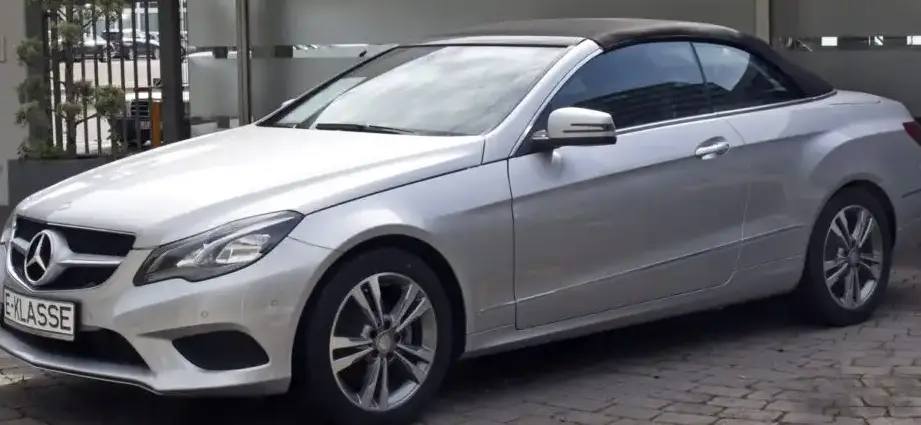
The Mercedes-Benz E-Class Cabriolet (A207) facelift, specifically the E 400 V6 3.5 (333 hp) variant paired with the 7G-TRONIC PLUS automatic transmission, was produced from July 2014 to March 2017. This model represented a high-performance offering within the A207 Cabriolet range, positioned as a luxurious and capable open-top grand tourer. It benefited from the mid-cycle refresh of the A207 generation, incorporating updated styling, technology, and engine options. The E 400 served as a step up from the E 350, offering significantly more power and a more refined driving experience, while remaining below the more exclusive and performance-focused AMG models. It was designed to appeal to buyers who wanted a blend of luxury, performance, and open-air driving enjoyment.
Powertrain & Engine Architecture
The heart of the E 400 Cabriolet is the M276.850 3.5-liter V6 engine. This engine is a naturally aspirated powerplant featuring direct fuel injection and twin turbochargers. The M276 engine family is known for its smooth power delivery and relatively high efficiency. The engine utilizes a double overhead camshaft (DOHC) valvetrain with four valves per cylinder, optimizing airflow for increased performance. The 7G-TRONIC PLUS automatic transmission, a seven-speed unit, was specifically tuned to complement the engine’s characteristics. This transmission offered smooth and responsive shifts, contributing to both performance and fuel economy. The transmission features a torque converter lock-up clutch to improve efficiency at cruising speeds. Mercedes-Benz engineers focused on reducing internal friction within the transmission to further enhance fuel economy and responsiveness.
Driving Characteristics
The E 400 Cabriolet offered a compelling blend of performance and comfort. The 333 hp and 354 lb-ft of torque provided brisk acceleration, with a 0-60 mph time of around 5 seconds. The 7G-TRONIC PLUS transmission was well-matched to the engine, providing seamless gear changes and allowing the driver to enjoy the V6’s power without interruption. Compared to the E 350 Cabriolet, the E 400 offered a noticeable increase in power and responsiveness. While not as overtly sporty as the AMG variants, the E 400 provided ample power for spirited driving and comfortable highway cruising. The rear-wheel-drive configuration contributed to a balanced feel, although traction could be a concern in wet conditions. The transmission’s gear ratios were optimized for both acceleration and fuel efficiency, providing a comfortable driving experience in a variety of conditions.
Equipment & Trim Levels
The E 400 Cabriolet typically came well-equipped as standard. Features included leather upholstery, automatic climate control, a premium sound system, and a power-operated soft top. Optional extras included features like the Airscarf system (neck-level heating), massaging seats, a panoramic sunroof, and advanced driver-assistance systems such as lane keeping assist and adaptive cruise control. Interior trim options varied, allowing buyers to personalize the cabin with different wood veneers and metallic accents. The standard dashboard configuration featured a high-resolution infotainment screen and analog gauges, reflecting Mercedes-Benz’s commitment to both technology and traditional luxury. The E 400 often included larger diameter wheels and upgraded brake calipers compared to the base E 350 model.
Chassis & Braking
The A207 Cabriolet chassis featured a multi-link suspension system at both the front and rear, providing a comfortable ride and good handling characteristics. The front suspension utilized coil springs and a transverse stabilizer bar, while the rear suspension employed a similar setup. The E 400 was equipped with ventilated disc brakes on all four wheels, providing ample stopping power. Anti-lock braking system (ABS) and electronic stability control (ESC) were standard features, enhancing safety and control. The steering system was a rack-and-pinion setup with electric power steering, offering precise and responsive steering feel. The Cabriolet models received specific chassis tuning to compensate for the lack of a fixed roof, enhancing rigidity and minimizing body flex.
Market Reception & Comparison
The E 400 Cabriolet was generally well-received by automotive critics. It was praised for its powerful engine, comfortable ride, and luxurious interior. Compared to competitors like the BMW 4 Series Convertible and Audi A5 Cabriolet, the E 400 offered a more refined and luxurious experience. Fuel economy was respectable for a vehicle of its size and performance, with combined fuel consumption figures around 33 mpg. Reliability was generally good, although some owners reported minor issues with the electronic systems. The E 400 offered a compelling alternative to the more expensive AMG models, providing a significant performance upgrade over the base E 350 without the higher price tag. Many reviewers noted the E 400’s ability to provide a comfortable and engaging driving experience, making it a strong contender in the luxury convertible segment.
Legacy
The M276 engine family, including the 3.5-liter variant found in the E 400 Cabriolet, has proven to be relatively reliable over the long term. While regular maintenance is essential, these engines are not known for any major inherent flaws. The 7G-TRONIC PLUS transmission is also generally durable, although fluid changes are crucial for maintaining its performance. Today, the E 400 Cabriolet represents a desirable used car option for those seeking a luxurious and capable open-top grand tourer. Its combination of performance, comfort, and style continues to appeal to enthusiasts and buyers looking for a refined driving experience. Well-maintained examples of the E 400 Cabriolet command a premium in the used car market, reflecting their desirable combination of features and performance.