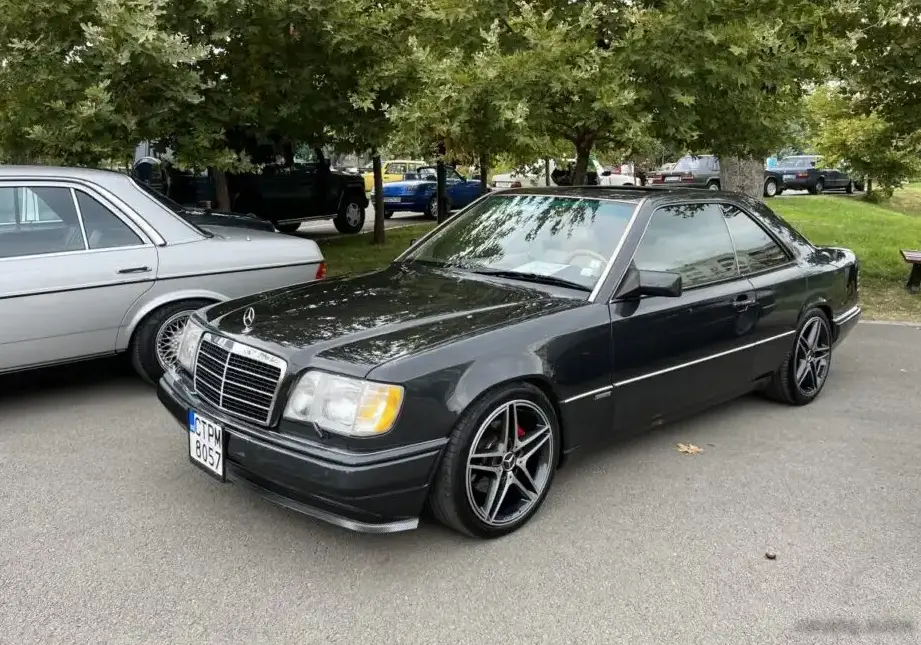
The Mercedes-Benz E 200 Coupe (C124) with the automatic transmission, produced between July 1993 and March 1996, represented a compelling entry point into the luxurious C124 coupe range. Positioned as a more accessible alternative to the higher-performance E 320 and E 280 models, the E 200 offered a blend of Mercedes-Benz refinement, comfortable cruising, and reasonable running costs. It was primarily aimed at buyers seeking a stylish coupe without the expense or sporting focus of its more powerful siblings. The C124 platform itself was a significant evolution of the W123 series, introducing independent suspension on all four wheels and a more modern, aerodynamic design.
Technical Specifications
| Brand | Mercedes-Benz |
| Model | E-class |
| Generation | E-class Coupe (C124) |
| Type (Engine) | E 200 (136 Hp) Automatic |
| Start of production | July, 1993 |
| End of production | March, 1996 |
| Powertrain Architecture | Internal Combustion engine |
| Body type | Coupe |
| Seats | 4 |
| Doors | 2 |
| Fuel consumption (urban) | 11.4 l/100 km (20.6 US mpg) |
| Fuel consumption (extra urban) | 8.6 l/100 km (27.4 US mpg) |
| Fuel Type | Petrol (Gasoline) |
| Acceleration 0 – 100 km/h | 12 sec |
| Acceleration 0 – 62 mph | 12 sec |
| Acceleration 0 – 60 mph | 11.4 sec |
| Maximum speed | 195 km/h (121.17 mph) |
| Weight-to-power ratio | 10.1 kg/Hp |
| Weight-to-torque ratio | 7.3 kg/Nm |
| Power | 136 Hp @ 5500 rpm |
| Power per litre | 68.1 Hp/l |
| Torque | 190 Nm @ 4000 rpm (140.14 lb.-ft. @ 4000 rpm) |
| Engine layout | Front, Longitudinal |
| Engine Model/Code | M 111 E 20 / 111.940 |
| Engine displacement | 1998 cm3 (121.93 cu. in.) |
| Number of cylinders | 4 |
| Engine configuration | Inline |
| Cylinder Bore | 89.9 mm (3.54 in.) |
| Piston Stroke | 78.7 mm (3.1 in.) |
| Compression ratio | 9.6:1 |
| Number of valves per cylinder | 4 |
| Fuel injection system | Multi-port manifold injection |
| Engine aspiration | Naturally aspirated engine |
| Valvetrain | DOHC |
| Engine oil capacity | 5.5 l (5.81 US qt | 4.84 UK qt) |
| Coolant | 8.5 l (8.98 US qt | 7.48 UK qt) |
| Kerb Weight | 1380 kg (3042.38 lbs.) |
| Max. weight | 1900 kg (4188.78 lbs.) |
| Max load | 520 kg (1146.4 lbs.) |
| Trunk (boot) space – minimum | 480 l (16.95 cu. ft.) |
| Fuel tank capacity | 70 l (18.49 US gal | 15.4 UK gal) |
| Length | 4655 mm (183.27 in.) |
| Width | 1740 mm (68.5 in.) |
| Height | 1395 mm (54.92 in.) |
| Wheelbase | 2715 mm (106.89 in.) |
| Front track | 1501 mm (59.09 in.) |
| Rear (Back) track | 1491 mm (58.7 in.) |
| Drivetrain Architecture | The Internal combustion engine (ICE) drives the rear wheels of the vehicle. |
| Drive wheel | Rear wheel drive |
| Number of gears and type of gearbox | 4 gears, automatic transmission |
| Front suspension | Wishbone |
| Rear suspension | Independent multi-link suspension |
| Front brakes | Ventilated discs |
| Rear brakes | Disc |
| Assisting systems | ABS (Anti-lock braking system) |
| Steering type | Cone worm with recirculation balls |
| Power steering | Hydraulic Steering |
| Tires size | Front wheel tires: 195/65 R15; 205/60 R15Rear wheel tires: 195/65 R15; 205/60 R15 |
| Wheel rims size | Front wheel rims: 6.5J x 15; 7J x 15Rear wheel rims: 6.5J x 15; 7J x 15 |
Powertrain & Engine Architecture
The heart of the E 200 was the M111 E 20 engine, a 1.998-liter inline-four cylinder powerplant. This engine was a significant departure from the older CIS (Continuous Injection System) fuel injection found in earlier Mercedes-Benz models, utilizing a Bosch multi-port fuel injection system. This resulted in improved fuel efficiency and smoother operation. The engine featured a double overhead camshaft (DOHC) valvetrain with four valves per cylinder, contributing to its respectable power output for its displacement. The compression ratio was set at 9.6:1. The automatic transmission was a four-speed unit, designed for smooth and comfortable shifts. While not particularly sporty, it was well-suited to the E 200’s intended role as a grand tourer.
Driving Characteristics
The E 200 Automatic offered a relaxed and refined driving experience. With 136 horsepower and 190 Nm (140 lb-ft) of torque, acceleration was adequate but not brisk. The 0-60 mph time of around 11.4 seconds reflects this. The automatic transmission, while smooth, did contribute to some power loss compared to the available five-speed manual. Gear ratios were optimized for comfortable cruising rather than outright performance. The E 200 excelled at highway driving, offering a quiet and composed ride. Compared to the E 280 or E 320, the E 200 felt noticeably less powerful, but it also offered better fuel economy and a lower purchase price.
Equipment & Trim Levels
The E 200 Coupe typically came standard with features expected of a luxury vehicle of its time, including power windows, central locking, and a high-quality audio system. Interior upholstery was typically cloth, although leather was available as an option. Standard dashboard configuration featured wood trim and analog gauges. Optional extras included a sunroof, automatic climate control, and upgraded sound systems. The level of equipment could vary depending on the specific market and individual customer preferences.
Chassis & Braking
The C124 chassis was a significant advancement over its predecessor, featuring independent suspension at all four wheels. The front suspension utilized wishbones, while the rear employed a multi-link setup. This provided a comfortable ride and good handling characteristics. The E 200 was equipped with ventilated disc brakes at the front and solid discs at the rear. Anti-lock braking system (ABS) was standard, enhancing safety. Stabilizer bars were fitted front and rear to reduce body roll during cornering.
Market Reception & Comparison
The E 200 Coupe was generally well-received by critics as a stylish and comfortable entry-level coupe. It was praised for its build quality, refinement, and fuel efficiency. However, some reviewers noted that its performance was somewhat underwhelming compared to its more powerful siblings. In terms of fuel economy, the E 200 offered a noticeable improvement over the E 280 and E 320. Reliability was generally good, although maintenance costs could be higher than those of more mainstream brands. The E 200 provided a compelling alternative for buyers who prioritized comfort and style over outright performance.
Legacy
The M111 engine, in its various iterations, proved to be a durable and reliable powerplant. The E 200 Coupe, while not the most sought-after C124 variant, has developed a following among enthusiasts who appreciate its classic Mercedes-Benz styling and comfortable driving experience. Today, well-maintained examples are becoming increasingly collectible. The automatic transmission, while not known for its sportiness, has proven to be relatively reliable with proper servicing. The C124 platform as a whole is regarded as one of Mercedes-Benz’s most robust and over-engineered designs, ensuring that many examples continue to provide years of reliable service.