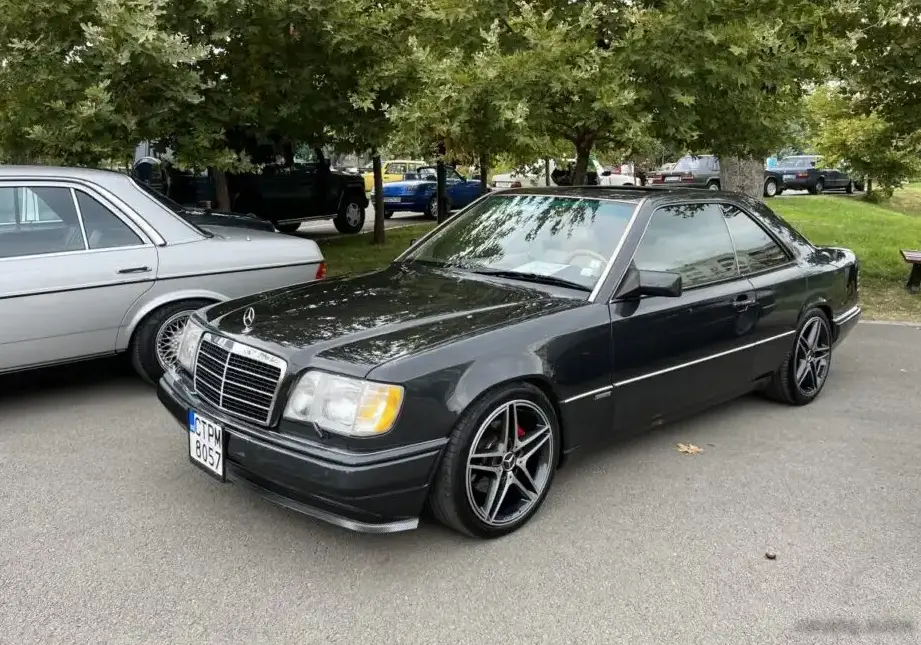
The Mercedes-Benz E 220 Coupe (C124) represents a refined and elegant offering from the German automaker, produced between July 1993 and March 1996. Positioned as a mid-range variant within the C124 coupe lineup, it bridged the gap between the more economical E 200 and the performance-oriented E 320. The C124 generation, launched in 1985, was a significant evolution of the W123 series, offering increased refinement, improved technology, and a more contemporary design. The E 220 Coupe specifically targeted buyers seeking a balance of luxury, performance, and fuel efficiency in a stylish two-door package. It was primarily sold in European markets, where coupes held a stronger appeal than in North America.
Technical Specifications
| Brand | Mercedes-Benz |
| Model | E-class |
| Generation | E-class Coupe (C124) |
| Type (Engine) | E 220 (150 Hp) |
| Start of production | July, 1993 |
| End of production | March, 1996 |
| Powertrain Architecture | Internal Combustion engine |
| Body type | Coupe |
| Seats | 4 |
| Doors | 2 |
| Fuel consumption (urban) | 12 l/100 km (19.6 US mpg) |
| Fuel consumption (extra urban) | 6.6 l/100 km (35.6 US mpg) |
| Fuel Type | Petrol (Gasoline) |
| Acceleration 0 – 100 km/h | 10.6 sec |
| Acceleration 0 – 62 mph | 10.6 sec |
| Acceleration 0 – 60 mph | 10.1 sec |
| Maximum speed | 210 km/h (130.49 mph) |
| Weight-to-power ratio | 9.3 kg/Hp |
| Weight-to-torque ratio | 6.6 kg/Nm |
| Power | 150 Hp @ 5500 rpm |
| Power per litre | 68.2 Hp/l |
| Torque | 210 Nm @ 4000 rpm (154.89 lb.-ft. @ 4000 rpm) |
| Engine layout | Front, Longitudinal |
| Engine Model/Code | M 111 E 22 / 111.960 |
| Engine displacement | 2199 cm3 (134.19 cu. in.) |
| Number of cylinders | 4 |
| Engine configuration | Inline |
| Cylinder Bore | 89.9 mm (3.54 in.) |
| Piston Stroke | 86.6 mm (3.41 in.) |
| Compression ratio | 10:1 |
| Number of valves per cylinder | 4 |
| Fuel injection system | Multi-port manifold injection |
| Engine aspiration | Naturally aspirated engine |
| Valvetrain | DOHC |
| Engine oil capacity | 5.5 l (5.81 US qt | 4.84 UK qt) |
| Coolant | 8.5 l (8.98 US qt | 7.48 UK qt) |
| Kerb Weight | 1390 kg (3064.43 lbs.) |
| Max. weight | 1910 kg (4210.83 lbs.) |
| Max load | 520 kg (1146.4 lbs.) |
| Trunk (boot) space – minimum | 480 l (16.95 cu. ft.) |
| Fuel tank capacity | 70 l (18.49 US gal | 15.4 UK gal) |
| Length | 4655 mm (183.27 in.) |
| Width | 1740 mm (68.5 in.) |
| Height | 1395 mm (54.92 in.) |
| Wheelbase | 2715 mm (106.89 in.) |
| Front track | 1501 mm (59.09 in.) |
| Rear (Back) track | 1491 mm (58.7 in.) |
| Drivetrain Architecture | The Internal combustion engine (ICE) drives the rear wheels of the vehicle. |
| Drive wheel | Rear wheel drive |
| Number of gears and type of gearbox | 5 gears, manual transmission |
| Front suspension | Wishbone |
| Rear suspension | Independent multi-link suspension |
| Front brakes | Ventilated discs |
| Rear brakes | Disc |
| Assisting systems | ABS (Anti-lock braking system) |
| Steering type | Cone worm with recirculation balls |
| Power steering | Hydraulic Steering |
| Tires size | Front wheel tires: 195/65 R15Rear wheel tires: 195/65 R15 |
| Wheel rims size | Front wheel rims: 6.5J x 15Rear wheel rims: 6.5J x 15 |
Powertrain & Engine Architecture
The E 220 Coupe was powered by the M111 E 22 engine, a 2.2-liter inline-four cylinder gasoline engine. This engine was a significant departure from the older M104 six-cylinder engines used in higher-spec C124 models. The M111 featured a short-stroke design, contributing to its relatively high-revving nature. It employed multi-port fuel injection and a double overhead camshaft (DOHC) valvetrain, enhancing both power and efficiency. The engine code 111.960 specifically denotes this configuration. The 150 horsepower output was achieved at 5500 rpm, while peak torque of 210 Nm (154.89 lb-ft) arrived at 4000 rpm. The engine’s design prioritized refinement and fuel economy over outright performance. The standard transmission was a 5-speed manual, though a 4-speed automatic transmission was also available, impacting acceleration slightly.
Driving Characteristics
The E 220 Coupe, particularly with the manual transmission, offered a reasonably engaging driving experience. While not a sports car, the engine provided adequate power for comfortable cruising and overtaking. The 0-60 mph time of around 10.1 seconds was respectable for the early 1990s. The automatic transmission, while offering convenience, did diminish acceleration and responsiveness. Gear ratios were tuned for fuel efficiency and smooth operation rather than aggressive performance. The rear-wheel-drive layout provided balanced handling, and the independent suspension offered a comfortable ride, typical of Mercedes-Benz vehicles of the era. Compared to the E 320, the E 220 felt noticeably less powerful, but it also offered better fuel economy and lower running costs. The E 200, being the entry-level model, provided even better fuel economy but lacked the E 220’s extra power.
Equipment & Trim Levels
The E 220 Coupe came reasonably well-equipped as standard. Interior features typically included cloth upholstery, power windows, central locking, and an AM/FM radio with cassette player. Leather upholstery, sunroof, automatic climate control, and upgraded sound systems were available as optional extras. The dashboard layout was typical of Mercedes-Benz at the time, featuring a classic analog instrument cluster and a wood trim finish. Trim levels were relatively simple, with options primarily consisting of individual upgrades rather than distinct packages. The focus was on providing a comfortable and luxurious interior environment.
Chassis & Braking
The C124 chassis featured a robust construction, prioritizing safety and durability. The front suspension utilized wishbones, while the rear employed an independent multi-link setup, providing a comfortable and controlled ride. Braking duties were handled by ventilated discs at the front and solid discs at the rear. Anti-lock braking system (ABS) was standard, enhancing safety in emergency braking situations. Steering was via a cone worm and recirculation ball system with hydraulic power assistance. The tires were typically 195/65 R15, providing a good balance of grip and ride comfort.
Market Reception & Comparison
The E 220 Coupe was generally well-received by automotive critics. It was praised for its comfortable ride, refined interior, and build quality. However, some critics noted that the engine lacked the punch of the larger six-cylinder models. Fuel economy was considered good for a vehicle of its size and class. Compared to rivals like the BMW 3 Series Coupe and Audi Coupe, the E 220 offered a more luxurious and comfortable experience, but perhaps lacked the same level of sporting agility. In terms of reliability, the M111 engine proved to be a durable unit, though regular maintenance was essential.
Legacy
The Mercedes-Benz E 220 Coupe (C124) has become a sought-after classic among enthusiasts. The M111 engine, while not the most powerful, is known for its reliability and relatively straightforward maintenance. Well-maintained examples are becoming increasingly rare and valuable. The C124 coupe, in general, is appreciated for its timeless design and build quality. Today, these cars represent a piece of automotive history, offering a glimpse into a bygone era of luxury and refinement. The availability of parts remains good, making ownership relatively manageable, though specialized knowledge is often required for more complex repairs.