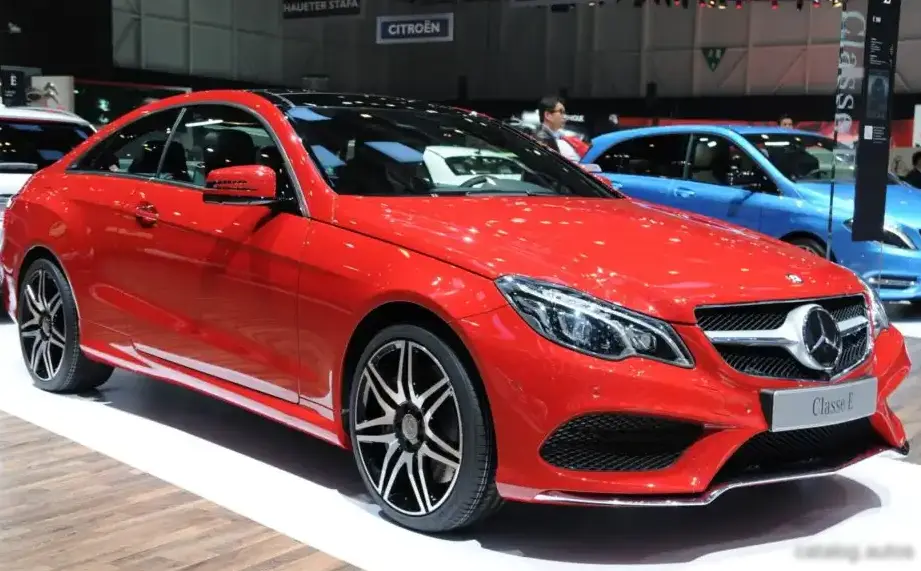
The Mercedes-Benz E-Class Coupe (C207) facelift, specifically the E 350 V6 model equipped with the 7G-TRONIC PLUS automatic transmission, was produced from June 2013 to July 2014. This variant occupied a mid-to-upper position within the C207 coupe lineup, offering a balance of performance, luxury, and technology. It represented a refinement of the second-generation C207, which itself was based on the W204 sedan platform, and aimed to compete with rivals like the BMW 3 Series Coupe and Audi A5 Coupe in the premium mid-size coupe segment.
Technical Specifications
| Brand | Mercedes-Benz |
| Model | E-Class |
| Generation | E-Class Coupe (C207, facelift 2013) |
| Type (Engine) | E 350 V6 (306 Hp) 7G-TRONIC PLUS |
| Start of production | June, 2013 |
| End of production | July, 2014 |
| Powertrain Architecture | Internal Combustion engine |
| Body type | Coupe |
| Seats | 4 |
| Doors | 2 |
| Fuel consumption (urban) | 9.5-10 l/100 km (24.8 – 23.5 US mpg) |
| Fuel consumption (extra urban) | 5.3-5.8 l/100 km (44.4 – 40.6 US mpg) |
| Fuel consumption (combined) | 6.9-7.3 l/100 km (34.1 – 32.2 US mpg) |
| CO2 emissions | 160-166 g/km |
| Fuel Type | Petrol (Gasoline) |
| Acceleration 0 – 100 km/h | 6.2 sec |
| Acceleration 0 – 62 mph | 6.2 sec |
| Acceleration 0 – 60 mph | 5.9 sec |
| Maximum speed | 250 km/h (155.34 mph), Electronically limited |
| Emission standard | Euro 5 |
| Weight-to-power ratio | 5.3 kg/Hp |
| Weight-to-torque ratio | 4.4 kg/Nm |
| Power | 306 Hp @ 6500 rpm |
| Torque | 370 Nm @ 3500-5250 rpm (272.9 lb.-ft. @ 3500-5250 rpm) |
| Engine layout | Front, Longitudinal |
| Engine Model/Code | M 276.952 |
| Engine displacement | 3498 cm3 (213.46 cu. in.) |
| Number of cylinders | 6 |
| Engine configuration | V-engine |
| Cylinder Bore | 92.9 mm (3.66 in.) |
| Piston Stroke | 86 mm (3.39 in.) |
| Compression ratio | 12:1 |
| Number of valves per cylinder | 4 |
| Fuel injection system | Direct injection |
| Engine aspiration | Naturally aspirated engine |
| Valvetrain | DOHC |
| Engine oil capacity | 6.5 l (6.87 US qt | 5.72 UK qt) |
| Coolant capacity | 9.6 l (10.14 US qt | 8.45 UK qt) |
| Kerb Weight | 1610 kg (3549.44 lbs.) |
| Max. weight | 2155 kg (4750.96 lbs.) |
| Max load | 545 kg (1201.52 lbs.) |
| Trunk (boot) space (minimum) | 450 l (15.89 cu. ft.) |
| Fuel tank capacity | 66 l (17.44 US gal | 14.52 UK gal) |
| Max. roof load | 100 kg (220.46 lbs.) |
| Permitted trailer load (with brakes) | 1800 kg (3968.32 lbs.) |
| Permitted trailer load (without brakes) | 750 kg (1653.47 lbs.) |
| Length | 4703 mm (185.16 in.) |
| Width | 1786 mm (70.31 in.) |
| Width including mirrors | 2016 mm (79.37 in.) |
| Height | 1397 mm (55 in.) |
| Wheelbase | 2760 mm (108.66 in.) |
| Front track | 1538 mm (60.55 in.) |
| Rear track | 1541 mm (60.67 in.) |
| Front overhang | 862 mm (33.94 in.) |
| Rear overhang | 1081 mm (42.56 in.) |
| Drag coefficient (Cd) | 0.27 |
| Minimum turning circle | 11.15 m (36.58 ft.) |
| Drivetrain | Rear wheel drive |
| Number of gears | 7 |
| Gearbox type | Automatic transmission G-TRONIC PLUS |
Powertrain & Engine Architecture
The E 350 Coupe utilized Mercedes-Benz’s M276.952 3.5-liter naturally aspirated V6 engine. This engine was a key component of the M276 family, known for its lightweight construction thanks to extensive use of aluminum alloys. It featured direct fuel injection, a double overhead camshaft (DOHC) valvetrain with four valves per cylinder, and a relatively high 12:1 compression ratio. The engine produced 306 horsepower at 6500 rpm and 370 Nm (272.9 lb-ft) of torque between 3500 and 5250 rpm. The 7G-TRONIC PLUS automatic transmission, a seven-speed unit, was specifically tuned to complement the V6’s power delivery. This transmission offered smooth shifts and a wide range of gear ratios, contributing to both performance and fuel efficiency.
Driving Characteristics
The E 350 Coupe with the 7G-TRONIC PLUS provided a refined and comfortable driving experience. While not as overtly sporty as some of its competitors, it offered ample power for confident overtaking and highway cruising. The automatic transmission, while smooth, wasn’t particularly quick to downshift, meaning the engine sometimes felt slightly strained when demanding immediate acceleration. Compared to the E 550 Coupe with its larger V8, the E 350 felt less powerful, but it offered a better balance between performance and fuel economy. Against the diesel-powered E 350 CDI, the gasoline version provided a more responsive and linear power delivery, albeit with higher fuel consumption.
Equipment & Trim Levels
The E 350 Coupe came standard with a generous array of features, including leather upholstery, automatic climate control, a premium sound system, and a suite of safety technologies like ABS, traction control, and stability control. Optional extras included a panoramic sunroof, upgraded leather packages, a driver assistance package with features like lane keeping assist and blind spot monitoring, and various cosmetic enhancements. The interior design was characterized by Mercedes-Benz’s signature blend of luxury and understated elegance, with high-quality materials and a well-laid-out dashboard.
Chassis & Braking
The C207 E-Class Coupe featured a multi-link suspension system at both the front and rear, providing a comfortable ride and good handling characteristics. The front suspension utilized coil springs and a transverse stabilizer bar, while the rear suspension also employed coil springs and a stabilizer bar. Braking duties were handled by ventilated discs on all four wheels, providing ample stopping power. The steering system was a rack-and-pinion setup with electric power steering, offering precise and responsive control.
Market Reception & Comparison
The E 350 Coupe was generally well-received by automotive critics, who praised its comfortable ride, refined interior, and strong engine performance. However, some reviewers noted that the handling wasn’t as sharp as some of its rivals, and the automatic transmission could feel a bit sluggish at times. Fuel economy was considered respectable for a vehicle in its class, but it lagged behind the diesel-powered E 350 CDI. Compared to the BMW 3 Series Coupe, the E 350 offered a more luxurious and comfortable experience, while the Audi A5 Coupe provided a more sporty and modern aesthetic.
Legacy
The M276 engine family, including the 3.5-liter V6 used in the E 350 Coupe, has proven to be relatively reliable, although preventative maintenance is crucial. Common issues include oil leaks and occasional problems with the fuel injectors. The 7G-TRONIC PLUS transmission is also generally durable, but regular fluid changes are essential to ensure smooth operation. In the used car market, the C207 E 350 Coupe represents a good value proposition for buyers seeking a stylish and comfortable luxury coupe. Its combination of performance, features, and reliability makes it a compelling alternative to its competitors.