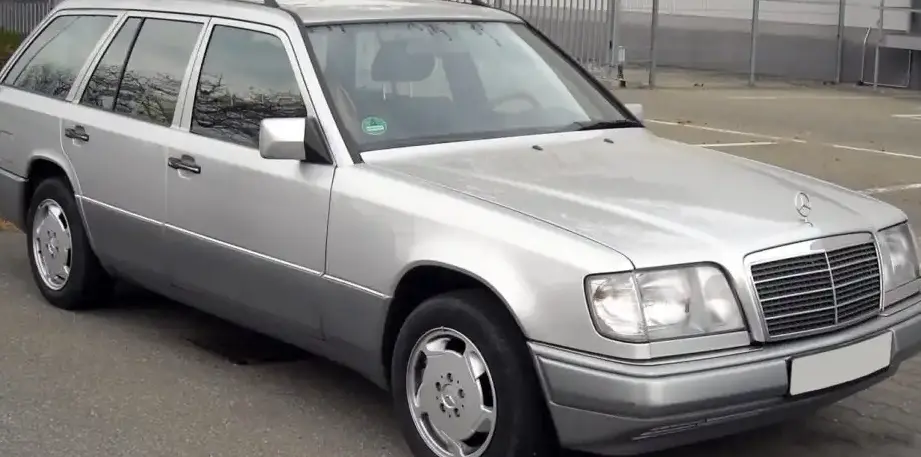
The Mercedes-Benz E 300 T Turbodiesel 4MATIC Automatic, produced between July 1993 and March 1995, represents a unique offering within the W124 series of estate vehicles (T-Modell). This variant combined the robust 3.0-liter turbodiesel engine with a four-speed automatic transmission and Mercedes-Benz’s 4MATIC all-wheel-drive system. Positioned as a premium, long-distance touring vehicle, it catered to buyers seeking practicality, comfort, and all-weather capability. The E 300 T Turbodiesel 4MATIC occupied a niche above the base diesel models and below the more performance-oriented gasoline variants like the E 320.
| Brand | Mercedes-Benz |
| Model | E-class |
| Generation | E-class T-modell (S124) |
| Type | E 300 T Turbodiesel (147 Hp) 4MATIC Automatic |
| Start of production | July, 1993 |
| End of production | March, 1995 |
| Powertrain Architecture | Internal Combustion engine |
| Body type | Station wagon (estate) |
| Seats | 5 |
| Doors | 5 |
| Fuel consumption (urban) | 10.2 l/100 km (23.1 US mpg, 27.7 UK mpg, 9.8 km/l) |
| Fuel consumption (extra urban) | 7.5 l/100 km (31.4 US mpg, 37.7 UK mpg, 13.3 km/l) |
| Fuel consumption (combined) | 9.1 l/100 km (25.8 US mpg, 31 UK mpg, 11 km/l) |
| Fuel Type | Diesel |
| Acceleration 0 – 100 km/h | 12.8 sec |
| Acceleration 0 – 62 mph | 12.8 sec |
| Acceleration 0 – 60 mph | 12.2 sec |
| Maximum speed | 188 km/h (116.82 mph) |
| Weight-to-power ratio | 11.6 kg/Hp, 86 Hp/tonne |
| Weight-to-torque ratio | 6.3 kg/Nm, 159.6 Nm/tonne |
| Power | 147 Hp @ 4600 rpm |
| Power per litre | 49.1 Hp/l |
| Torque | 273 Nm @ 2400 rpm (201.35 lb.-ft. @ 2400 rpm) |
| Engine layout | Front, Longitudinal |
| Engine Model/Code | OM 603 D 30 A / 603.963 |
| Engine displacement | 2996 cm3 (182.83 cu. in.) |
| Number of cylinders | 6 |
| Engine configuration | Inline |
| Cylinder Bore | 87 mm (3.43 in.) |
| Piston Stroke | 84 mm (3.31 in.) |
| Compression ratio | 22:1 |
| Number of valves per cylinder | 2 |
| Fuel injection system | Precombustion chamber injection |
| Engine aspiration | Turbocharger |
| Valvetrain | SOHC |
| Engine oil capacity | 7.5 l (7.93 US qt | 6.6 UK qt) |
| Coolant | 9 l (9.51 US qt | 7.92 UK qt) |
| Kerb Weight | 1710 kg (3769.9 lbs.) |
| Max. weight | 2340 kg (5158.82 lbs.) |
| Max load | 630 kg (1388.91 lbs.) |
| Trunk (boot) space – minimum | 530 l (18.72 cu. ft.) |
| Trunk (boot) space – maximum | 885 l (31.25 cu. ft.) |
| Fuel tank capacity | 72 l (19.02 US gal | 15.84 UK gal) |
| Length | 4765 mm (187.6 in.) |
| Width | 1740 mm (68.5 in.) |
| Height | 1490 mm (58.66 in.) |
| Wheelbase | 2800 mm (110.24 in.) |
| Front track | 1497 mm (58.94 in.) |
| Rear (Back) track | 1485 mm (58.46 in.) |
| Drivetrain Architecture | All wheel drive (4×4). ICE drives rear wheels, front wheels engaged via clutch. |
| Number of gears and type of gearbox | 4 gears, automatic transmission |
| Front suspension | Wishbone |
| Rear suspension | Independent multi-link suspension |
| Front brakes | Ventilated discs |
| Rear brakes | Disc |
| Assisting systems | ABS (Anti-lock braking system) |
| Steering type | Cone worm with recirculation balls |
| Power steering | Hydraulic Steering |
| Tires size | Front/Rear: 195/65 R15 |
| Wheel rims size | Front/Rear: 6.5J x 15 |
Powertrain & Engine Architecture
The heart of the E 300 T Turbodiesel 4MATIC is the OM 603 D 30 A engine, a 3.0-liter inline-six cylinder diesel. This engine utilized precombustion chamber injection, a system common in Mercedes-Benz diesels of the era, known for its relatively quiet operation and good combustion efficiency. The turbocharger, a Garrett unit, significantly boosted power output compared to naturally aspirated versions of the same engine. The engine produced 147 horsepower at 4600 rpm and a substantial 273 Nm (201 lb-ft) of torque at 2400 rpm. This torque delivery was a key characteristic, providing strong pulling power at lower engine speeds, ideal for towing or navigating challenging terrain. The four-speed automatic transmission, a 722.3 unit, was chosen for its smoothness and ease of use, complementing the engine’s torque curve. The 4MATIC system employed a viscous coupling to distribute power between the front and rear axles as needed, providing enhanced traction in slippery conditions.
Driving Characteristics
The E 300 T Turbodiesel 4MATIC offered a distinctly different driving experience compared to its gasoline-powered siblings or even the rear-wheel-drive diesel variants. While not a sports car, the combination of the torquey engine and all-wheel drive provided confident acceleration and stability, even when fully loaded. The automatic transmission, while smooth, wasn’t particularly quick to downshift, meaning drivers sometimes needed to anticipate acceleration needs. The 0-60 mph time of around 12.2 seconds reflects the car’s focus on usability rather than outright speed. The 4MATIC system noticeably improved handling on loose surfaces and in inclement weather, making it a popular choice in regions with harsh winters. The ride quality, typical of the W124 chassis, was comfortable and refined, absorbing bumps effectively.
Equipment & Trim Levels
The E 300 T Turbodiesel 4MATIC was generally well-equipped, reflecting its position as a premium estate car. Standard features typically included power windows, central locking, a sunroof, and a high-quality audio system. Interior upholstery was usually a durable cloth or optional leather. The dashboard layout was typical of the W124, with a functional and ergonomic design. Optional extras included automatic climate control, heated seats, and upgraded audio systems. The wood trim added a touch of luxury to the cabin. The 4MATIC models often featured a specific badge on the rear and sometimes had slightly different exterior trim details.
Chassis & Braking
The W124 chassis provided a solid foundation for the E 300 T Turbodiesel 4MATIC. The front suspension utilized wishbones, while the rear featured an independent multi-link setup, contributing to a comfortable ride and good handling. The braking system consisted of ventilated discs at the front and solid discs at the rear, providing adequate stopping power for the vehicle’s weight. Anti-lock braking system (ABS) was standard, enhancing safety. The steering was a recirculating ball system with hydraulic power assistance, offering a good balance of feel and ease of use.
Market Reception & Comparison
The E 300 T Turbodiesel 4MATIC was generally well-received by automotive critics, who praised its practicality, comfort, and all-weather capability. However, some noted that the automatic transmission could feel sluggish at times and that the diesel engine, while refined for its time, was not as quiet or powerful as the gasoline alternatives. Compared to the E 300 T, the 4MATIC version offered superior traction and stability, but at a higher price point and with slightly reduced fuel economy. Against other estate cars of the era, the E 300 T Turbodiesel 4MATIC stood out for its build quality, refinement, and robust diesel engine.
Legacy
The OM 603 engine, found in the E 300 T Turbodiesel 4MATIC, is renowned for its durability and longevity. Properly maintained examples can accumulate very high mileage with minimal issues. The W124 chassis is also highly regarded for its robustness and resistance to corrosion. Today, these vehicles are sought after by enthusiasts and collectors, particularly those who appreciate their classic styling, comfortable ride, and reliable diesel power. While finding well-maintained examples can be challenging, the E 300 T Turbodiesel 4MATIC remains a testament to Mercedes-Benz’s engineering prowess and a practical, capable estate car.