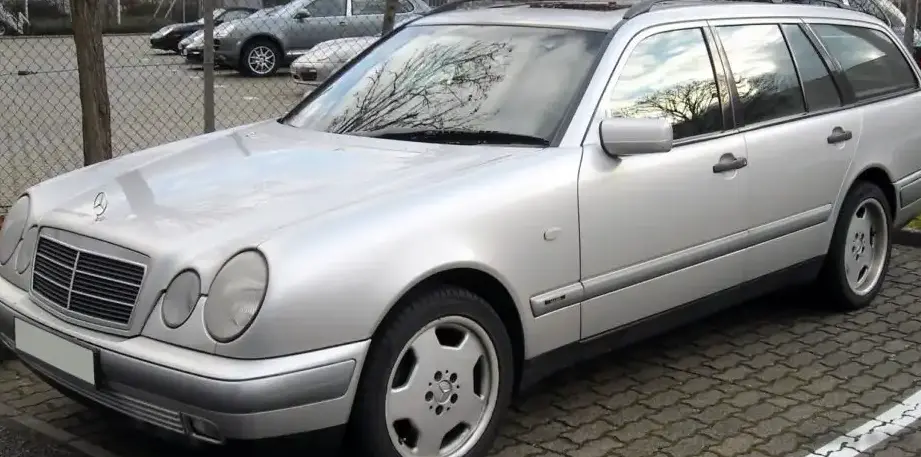
The Mercedes-Benz E 200 T-modell (S210), produced from August 1995 to July 1999, represented the estate, or wagon, variant of the W210 E-Class. Positioned as a mid-range offering within the broader E-Class lineup, the E 200 T-modell with the automatic transmission aimed to provide a balance of practicality, comfort, and reasonable performance for families and those requiring substantial cargo space. It served as a key model in the European market, where estate cars held significant popularity, offering a premium alternative to more utilitarian options. This variant filled the gap between the base E 180 and the more powerful E 230 and E 280 models.
Technical Specifications
| Brand | Mercedes-Benz |
| Model | E-class |
| Generation | E-class T-modell (S210) |
| Type (Engine) | E 200 (136 Hp) Automatic |
| Start of production | August, 1995 |
| End of production | July, 1999 |
| Powertrain Architecture | Internal Combustion engine |
| Body type | Station wagon (estate) |
| Seats | 5 |
| Doors | 5 |
| Fuel consumption (urban) | 10.8 l/100 km (21.8 US mpg) |
| Fuel consumption (extra urban) | 8.2 l/100 km (28.7 US mpg) |
| Fuel Type | Petrol (Gasoline) |
| Acceleration 0 – 100 km/h | 12.7 sec |
| Acceleration 0 – 62 mph | 12.7 sec |
| Acceleration 0 – 60 mph | 12.1 sec |
| Maximum speed | 195 km/h (121.17 mph) |
| Weight-to-power ratio | 11.5 kg/Hp |
| Weight-to-torque ratio | 8.2 kg/Nm |
| Power | 136 Hp @ 5500 rpm |
| Torque | 190 Nm @ 3700 rpm (140.14 lb.-ft. @ 3700 rpm) |
| Engine layout | Front, Longitudinal |
| Engine Model/Code | M 111 E 20 / 111.945 |
| Engine displacement | 1998 cm3 (121.93 cu. in.) |
| Number of cylinders | 4 |
| Engine configuration | Inline |
| Cylinder Bore | 89.9 mm (3.54 in.) |
| Piston Stroke | 78.7 mm (3.1 in.) |
| Compression ratio | 10:1 |
| Number of valves per cylinder | 4 |
| Fuel injection system | Multi-port manifold injection |
| Engine aspiration | Naturally aspirated engine |
| Valvetrain | DOHC |
| Engine oil capacity | 5.5 l (5.81 US qt | 4.84 UK qt) |
| Coolant | 8.5 l (8.98 US qt | 7.48 UK qt) |
| Kerb Weight | 1560 kg (3439.21 lbs.) |
| Max. weight | 2140 kg (4717.89 lbs.) |
| Max load | 580 kg (1278.68 lbs.) |
| Trunk (boot) space – minimum | 600 l (21.19 cu. ft.) |
| Trunk (boot) space – maximum | 1975 l (69.75 cu. ft.) |
| Fuel tank capacity | 70 l (18.49 US gal | 15.4 UK gal) |
| Length | 4816 mm (189.61 in.) |
| Width | 1799 mm (70.83 in.) |
| Height | 1505 mm (59.25 in.) |
| Wheelbase | 2833 mm (111.54 in.) |
| Front track | 1542 mm (60.71 in.) |
| Rear (Back) track | 1546 mm (60.87 in.) |
| Drivetrain Architecture | Rear wheel drive |
| Number of gears and type of gearbox | 5 gears, automatic transmission |
| Front suspension | Double wishbone |
| Rear suspension | Hydro-pneumatic element, Independent multi-link suspension |
| Front brakes | Ventilated discs |
| Rear brakes | Disc |
| Assisting systems | ABS (Anti-lock braking system) |
| Steering type | Steering rack and pinion |
| Power steering | Hydraulic Steering |
| Tires size | 205/65 R15 |
| Wheel rims size | 7J x 15 |
Powertrain & Engine Architecture
The E 200 T-modell utilized the M111 E 20 engine, a 1.998-liter (121.93 cubic inches) inline-four cylinder powerplant. This engine, designated with the code 111.945, featured multi-port fuel injection and a double overhead camshaft (DOHC) valvetrain with four valves per cylinder. The M111 engine family was known for its relatively smooth operation and decent fuel efficiency. The 10:1 compression ratio contributed to the engine’s 136 horsepower at 5500 rpm and 190 Nm (140.14 lb-ft) of torque at 3700 rpm. The engine was mounted longitudinally in the engine bay, driving the rear wheels. Paired with the M111 was a 5-speed automatic transmission, offering smooth shifts but not particularly sporty performance. This transmission was a common unit in Mercedes-Benz vehicles of the era, prioritizing comfort over outright speed.
Driving Characteristics
The E 200 T-modell Automatic offered a comfortable and refined driving experience, typical of Mercedes-Benz. However, the 136 hp engine and automatic transmission resulted in somewhat leisurely acceleration. The 0-60 mph time of around 12.1 seconds and a top speed of 195 km/h (121 mph) were adequate for everyday driving but didn’t provide particularly exhilarating performance. Compared to the E 230 or E 280 variants, the E 200 felt noticeably slower. The automatic transmission, while smooth, lacked the responsiveness of a manual gearbox and could sometimes feel hesitant during overtaking maneuvers. The gear ratios were optimized for fuel economy and cruising comfort rather than aggressive acceleration. Despite the lack of outright speed, the E 200 T-modell provided a stable and composed ride, thanks to its well-tuned suspension.
Equipment & Trim Levels
The E 200 T-modell came standard with a respectable level of equipment, including power windows, central locking, and an AM/FM radio. Interior upholstery typically consisted of cloth, although leather was available as an option. The dashboard featured a classic Mercedes-Benz design with wood trim accents. Optional extras included a sunroof, automatic climate control, heated seats, and a premium sound system. The estate body style itself was a significant feature, offering a generous 600 liters (21.19 cu ft) of cargo space with the rear seats up, expanding to 1975 liters (69.75 cu ft) with the seats folded down. This made the E 200 T-modell a practical choice for families and those needing to transport large items.
Chassis & Braking
The E 200 T-modell featured a double wishbone suspension at the front and an independent multi-link hydro-pneumatic suspension at the rear. This suspension setup provided a comfortable ride and good handling characteristics. The braking system consisted of ventilated discs at the front and solid discs at the rear, equipped with ABS (Anti-lock Braking System) as standard. The steering was a rack and pinion system with hydraulic power assistance, offering precise and responsive steering feel. The vehicle rode on 205/65 R15 tires mounted on 7J x 15 inch wheels.
Market Reception & Comparison
The E 200 T-modell was generally well-received by critics as a practical and comfortable estate car. However, its performance was often criticized as being somewhat underwhelming, particularly when compared to its more powerful siblings. Fuel economy was considered reasonable for its class, but not exceptional. In terms of reliability, the M111 engine proved to be a durable and dependable unit, although regular maintenance was essential. Compared to the E 230 T-modell, the E 200 offered a lower price point but sacrificed performance. The E 200 appealed to buyers who prioritized practicality and comfort over outright speed.
Legacy
The E 200 T-modell (S210) has proven to be a relatively reliable vehicle in the used car market. The M111 engine is known for its longevity, and many examples are still on the road today. However, like all older vehicles, they require regular maintenance and attention to prevent issues. Common problems include wear and tear on suspension components, corrosion, and electrical gremlins. Despite these potential issues, the E 200 T-modell remains a popular choice for those seeking a classic Mercedes-Benz estate car that offers a blend of practicality, comfort, and reliability.