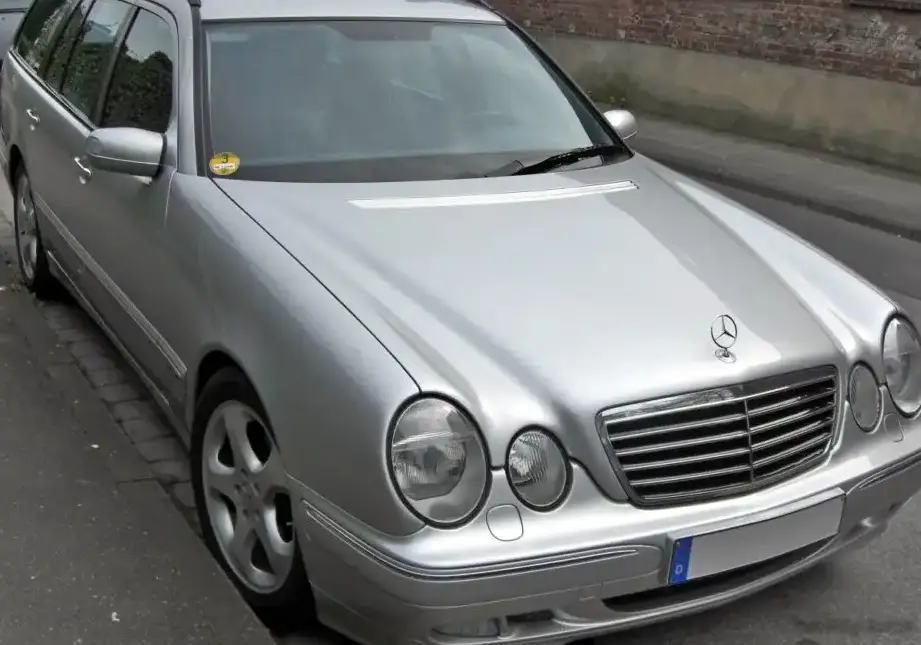
The Mercedes-Benz E 240 T-modell, part of the S210 series produced from November 1999 to December 2002, represented a compelling blend of practicality and luxury within the mid-size executive wagon segment. This facelifted version of the S210, often referred to as the “W210” after its predecessor, offered a refined driving experience and a spacious interior, making it a popular choice for families and those requiring substantial cargo capacity. The E 240, powered by a 2.6-liter V6 engine paired with a five-speed automatic transmission, occupied a middle ground in the E-Class T-modell lineup, offering a balance between performance and fuel efficiency. It sat below the more powerful E 320 and E 55 AMG variants, and above the four-cylinder E 200 Kompressor.
| Brand | Mercedes-Benz |
| Model | E-Class |
| Generation | E-Class T-modell (S210, facelift 1999) |
| Type (Engine) | E 240 2.6 V6 (170 Hp) Automatic |
| Start of production | November, 1999 |
| End of production | December, 2002 |
| Powertrain Architecture | Internal Combustion engine |
| Body type | Station wagon (estate) |
| Seats | 5 |
| Doors | 5 |
| Fuel consumption (urban) | 15.1 l/100 km (15.6 US mpg, 18.7 UK mpg) |
| Fuel consumption (extra urban) | 7.9 l/100 km (29.8 US mpg, 35.8 UK mpg) |
| Fuel consumption (combined) | 10.6 l/100 km (22.2 US mpg, 26.6 UK mpg) |
| Fuel Type | Petrol (Gasoline) |
| Acceleration 0 – 100 km/h | 10.5 sec |
| Acceleration 0 – 62 mph | 10.5 sec |
| Acceleration 0 – 60 mph | 10 sec |
| Maximum speed | 216 km/h (134.22 mph) |
| Weight-to-power ratio | 9.9 kg/Hp, 101.2 Hp/tonne |
| Weight-to-torque ratio | 7 kg/Nm, 142.9 Nm/tonne |
| Power | 170 Hp @ 5500 rpm |
| Power per litre | 65.5 Hp/l |
| Torque | 240 Nm @ 4500 rpm (177.01 lb.-ft. @ 4500 rpm) |
| Engine layout | Front, Longitudinal |
| Engine Model/Code | M 112 E 26 / 112.914 |
| Engine displacement | 2597 cm3 (158.48 cu. in.) |
| Number of cylinders | 6 |
| Engine configuration | V-engine |
| Cylinder Bore | 89.9 mm (3.54 in.) |
| Piston Stroke | 68.2 mm (2.69 in.) |
| Compression ratio | 10.5:1 |
| Number of valves per cylinder | 3 |
| Fuel injection system | Multi-port manifold injection |
| Engine aspiration | Naturally aspirated engine |
| Valvetrain | SOHC |
| Engine oil capacity | 8 l (8.45 US qt | 7.04 UK qt) |
| Coolant | 10 l (10.57 US qt | 8.8 UK qt) |
| Kerb Weight | 1680 kg (3703.77 lbs.) |
| Max. weight | 2260 kg (4982.45 lbs.) |
| Max load | 580 kg (1278.68 lbs.) |
| Trunk (boot) space – minimum | 600 l (21.19 cu. ft.) |
| Trunk (boot) space – maximum | 1920 l (67.8 cu. ft.) |
| Fuel tank capacity | 70 l (18.49 US gal | 15.4 UK gal) |
| Length | 4839 mm (190.51 in.) |
| Width | 1799 mm (70.83 in.) |
| Height | 1505 mm (59.25 in.) |
| Wheelbase | 2833 mm (111.54 in.) |
| Front track | 1542 mm (60.71 in.) |
| Rear (Back) track | 1546 mm (60.87 in.) |
| Drag coefficient (Cd) | 0.31 |
| Drivetrain Architecture | Rear wheel drive |
| Number of gears and type of gearbox | 5 gears, automatic transmission |
| Front suspension | Double wishbone |
| Rear suspension | Hydro-pneumatic element, Independent multi-link suspension |
| Front brakes | Ventilated discs |
| Rear brakes | Disc |
| Assisting systems | ABS (Anti-lock braking system) |
| Steering type | Steering rack and pinion |
| Power steering | Hydraulic Steering |
| Tires size | 205/65 R15 |
| Wheel rims size | 7J x 15 |
Powertrain & Engine Architecture
The heart of the E 240 T-modell was the M112 E 26 engine, a 2.6-liter naturally aspirated V6. This engine, part of Mercedes-Benz’s modular V-engine family, featured a 60-degree V-angle and a single overhead camshaft (SOHC) design per cylinder bank. The M112 utilized a multi-port fuel injection system, delivering fuel directly into the intake ports, and a relatively high compression ratio of 10.5:1. The engine’s construction incorporated aluminum alloy cylinder heads and a cast iron block, balancing weight and durability. Paired with this engine was a five-speed automatic transmission (typically the 722.6), known for its smooth shifting characteristics, though not particularly sporty. This transmission was electronically controlled, adapting shift points based on driving conditions and throttle input.
Driving Characteristics
The E 240 T-modell with the automatic transmission offered a comfortable and refined driving experience. While not a performance-oriented variant, the 170 horsepower and 240 Nm (177 lb-ft) of torque provided adequate power for everyday driving and highway cruising. Acceleration from 0 to 60 mph took around 10 seconds, and top speed was electronically limited to 134 mph. The automatic transmission, while smooth, did result in some power loss compared to the available manual transmission. Gear ratios were tuned for fuel efficiency and comfort rather than outright acceleration. The rear-wheel drive configuration provided a balanced feel, although it lacked the all-weather capability of all-wheel drive models offered in the E-Class range.
Equipment & Trim Levels
The E 240 T-modell typically came standard with a respectable level of equipment, including automatic climate control, power windows and locks, a multi-function steering wheel, and a basic audio system. Interior upholstery was usually cloth, though leather was available as an option. Common optional extras included a sunroof, upgraded audio systems, navigation, heated seats, and parking assistance systems. The dashboard layout was typical of the W210 generation, featuring a classic Mercedes-Benz design with wood trim and analog gauges. Trim levels were relatively simple, with options primarily focused on adding comfort and convenience features.
Chassis & Braking
The S210 E-Class T-modell utilized a double wishbone suspension at the front and an independent multi-link suspension at the rear, providing a comfortable ride and good handling characteristics. The E 240 typically featured ventilated disc brakes at the front and solid discs at the rear. Anti-lock braking system (ABS) was standard. The suspension was tuned for comfort, prioritizing ride quality over sporty handling. Stabilizer bars were fitted front and rear to reduce body roll during cornering. The steering was a hydraulic power-assisted rack and pinion system, offering precise and responsive steering feel.
Market Reception & Comparison
The E 240 T-modell was generally well-received by automotive critics as a practical and luxurious wagon. It was praised for its spacious interior, comfortable ride, and refined engine. However, some critics noted that the automatic transmission could feel sluggish at times, and the overall driving experience wasn’t as engaging as some of its competitors. Compared to the E 320, the E 240 offered a more affordable entry point into the E-Class wagon range, but with a noticeable reduction in performance. The E 240 also offered better fuel economy than the larger-engined models. Reliability was generally good, although the complex Mercedes-Benz systems could be expensive to repair.
Legacy
The E 240 T-modell, particularly with the automatic transmission, has become a popular choice among enthusiasts seeking a comfortable and reliable classic Mercedes-Benz wagon. The M112 engine is known for its durability, and with proper maintenance, can provide many years of service. While not a high-performance model, the E 240 offers a unique blend of practicality, luxury, and German engineering. In the used car market, well-maintained examples command reasonable prices, making them an attractive option for those seeking a spacious and refined wagon with a touch of Mercedes-Benz prestige. Parts availability remains good, although specialized components can be costly.