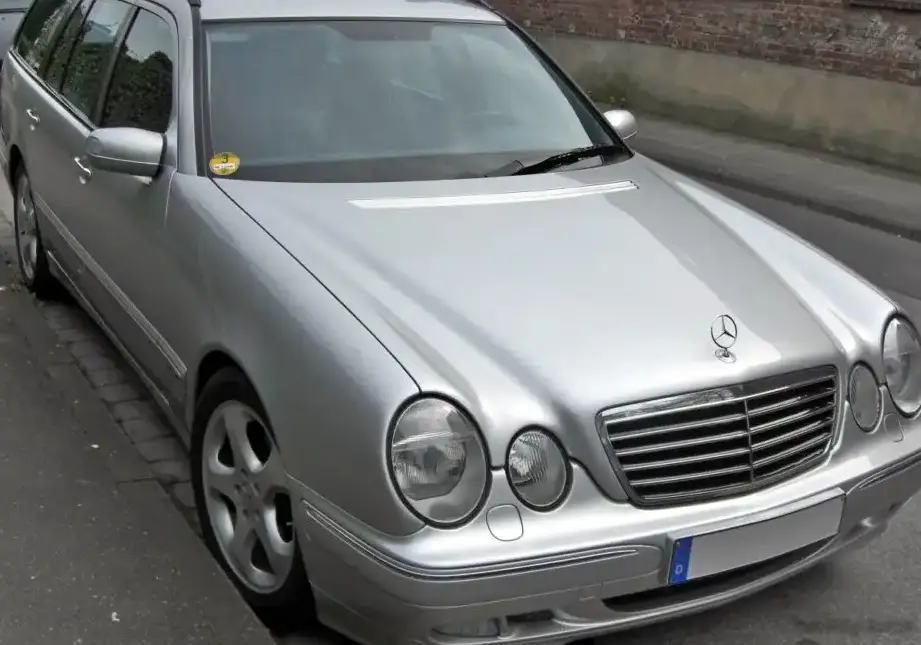
The Mercedes-Benz E-Class T-modell (S210) facelift, specifically the E 430 V8 Automatic produced from July 1999 to December 2002, represented the pinnacle of performance and luxury within the S210 wagon range. Positioned as the flagship variant, it catered to buyers seeking a high-performance estate car with a refined driving experience. The S210 series, introduced in 1996, was Mercedes-Benz’s offering in the mid-size executive wagon segment, competing with models like the BMW Touring and Audi Avant. The 1999 facelift brought styling updates, improved equipment levels, and crucially, enhancements to the engine lineup, including the potent 4.3-liter V8 in the E 430.
Technical Specifications
| Brand | Mercedes-Benz |
| Model | E-Class |
| Generation | E-Class T-modell (S210, facelift 1999) |
| Type (Engine) | E 430 V8 (279 Hp) Automatic |
| Start of production | July, 1999 |
| End of production | December, 2002 |
| Powertrain Architecture | Internal Combustion engine |
| Body type | Station wagon (estate) |
| Seats | 5 |
| Doors | 5 |
| Fuel consumption (urban) | 16.5 l/100 km (14.3 US mpg / 17.1 UK mpg / 6.1 km/l) |
| Fuel consumption (extra urban) | 8.6 l/100 km (27.4 US mpg / 32.8 UK mpg / 11.6 km/l) |
| Fuel consumption (combined) | 11.4 l/100 km (20.6 US mpg / 24.8 UK mpg / 8.8 km/l) |
| Fuel Type | Petrol (Gasoline) |
| Acceleration 0 – 100 km/h | 6.9 sec |
| Acceleration 0 – 62 mph | 6.9 sec |
| Acceleration 0 – 60 mph | 6.6 sec |
| Maximum speed | 243 km/h (150.99 mph) |
| Weight-to-power ratio | 6.3 kg/Hp, 157.6 Hp/tonne |
| Weight-to-torque ratio | 4.4 kg/Nm, 226 Nm/tonne |
| Power | 279 Hp @ 5750 rpm |
| Power per litre | 65.4 Hp/l |
| Torque | 400 Nm @ 3000-4400 rpm (295.02 lb.-ft. @ 3000-4400 rpm) |
| Engine layout | Front, Longitudinal |
| Engine Model/Code | M 113 E 43 / 113.940 |
| Engine displacement | 4266 cm3 (260.33 cu. in.) |
| Number of cylinders | 8 |
| Engine configuration | V-engine |
| Cylinder Bore | 89.9 mm (3.54 in.) |
| Piston Stroke | 84 mm (3.31 in.) |
| Compression ratio | 10:1 |
| Number of valves per cylinder | 3 |
| Fuel injection system | Multi-port manifold injection |
| Engine aspiration | Naturally aspirated engine |
| Valvetrain | SOHC |
| Engine oil capacity | 8 l (8.45 US qt | 7.04 UK qt) |
| Coolant | 11 l (11.62 US qt | 9.68 UK qt) |
| Kerb Weight | 1770 kg (3902.18 lbs.) |
| Max. weight | 2330 kg (5136.77 lbs.) |
| Max load | 560 kg (1234.59 lbs.) |
| Trunk (boot) space – minimum | 600 l (21.19 cu. ft.) |
| Trunk (boot) space – maximum | 1920 l (67.8 cu. ft.) |
| Fuel tank capacity | 70 l (18.49 US gal | 15.4 UK gal) |
| Length | 4839 mm (190.51 in.) |
| Width | 1799 mm (70.83 in.) |
| Height | 1509 mm (59.41 in.) |
| Wheelbase | 2833 mm (111.54 in.) |
| Front track | 1542 mm (60.71 in.) |
| Rear (Back) track | 1546 mm (60.87 in.) |
| Drag coefficient (Cd) | 0.32 |
| Drivetrain Architecture | The Internal combustion engine (ICE) drives the rear wheels of the vehicle. |
| Drive wheel | Rear wheel drive |
| Number of gears and type of gearbox | 5 gears, automatic transmission |
| Front suspension | Double wishbone |
| Rear suspension | Hydro-pneumatic element, Independent multi-link suspension |
| Front brakes | Ventilated discs |
| Rear brakes | Disc |
| Assisting systems | ABS (Anti-lock braking system) |
| Steering type | Steering rack and pinion |
| Power steering | Hydraulic Steering |
| Tires size | 235/45 R17 |
| Wheel rims size | 7.5J x 17 |
Powertrain & Engine Architecture
The heart of the E 430 T-modell was the M113 E 43 engine, a 4.3-liter naturally aspirated V8. This engine, part of Mercedes-Benz’s modular V8 engine family, featured all-aluminum construction, a three-valve per cylinder (two intake, one exhaust) SOHC valvetrain, and a multi-point fuel injection system. The M113 was known for its smooth power delivery and robust build quality. The engine produced 279 horsepower at 5750 rpm and 400 Nm (295 lb-ft) of torque between 3000 and 4400 rpm. Paired with the engine was a 5-speed automatic transmission (typically the 722.6), offering smooth and relatively quick shifts. This transmission was electronically controlled and adapted to driving conditions for optimal performance and efficiency.
Driving Characteristics
The E 430 T-modell Automatic offered a distinctly different driving experience compared to its four-cylinder or six-cylinder siblings. While not overtly sporty, the V8 provided ample power for effortless cruising and confident overtaking. The automatic transmission, while not as engaging as a manual, offered seamless gear changes and contributed to a relaxed driving experience. Acceleration from 0-60 mph was achieved in approximately 6.6-6.9 seconds, making it one of the quickest wagons of its era. The rear-wheel-drive configuration provided a balanced feel, although it lacked the all-weather capability of all-wheel-drive variants. The gear ratios were tuned for a blend of performance and fuel economy, prioritizing comfortable highway driving.
Equipment & Trim Levels
The E 430 T-modell came standard with a generous array of features, reflecting its position as the range-topping variant. Standard equipment typically included leather upholstery, wood trim, automatic climate control, power-adjustable front seats with memory function, a premium sound system, and alloy wheels. Optional extras included a sunroof, navigation system, upgraded sound systems, and various driver assistance features. Interior color schemes were typically conservative, with shades of gray, beige, and black being the most common.
Chassis & Braking
The S210 chassis featured a double wishbone front suspension and an independent multi-link rear suspension, providing a comfortable and controlled ride. The E 430 typically received slightly stiffer springs and dampers compared to lower-spec models to manage the increased weight of the V8 engine. Braking duties were handled by ventilated disc brakes at all four corners, coupled with ABS (Anti-lock Braking System). The E 430’s weight distribution was relatively balanced, contributing to stable handling characteristics.
Market Reception & Comparison
The E 430 T-modell was generally well-received by automotive critics, who praised its powerful engine, luxurious interior, and spacious cargo area. However, its fuel consumption was often cited as a drawback. Compared to the E 320 T-modell (with its inline-six engine), the E 430 offered significantly more power but at the expense of fuel economy. Against competitors like the BMW 540i Touring, the E 430 offered a more refined and comfortable ride, while the BMW was often considered more engaging to drive. The diesel variants, like the E 320 CDI, provided superior fuel economy but lacked the V8’s effortless power.
Legacy
The M113 V8 engine, found in the E 430, is known for its durability and reliability, provided it receives regular maintenance. While the complex electronics of the S210 can be prone to issues as the cars age, the engine itself is generally considered robust. Today, the E 430 T-modell is a sought-after classic among Mercedes-Benz enthusiasts, offering a unique combination of performance, luxury, and practicality. Well-maintained examples command a premium in the used car market, appealing to collectors and those seeking a distinctive and capable estate car.