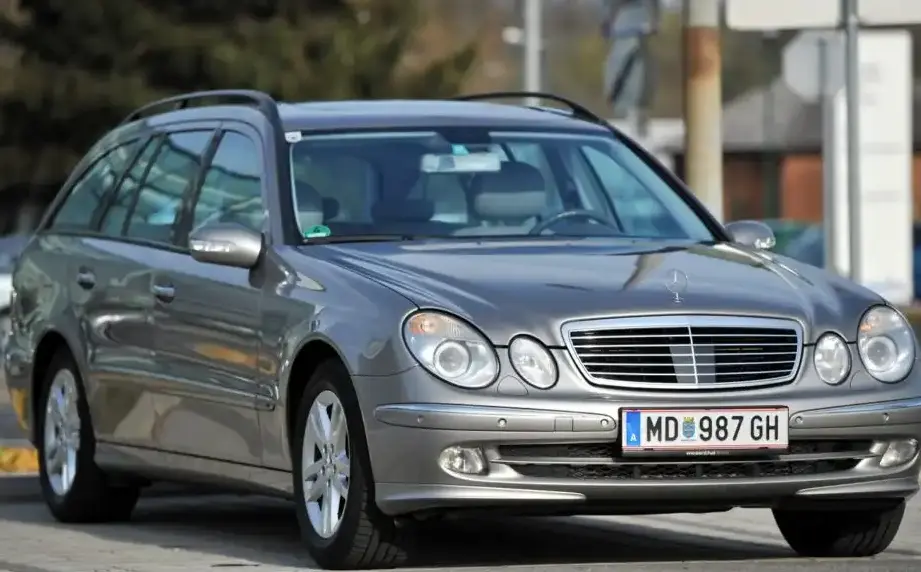
The Mercedes-Benz E-Class T-modell (S211) E 270 CDI, produced from 2003 to 2005, represented a compelling blend of practicality and luxury within the E-Class range. As a diesel-powered station wagon (estate), it catered to European buyers seeking a versatile vehicle capable of both family duties and long-distance cruising. This variant occupied a mid-range position in the S211 lineup, offering a balance between performance and fuel efficiency, slotting below the more powerful E 320 CDI and above the entry-level E 200 CDI. The E 270 CDI combined a robust five-cylinder diesel engine with Mercedes’ 5G-TRONIC automatic transmission, creating a comfortable and capable grand tourer.
Technical Specifications
| Brand | Mercedes-Benz |
| Model | E-Class |
| Generation | E-Class T-modell (S211) |
| Type (Engine) | E 270 CDI (177 Hp) 5G-TRONIC |
| Start of production | 2003 |
| End of production | 2005 |
| Powertrain Architecture | Internal Combustion engine |
| Body type | Station wagon (estate) |
| Seats | 5 |
| Doors | 5 |
| Fuel consumption (urban) | 9.8 l/100 km (24 US mpg, 28.8 UK mpg, 10.2 km/l) |
| Fuel consumption (extra urban) | 5.6 l/100 km (42 US mpg, 50.4 UK mpg, 17.9 km/l) |
| Fuel consumption (combined) | 7.2 l/100 km (32.7 US mpg, 39.2 UK mpg, 13.9 km/l) |
| Fuel Type | Diesel |
| Acceleration 0 – 100 km/h | 9.3 sec |
| Acceleration 0 – 62 mph | 9.3 sec |
| Acceleration 0 – 60 mph | 8.8 sec |
| Maximum speed | 220 km/h (136.7 mph) |
| Weight-to-power ratio | 10.3 kg/Hp, 96.7 Hp/tonne |
| Weight-to-torque ratio | 4.6 kg/Nm, 218.6 Nm/tonne |
| Power | 177 Hp @ 4200 rpm |
| Power per litre | 65.9 Hp/l |
| Torque | 400 Nm @ 1800 rpm (295.02 lb.-ft. @ 1800 rpm) |
| Engine layout | Front, Longitudinal |
| Engine Model/Code | OM 647.961 |
| Engine displacement | 2685 cm3 (163.85 cu. in.) |
| Number of cylinders | 5 |
| Engine configuration | Inline |
| Cylinder Bore | 88 mm (3.46 in.) |
| Piston Stroke | 88.3 mm (3.48 in.) |
| Compression ratio | 18:1 |
| Number of valves per cylinder | 4 |
| Fuel injection system | Diesel Commonrail |
| Engine aspiration | Turbocharger, Intercooler |
| Engine oil capacity | 6.5 l (6.87 US qt | 5.72 UK qt) |
| Coolant capacity | 11.7 l (12.36 US qt | 10.29 UK qt) |
| Kerb Weight | 1830 kg (4034.46 lbs.) |
| Max. weight | 2405 kg (5302.12 lbs.) |
| Max load | 575 kg (1267.66 lbs.) |
| Trunk (boot) space – minimum | 690 l (24.37 cu. ft.) |
| Trunk (boot) space – maximum | 1950 l (68.86 cu. ft.) |
| Fuel tank capacity | 70 l (18.49 US gal | 15.4 UK gal) |
| Length | 4850 mm (190.94 in.) |
| Width | 1822 mm (71.73 in.) |
| Height | 1495 mm (58.86 in.) |
| Wheelbase | 2854 mm (112.36 in.) |
| Front track | 1559 mm (61.38 in.) |
| Rear track | 1552 mm (61.1 in.) |
| Drag coefficient (Cd) | 0.30 |
| Drivetrain Architecture | Rear wheel drive |
| Number of gears | 5 |
| Gearbox type | Automatic transmission |
| Front suspension | Coil spring |
| Rear suspension | Coil spring |
| Front brakes | Ventilated discs |
| Rear brakes | Disc |
| Assisting systems | ABS (Anti-lock braking system) |
| Steering type | Steering rack and pinion |
| Power steering | Hydraulic Steering |
| Tires size | 225/55 R16 |
| Wheel rims size | 7.5 J X 16 |
Powertrain & Engine Architecture
The heart of the E 270 CDI is the OM 647.961, a 2.7-liter inline five-cylinder diesel engine. This engine was a significant development for Mercedes-Benz, representing a move towards more refined and powerful diesel engines. It featured a common rail direct injection system, delivering fuel at extremely high pressure for improved combustion efficiency and reduced emissions. A variable geometry turbocharger with an intercooler further enhanced performance, providing increased boost across a wider rev range. The engine produced 177 horsepower at 4200 rpm and a substantial 400 Nm (295 lb-ft) of torque at just 1800 rpm. This torque output was a key characteristic, providing strong acceleration and effortless cruising. The 5G-TRONIC automatic transmission, a five-speed unit, was specifically calibrated to work with the engine’s torque curve, offering smooth and responsive gear changes.
Driving Characteristics
The E 270 CDI Automatic offered a relaxed and refined driving experience. The abundance of low-end torque meant that strong acceleration was readily available without the need for frequent downshifts. While not a sports car, the E 270 CDI could achieve 0-60 mph in around 8.8 seconds and reach a top speed of 136.7 mph. Compared to the manual transmission version, the automatic offered greater convenience, particularly in urban traffic. However, it did slightly diminish acceleration times and fuel economy. Compared to the more powerful E 320 CDI, the E 270 CDI felt less urgent, but it provided a more economical and accessible option for many buyers. The automatic transmission’s gear ratios were optimized for both fuel efficiency and comfortable highway cruising.
Equipment & Trim Levels
The E 270 CDI T-modell typically came well-equipped, reflecting Mercedes-Benz’s commitment to luxury and comfort. Standard features included automatic climate control, power windows and mirrors, a multi-function steering wheel, and a high-quality audio system. Interior upholstery was typically a combination of cloth and leatherette, with full leather options available as an upgrade. Optional extras included a sunroof, navigation system, heated seats, and upgraded audio systems. The dashboard layout was typical of the S211 generation, featuring a classic Mercedes-Benz design with wood trim and analog gauges.
Chassis & Braking
The S211 E-Class featured a robust chassis designed for both comfort and handling. The E 270 CDI utilized coil spring suspension on both the front and rear axles. The front suspension incorporated independent control arms, while the rear used a multi-link setup. This configuration provided a comfortable ride while maintaining good handling characteristics. Braking duties were handled by ventilated discs at the front and solid discs at the rear, assisted by ABS (Anti-lock Braking System). The hydraulic power steering provided precise and responsive steering feel.
Market Reception & Comparison
The E 270 CDI T-modell was generally well-received by automotive critics. It was praised for its comfortable ride, spacious interior, and fuel efficiency. The diesel engine was noted for its refinement and strong torque output. However, some critics pointed to the slightly sluggish performance compared to higher-powered variants. In terms of fuel economy, the E 270 CDI offered a significant advantage over its gasoline-powered counterparts. Reliability was generally good, although, like all complex vehicles, it was susceptible to age-related issues. Compared to the E 320 CDI, the E 270 CDI offered a more affordable entry point into the E-Class range, appealing to buyers who prioritized fuel economy and practicality over outright performance.
Legacy
The OM 647 engine family, including the OM 647.961 found in the E 270 CDI, proved to be a durable and reliable powerplant. While some early common rail diesel engines suffered from injector issues, the OM 647 generally held up well over time. Today, well-maintained E 270 CDI T-modells can still be found on the used car market, offering a compelling combination of practicality, comfort, and fuel efficiency. However, potential buyers should be aware of the age-related maintenance requirements associated with any vehicle of this vintage, including checking for signs of wear in the suspension components and ensuring the automatic transmission has been properly serviced.