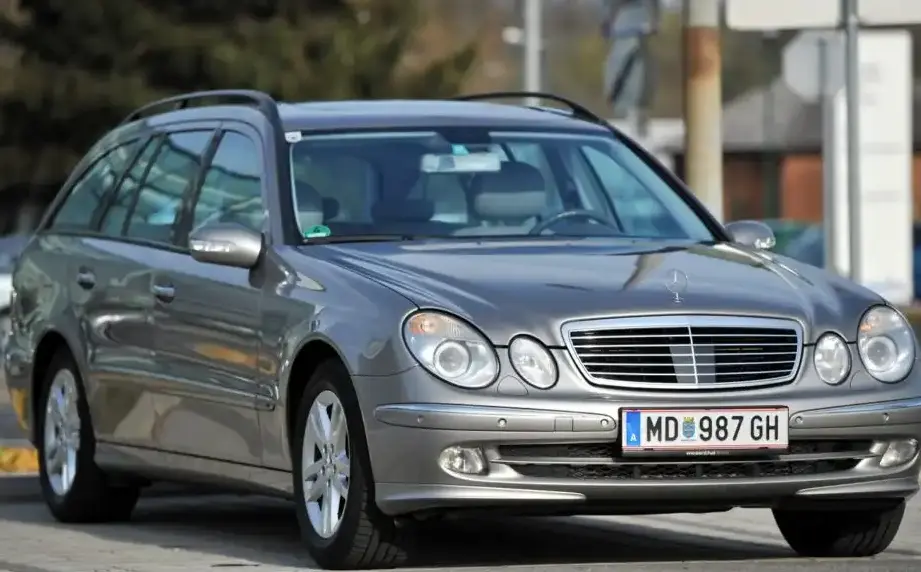
The Mercedes-Benz E 500 T-modell (S211), produced from 2005 to 2006, represented the pinnacle of performance within the second-generation E-Class wagon lineup. Positioned as the flagship variant, it combined the practicality of a station wagon with the power of a large-displacement V8 engine and the security of all-wheel drive. This model occupied the premium segment of the E-Class range, appealing to buyers seeking a high-performance, luxurious, and versatile vehicle. It was part of the W211 series, specifically the T-modell (estate) body style, and utilized Mercedes-Benz’s 5G-TRONIC automatic transmission.
Technical Specifications
| Brand | Mercedes-Benz |
| Model | E-class |
| Generation | E-class T-modell (S211) |
| Type | E 500 (306 Hp) 4MATIC 5G-TRONIC |
| Start of production | 2005 |
| End of production | 2006 |
| Powertrain Architecture | Internal Combustion engine |
| Body type | Station wagon (estate) |
| Seats | 5 |
| Doors | 5 |
| Fuel consumption (urban) | 18.2 l/100 km (12.9 US mpg, 15.5 UK mpg, 5.5 km/l) |
| Fuel consumption (extra urban) | 9.2 l/100 km (25.6 US mpg, 30.7 UK mpg, 10.9 km/l) |
| Fuel consumption (combined) | 12.3 l/100 km (19.1 US mpg, 23 UK mpg, 8.1 km/l) |
| CO2 emissions | 296 g/km |
| Fuel Type | Petrol (Gasoline) |
| Acceleration 0 – 100 km/h | 6.8 sec |
| Acceleration 0 – 62 mph | 6.8 sec |
| Acceleration 0 – 60 mph | 6.5 sec |
| Maximum speed | 250 km/h (155.34 mph) |
| Weight-to-power ratio | 6.1 kg/Hp, 163.2 Hp/tonne |
| Weight-to-torque ratio | 4.1 kg/Nm, 245.3 Nm/tonne |
| Power | 306 Hp @ 5600 rpm |
| Power per litre | 61.6 Hp/l |
| Torque | 460 Nm @ 4250 rpm (339.28 lb.-ft. @ 4250 rpm) |
| Engine layout | Front, Longitudinal |
| Engine Model/Code | M 113.969 |
| Engine displacement | 4966 cm3 (303.04 cu. in.) |
| Number of cylinders | 8 |
| Engine configuration | V-engine |
| Cylinder Bore | 97 mm (3.82 in.) |
| Piston Stroke | 84 mm (3.31 in.) |
| Compression ratio | 10:1 |
| Number of valves per cylinder | 3 |
| Fuel injection system | Multi-port manifold injection |
| Engine aspiration | Naturally aspirated engine |
| Valvetrain | OHC |
| Engine oil capacity | 7.5 l (7.93 US qt | 6.6 UK qt) |
| Coolant | 11.3 l (11.94 US qt | 9.94 UK qt) |
| Kerb Weight | 1875 kg (4133.67 lbs.) |
| Max. weight | 2520 kg (5555.65 lbs.) |
| Max load | 645 kg (1421.98 lbs.) |
| Trunk (boot) space – minimum | 690 l (24.37 cu. ft.) |
| Trunk (boot) space – maximum | 1950 l (68.86 cu. ft.) |
| Fuel tank capacity | 80 l (21.13 US gal | 17.6 UK gal) |
| Length | 4850 mm (190.94 in.) |
| Width | 1822 mm (71.73 in.) |
| Height | 1496 mm (58.9 in.) |
| Wheelbase | 2854 mm (112.36 in.) |
| Front track | 1559 mm (61.38 in.) |
| Rear (Back) track | 1552 mm (61.1 in.) |
| Drag coefficient (Cd) | 0.32 |
| Drive wheel | All wheel drive (4×4) |
| Number of gears and type of gearbox | 5 gears, automatic transmission |
| Front suspension | Coil spring |
| Rear suspension | Coil spring |
| Front brakes | Ventilated discs |
| Rear brakes | Disc |
| Assisting systems | ABS (Anti-lock braking system) |
| Steering type | Steering rack and pinion |
| Power steering | Hydraulic Steering |
| Tires size | 245/45 R17 |
INTRODUCTION
The S211 E-Class T-modell, introduced in 2003, brought a new level of sophistication and practicality to the Mercedes-Benz wagon lineup. The E 500 4MATIC, launched in 2005 and continuing through 2006, was the performance leader of this generation. Built on the 1HX0/A3 platform, it aimed to deliver the driving experience of a sports sedan within the body of a versatile estate car. It was positioned above the E320 and E350 wagons, offering a significant power upgrade and a more luxurious experience. The 4MATIC all-wheel-drive system was standard, providing enhanced traction and stability in all weather conditions.
Powertrain & Engine Architecture
The heart of the E 500 T-modell was the M113.969 engine, a naturally aspirated 5.0-liter V8. This engine, a cornerstone of Mercedes-Benz’s performance offerings in the early 2000s, featured a three-valve-per-cylinder design (two intake, one exhaust) and a relatively high 10:1 compression ratio. It utilized a multi-port fuel injection system, delivering fuel directly into the intake ports. The engine produced 306 horsepower at 5600 rpm and 460 Nm (339 lb-ft) of torque at 4250 rpm.
The engine was mated to Mercedes-Benz’s 5G-TRONIC automatic transmission, a five-speed unit known for its smooth shifting and responsiveness. This transmission was electronically controlled and featured adaptive shift programming, adjusting shift points based on driving style and conditions. The 4MATIC system was a full-time all-wheel-drive system, distributing power between the front and rear axles to maximize traction. The system typically operated with a 40/60 front/rear split, but could dynamically adjust the distribution based on wheel slip.
Driving Characteristics
The E 500 T-modell offered a compelling blend of performance and comfort. The V8 engine provided ample power for effortless acceleration and confident highway cruising. The 0-60 mph sprint was achieved in approximately 6.5 seconds, and the car was electronically limited to a top speed of 155 mph. While the 5G-TRONIC transmission wasn’t as quick-shifting as some modern automatics, it provided smooth and predictable gear changes. The 4MATIC system instilled a sense of security and stability, particularly in inclement weather. Compared to the E320 or E350 wagons, the E 500 offered a noticeably more powerful and refined driving experience. The manual transmission options available on the lower trims were not offered on the E 500, focusing solely on the automatic for a more luxurious feel.
Equipment & Trim Levels
As the top-of-the-line E-Class wagon, the E 500 T-modell came standard with a comprehensive list of features. These included leather upholstery, wood trim, automatic climate control, a premium sound system, and power-adjustable front seats with memory function. Standard safety features included ABS, traction control, stability control, and multiple airbags. Optional extras included a sunroof, navigation system, heated seats, and a rear entertainment system. The interior was designed to provide a luxurious and comfortable environment for both driver and passengers.
Chassis & Braking
The S211 E-Class T-modell featured a fully independent suspension system, with coil springs and shock absorbers at all four corners. The E 500 typically came equipped with slightly stiffer springs and dampers compared to the lower trims, to better manage the increased weight and power. Braking duties were handled by ventilated discs at all four wheels, providing ample stopping power. The anti-lock braking system (ABS) and electronic stability program (ESP) were standard, enhancing safety and control. The E 500 often featured larger brake rotors than the base models.
Market Reception & Comparison
The E 500 T-modell was generally well-received by automotive critics, who praised its powerful engine, luxurious interior, and versatile practicality. However, its fuel economy was often criticized, as expected with a large-displacement V8. Compared to the E320 or E350 wagons, the E 500 offered a significant performance advantage, but at a higher price point. The E 500 also faced competition from other high-performance wagons, such as the BMW 5 Series Touring and the Audi A6 Avant.
Legacy
The M113 V8 engine, found in the E 500 T-modell, is known for its durability and reliability, provided it receives regular maintenance. While the S211 E-Class wagons are now considered used cars, well-maintained examples of the E 500 can still command a premium price. The combination of performance, luxury, and practicality makes it a desirable vehicle for enthusiasts. Common maintenance items include checking for oil leaks, maintaining the cooling system, and addressing any issues with the electronic systems. The 5G-TRONIC transmission, while generally reliable, may require servicing or rebuilding at higher mileages.