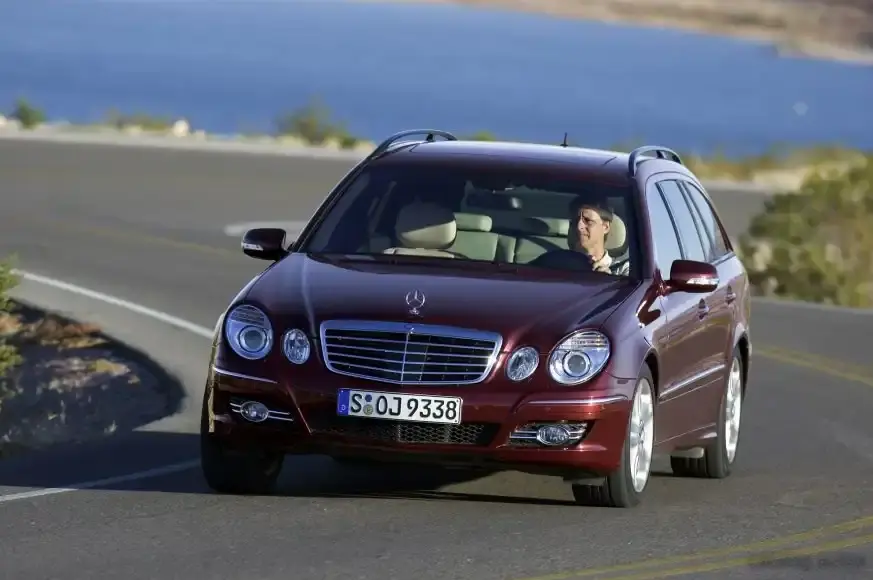
The Mercedes-Benz E-Class T-modell (S211) facelift, specifically the E 200 CDI variant producing 136 horsepower, was a popular choice in the European market from 2006 to 2009. Positioned as a practical and efficient option within the E-Class range, it offered the versatility of a station wagon (estate) combined with a fuel-efficient diesel engine. This model represented a mid-cycle refresh of the S211 generation, introducing styling updates and refined technology while maintaining the core strengths of the platform. It served as an alternative to petrol-powered E-Class wagons and competed with similar offerings from BMW, Audi, and Volvo.
Technical Specifications
| Brand | Mercedes-Benz |
| Model | E-Class |
| Generation | E-Class T-modell (S211, facelift 2006) |
| Type (Engine) | E 200 CDI (136 Hp) |
| Start of production | 2006 |
| End of production | 2009 |
| Powertrain Architecture | Internal Combustion engine |
| Body type | Station wagon (estate) |
| Seats | 5 |
| Doors | 5 |
| Fuel consumption (urban) | 9.3-9.6 l/100 km (25.3 – 24.5 US mpg) |
| Fuel consumption (extra urban) | 5.6-5.9 l/100 km (42 – 39.9 US mpg) |
| Fuel consumption (combined) | 7.1-7.2 l/100 km (33.1 – 32.7 US mpg) |
| CO2 emissions | 188-189 g/km |
| Fuel Type | Diesel |
| Acceleration 0 – 100 km/h | 10.5 sec |
| Acceleration 0 – 62 mph | 10.5 sec |
| Acceleration 0 – 60 mph | 10 sec |
| Maximum speed | 202 km/h (125.52 mph) |
| Emission standard | Euro 4 |
| Weight-to-power ratio | 12.6 kg/Hp |
| Weight-to-torque ratio | 5 kg/Nm |
| Power | 136 Hp @ 3800 rpm |
| Torque | 340 Nm @ 1800-2600 rpm (250.77 lb.-ft. @ 1800-2600 rpm) |
| Engine layout | Front, Longitudinal |
| Engine Model/Code | OM 646.952 |
| Engine displacement | 2148 cm3 (131.08 cu. in.) |
| Number of cylinders | 4 |
| Engine configuration | Inline |
| Cylinder Bore | 88 mm (3.46 in.) |
| Piston Stroke | 88.3 mm (3.48 in.) |
| Compression ratio | 17.5:1 |
| Number of valves per cylinder | 4 |
| Fuel injection system | Diesel Commonrail |
| Engine aspiration | Turbocharger, Intercooler |
| Valvetrain | DOHC |
| Engine oil capacity | 6.5 l (6.87 US qt | 5.72 UK qt) |
| Coolant | 10.2 l (10.78 US qt | 8.97 UK qt) |
| Kerb Weight | 1710 kg (3769.9 lbs.) |
| Max. weight | 2360 kg (5202.91 lbs.) |
| Max load | 650 kg (1433 lbs.) |
| Trunk (boot) space – minimum | 690 l (24.37 cu. ft.) |
| Trunk (boot) space – maximum | 1950 l (68.86 cu. ft.) |
| Fuel tank capacity | 70 l (18.49 US gal | 15.4 UK gal) |
| Max. roof load | 100 kg (220.46 lbs.) |
| Permitted trailer load with brakes (12%) | 1900 kg (4188.78 lbs.) |
| Permitted trailer load without brakes | 750 kg (1653.47 lbs.) |
| Length | 4888 mm (192.44 in.) |
| Width | 1822 mm (71.73 in.) |
| Width including mirrors | 2063 mm (81.22 in.) |
| Height | 1506 mm (59.29 in.) |
| Wheelbase | 2854 mm (112.36 in.) |
| Front track | 1559 mm (61.38 in.) |
| Rear track | 1552 mm (61.1 in.) |
| Front overhang | 869 mm (34.21 in.) |
| Rear overhang | 1165 mm (45.87 in.) |
| Drag coefficient (Cd) | 0.31 |
| Minimum turning circle | 11.4 m (37.4 ft.) |
| Drivetrain Architecture | Rear wheel drive |
| Number of gears | 6 |
| Type of gearbox | Manual transmission |
| Front suspension | Double wishbone, Transverse stabilizer |
| Rear suspension | Independent multi-link suspension, Air suspension, Transverse stabilizer |
| Front brakes | Ventilated discs |
| Rear brakes | Disc |
| Assisting systems | ABS (Anti-lock braking system) |
| Steering type | Steering rack and pinion |
| Power steering | Hydraulic Steering |
| Tires size | 255/55 R16 |
| Wheel rims size | 7.5J X 16 |
INTRODUCTION
The E 200 CDI T-modell, introduced with the 2006 facelift of the S211 E-Class, was designed to appeal to buyers seeking a practical, fuel-efficient wagon. Built on the W211 platform (specifically the S211 estate variant), it offered a spacious interior and large cargo area. The facelift brought revised front and rear styling, updated interior trim, and improvements to the engine range, including the OM 646.952 diesel engine powering the E 200 CDI. This variant occupied a middle ground in the E-Class T-modell lineup, offering a balance between performance, economy, and price. It was positioned below the more powerful E 320 CDI and petrol-powered models, and above the entry-level E 180 CDI.
Powertrain & Engine Architecture
The heart of the E 200 CDI T-modell is the OM 646.952 2.1-liter inline-four cylinder diesel engine. This engine utilizes a common rail direct injection system, delivering fuel at extremely high pressure for improved combustion efficiency and reduced emissions. The engine features a turbocharger with an intercooler, boosting power output and torque. The valvetrain is a double overhead camshaft (DOHC) design with four valves per cylinder, optimizing airflow for enhanced performance. The engine produces 136 horsepower at 3800 rpm and 340 Nm (250.77 lb.-ft.) of torque between 1800 and 2600 rpm. The standard transmission for this model was a 6-speed manual gearbox, although a 5-speed automatic transmission was also available as an option. The automatic transmission was designed to provide smooth shifts and contribute to the vehicle’s overall refinement.
Driving Characteristics
The E 200 CDI T-modell, equipped with the manual transmission, offered a respectable driving experience. Acceleration from 0 to 100 km/h (0-62 mph) took approximately 10.5 seconds, and the top speed was limited to 202 km/h (125.52 mph). While not a performance-oriented vehicle, the engine’s strong low-end torque made it well-suited for everyday driving and hauling loads. The 6-speed manual gearbox allowed for precise control and efficient cruising. Compared to the higher-output E 320 CDI, the E 200 CDI felt less powerful, particularly during overtaking maneuvers. However, it offered significantly better fuel economy. The automatic transmission, while convenient, slightly dulled the driving experience and resulted in marginally slower acceleration.
Equipment & Trim Levels
The E 200 CDI T-modell came standard with a comprehensive list of features, including automatic climate control, power windows, power mirrors, a multi-function steering wheel, and an audio system. Upholstery was typically cloth, with leather options available as an upgrade. Common optional extras included a sunroof, navigation system, parking sensors, and upgraded audio systems. Trim levels varied depending on the market, but generally included options for different wheel designs, interior trim materials, and exterior chrome accents. Safety features such as ABS, traction control, and multiple airbags were standard.
Chassis & Braking
The S211 E-Class T-modell featured a robust chassis with a double wishbone front suspension and an independent multi-link rear suspension. Many models, including the E 200 CDI, were equipped with air suspension on the rear axle, providing a comfortable ride and the ability to adjust the ride height. The braking system consisted of ventilated discs at the front and solid discs at the rear. ABS (Anti-lock Braking System) was standard, enhancing braking performance and stability. Stabilizer bars were fitted to both the front and rear axles to reduce body roll during cornering.
Market Reception & Comparison
The E 200 CDI T-modell was well-received in the European market as a practical and economical wagon. Critics praised its spacious interior, comfortable ride, and fuel efficiency. However, some noted that the engine lacked the refinement and power of its larger counterparts. Compared to the E 320 CDI, the E 200 CDI offered significantly better fuel economy (around 7.1-7.2 l/100 km vs. 8.5-9.0 l/100 km) but slower acceleration. Against competitors like the BMW 3 Series Touring and Audi A4 Avant, the E-Class T-modell offered a more luxurious interior and a larger cargo capacity.
Legacy
The OM 646 engine family, including the OM 646.952 found in the E 200 CDI, is generally considered to be a reliable and durable powerplant. While some early examples experienced issues with injector seals and turbocharger failures, these problems were largely addressed in later production years. Today, well-maintained E 200 CDI T-modell vehicles can still provide years of reliable service. The used car market values these wagons for their practicality, fuel efficiency, and relatively low running costs. However, potential buyers should be aware of the age-related wear and tear common to older vehicles and ensure a thorough inspection before purchase.