Technical Specifications
| Brand | Mercedes-Benz |
| Model | E-Class |
| Generation | E-Class T-modell (S211, facelift 2006) |
| Type (Engine) | E 200 Kompressor (184 Hp) 5G-TRONIC |
| Start of production | 2006 |
| End of production | 2009 |
| Powertrain Architecture | Internal Combustion engine |
| Body type | Station wagon (estate) |
| Seats | 5 |
| Doors | 5 |
| Fuel consumption (urban) | 12.9-13 l/100 km (18.2 – 18.1 US mpg) |
| Fuel consumption (extra urban) | 6.9-7.4 l/100 km (34.1 – 31.8 US mpg) |
| Fuel consumption (combined) | 9.2-9.4 l/100 km (25.6 – 25 US mpg) |
| CO2 emissions | 219-224 g/km |
| Fuel Type | Petrol (Gasoline) |
| Acceleration 0 – 100 km/h | 9.7 sec |
| Acceleration 0 – 62 mph | 9.7 sec |
| Acceleration 0 – 60 mph | 9.2 sec |
| Maximum speed | 222 km/h (137.94 mph) |
| Emission standard | Euro 4 |
| Weight-to-power ratio | 9.1 kg/Hp |
| Weight-to-torque ratio | 6.7 kg/Nm |
| Power | 184 Hp @ 5500 rpm |
| Torque | 250 Nm @ 3500-4000 rpm (184.39 lb.-ft.) |
| Engine layout | Front, Longitudinal |
| Engine Model/Code | M 271.956 |
| Engine displacement | 1796 cm3 (109.6 cu. in.) |
| Number of cylinders | 4 |
| Engine configuration | Inline |
| Cylinder Bore | 82 mm (3.23 in.) |
| Piston Stroke | 85 mm (3.35 in.) |
| Compression ratio | 8.5:1 |
| Number of valves per cylinder | 4 |
| Fuel injection system | Multi-port manifold injection |
| Engine aspiration | Supercharger, Intercooler |
| Valvetrain | DOHC |
| Engine oil capacity | 5.5 l (5.81 US qt | 4.84 UK qt) |
| Coolant | 9.2 l (9.72 US qt | 8.09 UK qt) |
| Kerb Weight | 1670 kg (3681.72 lbs.) |
| Max. weight | 2295 kg (5059.61 lbs.) |
| Max load | 625 kg (1377.89 lbs.) |
| Trunk (boot) space – minimum | 690 l (24.37 cu. ft.) |
| Trunk (boot) space – maximum | 1950 l (68.86 cu. ft.) |
| Fuel tank capacity | 70 l (18.49 US gal | 15.4 UK gal) |
| Max. roof load | 100 kg (220.46 lbs.) |
| Permitted trailer load with brakes (12%) | 1900 kg (4188.78 lbs.) |
| Permitted trailer load without brakes | 750 kg (1653.47 lbs.) |
| Length | 4888 mm (192.44 in.) |
| Width | 1822 mm (71.73 in.) |
| Width including mirrors | 2063 mm (81.22 in.) |
| Height | 1506 mm (59.29 in.) |
| Wheelbase | 2854 mm (112.36 in.) |
| Front track | 1559 mm (61.38 in.) |
| Rear track | 1552 mm (61.1 in.) |
| Front overhang | 869 mm (34.21 in.) |
| Rear overhang | 1165 mm (45.87 in.) |
| Drag coefficient (Cd) | 0.31 |
| Minimum turning circle | 11.4 m (37.4 ft.) |
| Drivetrain Architecture | Rear wheel drive |
| Number of gears and type of gearbox | 5 gears, automatic transmission |
| Front suspension | Double wishbone, Transverse stabilizer |
| Rear suspension | Independent multi-link suspension, Air suspension, Transverse stabilizer |
| Front brakes | Ventilated discs |
| Rear brakes | Disc |
| Assisting systems | ABS (Anti-lock braking system) |
| Steering type | Steering rack and pinion |
| Power steering | Hydraulic Steering |
| Tires size | 255/55 R16 |
| Wheel rims size | 7.5J x 16 |
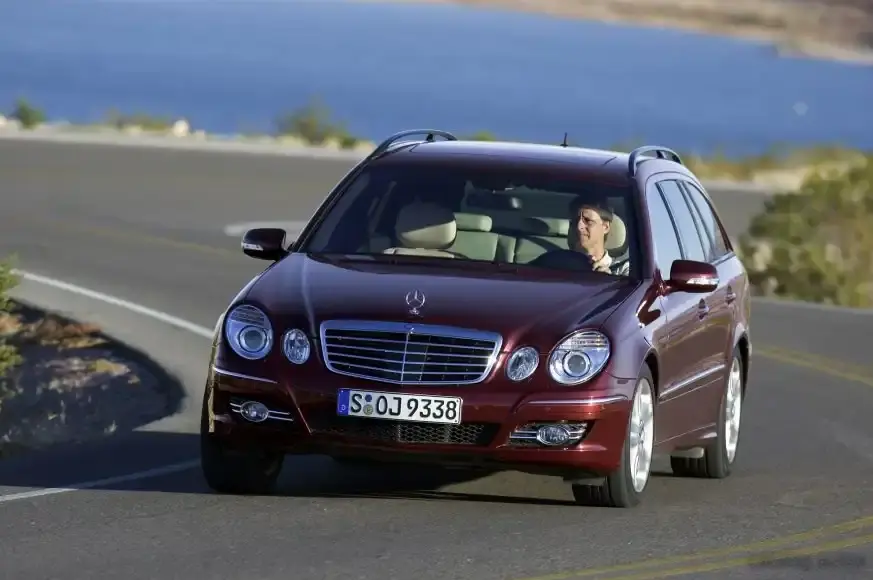
The Mercedes-Benz E-Class T-modell (S211) facelift, produced from 2006 to 2009, represented a significant refinement of the popular E-Class wagon. The E 200 Kompressor variant, equipped with a 1.8-liter supercharged engine and the 5G-TRONIC automatic transmission, occupied a crucial mid-range position within the lineup. This model aimed to balance practicality, comfort, and reasonable performance, appealing to buyers seeking a versatile family vehicle with the prestige of the Mercedes-Benz brand. It was positioned below the more powerful E 280 and E 320 models, and above the base E 200 CDI diesel.
Powertrain & Engine Architecture
The heart of the E 200 Kompressor is the M 271.956 engine, a 1.8-liter (1796 cc) inline-four cylinder powerplant. This engine is notable for its supercharger, which provides increased torque at lower engine speeds compared to naturally aspirated engines. The supercharger, an Eaton Roots-type unit, is electromagnetically controlled and engages at around 2000 rpm, significantly boosting performance. Fuel delivery is managed by a multi-port fuel injection system. The engine features a double overhead camshaft (DOHC) valvetrain with four valves per cylinder, optimizing airflow for improved efficiency and power. The 5G-TRONIC automatic transmission, a five-speed torque converter automatic, was specifically tuned to complement the engine’s characteristics. It offered smooth shifts and a focus on fuel efficiency, though it lacked the responsiveness of some contemporary manual transmissions.
Driving Characteristics
The E 200 Kompressor Automatic delivered a comfortable and refined driving experience. While not overtly sporty, the supercharger provided a noticeable surge of power, making overtaking maneuvers relatively effortless. Acceleration from 0 to 60 mph took approximately 9.2 seconds, and the top speed was electronically limited to 137.94 mph. The automatic transmission, while smooth, could feel somewhat hesitant during quick downshifts. Compared to the manual transmission versions of the E 200, the automatic offered less driver engagement. The higher-output E 280 and E 320 models provided significantly more performance, but at the cost of increased fuel consumption and a higher purchase price. The gear ratios were optimized for cruising comfort and fuel economy rather than outright acceleration.
Equipment & Trim Levels
The E 200 Kompressor typically came standard with a generous array of features, reflecting Mercedes-Benz’s commitment to luxury and comfort. Standard equipment included automatic climate control, power windows and mirrors, a multi-function steering wheel, and a high-quality audio system. Interior upholstery was typically a combination of fabric and leatherette, with full leather options available as an upgrade. Optional extras included a sunroof, navigation system, premium sound system, and parking sensors. The facelifted S211 models also benefited from revised interior trim and updated infotainment systems.
Chassis & Braking
The E 200 Kompressor T-modell featured a robust chassis designed for both comfort and handling. The front suspension utilized a double wishbone setup with a transverse stabilizer, while the rear suspension employed an independent multi-link system, often incorporating air suspension on higher trim levels. This air suspension provided a particularly smooth ride and allowed for automatic load leveling. Braking duties were handled by ventilated discs at the front and solid discs at the rear, coupled with an Anti-lock Braking System (ABS) for enhanced safety. The steering was a rack and pinion system with hydraulic power assistance, offering precise and responsive control.
Market Reception & Comparison
The E 200 Kompressor Automatic was generally well-received by automotive critics as a practical and comfortable family wagon. It was praised for its refined ride, spacious interior, and the added punch provided by the supercharger. However, some reviewers noted that the automatic transmission could feel sluggish at times, and the fuel economy, while reasonable, wasn’t class-leading. Compared to the diesel-powered E 200 CDI, the E 200 Kompressor offered more responsive performance but at the expense of fuel efficiency. Against its petrol-powered siblings, it represented a more affordable option with a good balance of performance and economy.
Legacy
The M 271 engine, in its various iterations, proved to be a relatively reliable powerplant. However, some owners have reported issues with the supercharger clutch and occasional oil leaks. The 5G-TRONIC transmission is generally durable, but regular fluid changes are crucial for maintaining its longevity. Today, the E 200 Kompressor T-modell (S211) facelift represents a compelling value proposition in the used car market. It offers a blend of practicality, comfort, and prestige at a relatively affordable price point. Well-maintained examples are still sought after by buyers looking for a versatile and reliable family wagon with the iconic Mercedes-Benz badge.