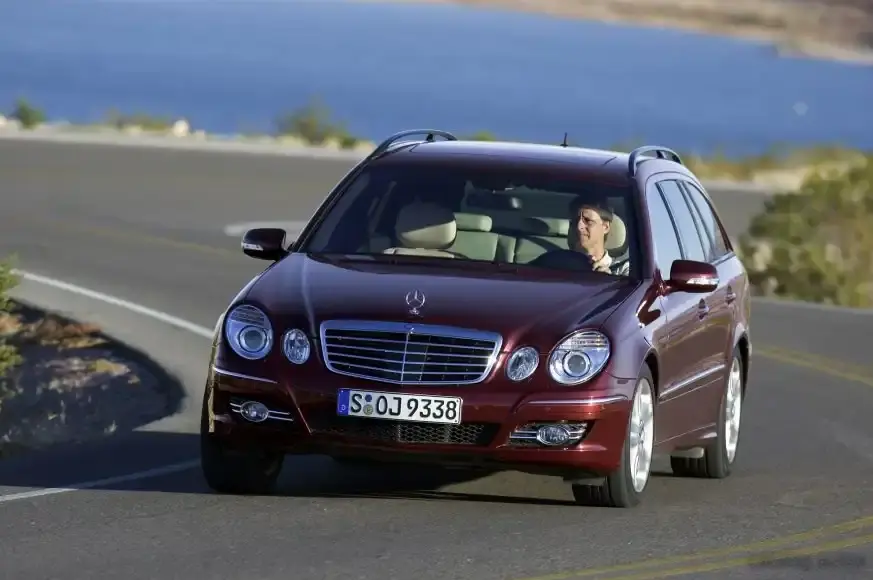
The Mercedes-Benz E 500 T-modell, part of the S211 facelift series produced from 2006 to 2009, represented the pinnacle of performance and luxury within the E-Class wagon lineup. Positioned as the flagship variant, it combined the practicality of a station wagon (estate) with the potent power of a naturally aspirated 5.5-liter V8 engine. This model catered to buyers seeking a high-performance, all-weather vehicle capable of both spirited driving and comfortable long-distance travel. The S211 generation, introduced in 2003, was a significant update to the W211 E-Class, addressing criticisms of the original model and solidifying Mercedes-Benz’s reputation for engineering excellence.
Technical Specifications
| Brand | Mercedes-Benz |
| Model | E-class |
| Generation | E-class T-modell (S211, facelift 2006) |
| Type (Engine) | E 500 V8 (388 Hp) 4MATIC 5G-TRONIC |
| Start of production | 2006 |
| End of production | 2009 |
| Powertrain Architecture | Internal Combustion engine |
| Body type | Station wagon (estate) |
| Seats | 5 |
| Doors | 5 |
| Fuel consumption (urban) | 18.2 l/100 km (12.9 US mpg, 15.5 UK mpg, 5.5 km/l) |
| Fuel consumption (extra urban) | 9.2 l/100 km (25.6 US mpg, 30.7 UK mpg, 10.9 km/l) |
| Fuel consumption (combined) | 12.6 l/100 km (18.7 US mpg, 22.4 UK mpg, 7.9 km/l) |
| CO2 emissions | 300 g/km |
| Fuel Type | Petrol (Gasoline) |
| Acceleration 0 – 100 km/h | 5.7 sec |
| Acceleration 0 – 62 mph | 5.7 sec |
| Acceleration 0 – 60 mph | 5.4 sec |
| Maximum speed | 250 km/h (155.34 mph) |
| Weight-to-power ratio | 4.9 kg/Hp, 202.6 Hp/tonne |
| Weight-to-torque ratio | 3.6 kg/Nm, 276.8 Nm/tonne |
| Power | 388 Hp @ 6000 rpm |
| Power per litre | 71 Hp/l |
| Torque | 530 Nm @ 2800-4800 rpm (390.91 lb.-ft. @ 2800-4800 rpm) |
| Engine layout | Front, Longitudinal |
| Engine Model/Code | M 273.962 |
| Engine displacement | 5461 cm3 (333.25 cu. in.) |
| Number of cylinders | 8 |
| Engine configuration | V-engine |
| Cylinder Bore | 98 mm (3.86 in.) |
| Piston Stroke | 90.5 mm (3.56 in.) |
| Compression ratio | 10.7:1 |
| Number of valves per cylinder | 4 |
| Fuel injection system | Multi-port manifold injection |
| Engine aspiration | Naturally aspirated engine |
| Engine oil capacity | 8.5 l (8.98 US qt | 7.48 UK qt) |
| Coolant | 11.3 l (11.94 US qt | 9.94 UK qt) |
| Kerb Weight | 1915 kg (4221.85 lbs.) |
| Max. weight | 2535 kg (5588.72 lbs.) |
| Max load | 620 kg (1366.87 lbs.) |
| Trunk (boot) space – minimum | 690 l (24.37 cu. ft.) |
| Trunk (boot) space – maximum | 1950 l (68.86 cu. ft.) |
| Fuel tank capacity | 80 l (21.13 US gal | 17.6 UK gal) |
| Length | 4888 mm (192.44 in.) |
| Width | 1822 mm (71.73 in.) |
| Width including mirrors | 2063 mm (81.22 in.) |
| Height | 1506 mm (59.29 in.) |
| Wheelbase | 2854 mm (112.36 in.) |
| Front track | 1559 mm (61.38 in.) |
| Rear (Back) track | 1552 mm (61.1 in.) |
| Front overhang | 869 mm (34.21 in.) |
| Rear overhang | 1165 mm (45.87 in.) |
| Minimum turning circle | 11.4 m (37.4 ft.) |
| Drive wheel | All wheel drive (4×4) |
| Number of gears | 5 |
| Gearbox type | automatic transmission |
| Front suspension | Air suspension |
| Rear suspension | Air suspension |
| Front brakes | Ventilated discs |
| Rear brakes | Ventilated discs |
| Assisting systems | ABS (Anti-lock braking system) |
| Steering type | Steering rack and pinion |
| Tires size | 245/45R17 |
| Wheel rims size | 17 |
Powertrain & Engine Architecture
The heart of the E 500 T-modell was the M273.962 5.5-liter naturally aspirated V8 engine. This engine, a cornerstone of Mercedes-Benz’s engineering prowess, featured all-aluminum construction, three valves per cylinder, and a sophisticated multi-port fuel injection system. The engine produced 388 horsepower at 6000 rpm and a substantial 530 Nm (390.91 lb-ft) of torque available from 2800 to 4800 rpm. This broad torque curve provided effortless acceleration in virtually any gear. The engine’s design prioritized smooth operation and refinement over outright peak power, aligning with Mercedes-Benz’s focus on a luxurious driving experience. The engine was paired with the 5G-TRONIC automatic transmission, a five-speed unit known for its smooth shifts and adaptive learning capabilities. This transmission was specifically tuned to handle the V8’s power and torque, offering both automatic and manual shift modes.
Driving Characteristics
The E 500 T-modell delivered a unique blend of performance and practicality. The 5.7-second 0-60 mph acceleration time was impressive for a wagon of its size and weight. The 5G-TRONIC transmission, while not as quick-shifting as some modern gearboxes, provided seamless gear changes and contributed to the car’s overall refinement. The 4MATIC all-wheel-drive system ensured excellent traction in all weather conditions, making it a capable year-round vehicle. Compared to the E 350 wagon, the E 500 offered a significantly more powerful and responsive driving experience. While the E 350 provided adequate performance, the E 500’s V8 delivered a level of effortless power that was particularly noticeable when fully loaded or towing. The air suspension, standard on this model, further enhanced ride comfort and handling, providing a smooth and controlled ride even on uneven surfaces.
Equipment & Trim Levels
The E 500 T-modell came standard with a comprehensive list of features, befitting its flagship status. These included leather upholstery, wood trim, automatic climate control, a premium sound system, and a sunroof. Standard safety features included ABS, traction control, stability control, and multiple airbags. Optional extras included a navigation system, heated and ventilated front seats, a rear entertainment system, and advanced parking assist features. The interior was designed with a focus on luxury and comfort, offering a spacious and well-appointed cabin. The wagon’s rear seats could be folded down to create a large cargo area, further enhancing its practicality.
Chassis & Braking
The S211 E-Class featured a robust chassis designed to handle the power of the V8 engine. The E 500 T-modell was equipped with an air suspension system, providing adjustable ride height and damping. This system allowed drivers to tailor the suspension to their preferences, prioritizing comfort or handling as desired. The braking system consisted of ventilated discs on all four wheels, providing ample stopping power. The ABS (Anti-lock Braking System) and stability control systems further enhanced safety and control, particularly in emergency braking situations.
Market Reception & Comparison
The E 500 T-modell was generally well-received by automotive critics, who praised its powerful engine, luxurious interior, and all-weather capability. However, its high price tag and relatively poor fuel economy were often cited as drawbacks. Compared to other performance wagons of the time, such as the BMW 5 Series Touring and the Audi A6 Avant, the E 500 offered a unique combination of power, luxury, and practicality. While the BMW and Audi offered more sporty handling characteristics, the E 500 prioritized comfort and refinement. Fuel economy was a common criticism, with the combined fuel consumption of 12.6 l/100 km (18.7 US mpg) being significantly higher than that of the smaller-engined variants.
Legacy
The M273 engine, found in the E 500 T-modell, is generally considered a reliable powerplant when properly maintained. Common issues include occasional oil leaks and problems with the thermostat. The 5G-TRONIC transmission is also generally reliable, but requires regular fluid changes to ensure smooth operation. Today, the E 500 T-modell is a sought-after vehicle among enthusiasts who appreciate its unique combination of performance, luxury, and practicality. Well-maintained examples command a premium in the used car market, reflecting their rarity and desirability. The S211 E-Class, and particularly the E 500 variant, represents a high point in Mercedes-Benz’s wagon history, offering a compelling alternative to traditional SUVs and crossovers.