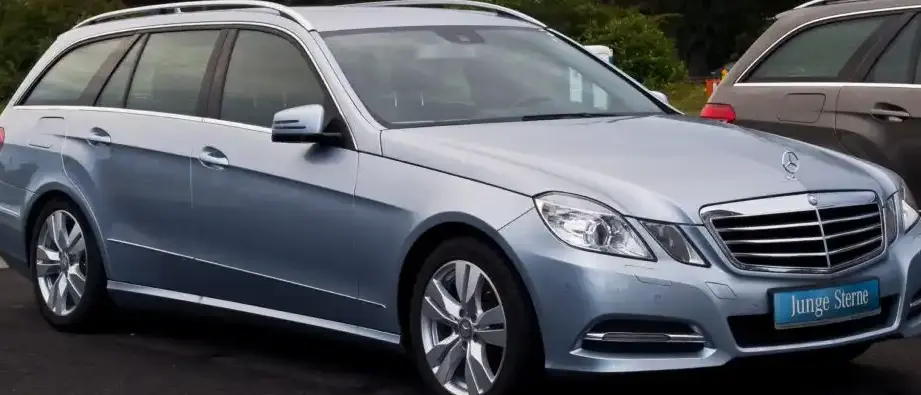
The Mercedes-Benz E 500 T-modell (S212), produced from November 2009 to August 2011, represented the high-performance estate variant of the third-generation (W212) E-Class. Positioned as the flagship of the T-modell lineup, it combined the practicality of a station wagon with the power of a naturally aspirated V8 engine. This model occupied the premium segment, offering a blend of luxury, performance, and cargo capacity aimed at buyers seeking a versatile yet powerful vehicle. It was built on the 1HX0 platform, shared with the E-Class sedan and coupe.
Technical Specifications
| Brand | Mercedes-Benz |
| Model | E-class |
| Generation | E-class T-modell (S212) |
| Type | E 500 V8 (388 Hp) 7G-TRONIC |
| Start of production | November, 2009 |
| End of production | August, 2011 |
| Powertrain Architecture | Internal Combustion engine |
| Body type | Station wagon (estate) |
| Seats | 5 |
| Doors | 5 |
| Fuel consumption (urban) | 16.2-16.3 l/100 km (14.5 – 14.4 US mpg, 17.4 – 17.3 UK mpg, 6.2 – 6.1 km/l) |
| Fuel consumption (extra urban) | 8-8.1 l/100 km (29.4 – 29 US mpg, 35.3 – 34.9 UK mpg, 12.5 – 12.3 km/l) |
| Fuel consumption (combined) | 11.1-11.2 l/100 km (21.2 – 21 US mpg, 25.4 – 25.2 UK mpg, 9 – 8.9 km/l) |
| CO2 emissions | 258-260 g/km |
| Fuel Type | Petrol (Gasoline) |
| Acceleration 0 – 100 km/h | 5.4 sec |
| Acceleration 0 – 62 mph | 5.4 sec |
| Acceleration 0 – 60 mph | 5.1 sec |
| Maximum speed | 250 km/h (155.34 mph) – Electronically limited |
| Emission standard | Euro 5 |
| Weight-to-power ratio | 4.8 kg/Hp, 209.7 Hp/tonne |
| Weight-to-torque ratio | 3.5 kg/Nm, 286.5 Nm/tonne |
| Power | 388 Hp @ 6000 rpm |
| Power per litre | 71 Hp/l |
| Torque | 530 Nm @ 2800-4800 rpm (390.91 lb.-ft. @ 2800-4800 rpm) |
| Engine layout | Front, Longitudinal |
| Engine Model/Code | M 273.971 |
| Engine displacement | 5461 cm3 (333.25 cu. in.) |
| Number of cylinders | 8 |
| Engine configuration | V-engine |
| Cylinder Bore | 98 mm (3.86 in.) |
| Piston Stroke | 90.5 mm (3.56 in.) |
| Compression ratio | 10.7:1 |
| Number of valves per cylinder | 4 |
| Fuel injection system | Multi-port manifold injection |
| Engine aspiration | Naturally aspirated engine |
| Valvetrain | DOHC |
| Engine oil capacity | 8.5 l (8.98 US qt | 7.48 UK qt) |
| Kerb Weight | 1850 kg (4078.55 lbs.) |
| Max. weight | 2500 kg (5511.56 lbs.) |
| Max load | 650 kg (1433 lbs.) |
| Trunk (boot) space – minimum | 695 l (24.54 cu. ft.) |
| Trunk (boot) space – maximum | 1220 l (43.08 cu. ft.) |
| Fuel tank capacity | 80 l (21.13 US gal | 17.6 UK gal) |
| Max. roof load | 100 kg (220.46 lbs.) |
| Permitted trailer load with brakes (12%) | 2100 kg (4629.71 lbs.) |
| Permitted trailer load without brakes | 750 kg (1653.47 lbs.) |
| Permitted towbar download | 84 kg (185.19 lbs.) |
| Length | 4895 mm (192.72 in.) |
| Width | 1854 mm (72.99 in.) |
| Width including mirrors | 2071 mm (81.54 in.) |
| Height | 1512 mm (59.53 in.) |
| Wheelbase | 2874 mm (113.15 in.) |
| Front track | 1585 mm (62.4 in.) |
| Rear track | 1604 mm (63.15 in.) |
| Front overhang | 841 mm (33.11 in.) |
| Rear overhang | 1180 mm (46.46 in.) |
| Drag coefficient (Cd) | 0.31 |
| Minimum turning circle | 11.25 m (36.91 ft.) |
| Drivetrain Architecture | Rear wheel drive |
| Number of gears and type of gearbox | 7 gears, automatic transmission G-TRONIC |
| Front suspension | Independent multi-link suspension, Transverse stabilizer, Air suspension |
| Rear suspension | Independent multi-link suspension, Air suspension, Transverse stabilizer |
| Front brakes | Ventilated discs |
| Rear brakes | Ventilated discs |
| Assisting systems | ABS (Anti-lock braking system) |
| Steering type | Steering rack and pinion |
| Power steering | Hydraulic Steering |
| Tires size (Front) | 245/45 R17; 245/40 R18 |
| Tires size (Rear) | 245/45 R17; 265/35 R18 |
| Wheel rims size (Front) | 8J x 17; 8.5J x 18 |
| Wheel rims size (Rear) | 8J x 17; 9J x 18 |
Powertrain & Engine Architecture
The E 500 T-modell was powered by the M273.971 5.5-liter naturally aspirated V8 engine. This engine, a mainstay of Mercedes-Benz’s performance lineup at the time, featured a three-valve per cylinder (two intake, one exhaust) design and a multi-port fuel injection system. The engine produced 388 horsepower at 6000 rpm and 530 Nm (390.91 lb-ft) of torque between 2800 and 4800 rpm. The engine’s architecture was a 90-degree V8, known for its smooth operation and inherent balance. It utilized a cast aluminum engine block and cylinder heads. The 7G-TRONIC seven-speed automatic transmission was standard, offering smooth and relatively quick shifts. This transmission was known for its efficiency and adaptability to different driving styles.
Driving Characteristics
The combination of the powerful V8 and the 7G-TRONIC transmission resulted in brisk acceleration. The 0-60 mph sprint was achieved in approximately 5.1 seconds, and the car was electronically limited to a top speed of 155 mph. While the automatic transmission didn’t offer the direct control of a manual gearbox, it provided seamless power delivery and made the E 500 T-modell a comfortable and effortless grand tourer. Compared to the E 350 models, the E 500 offered significantly more power and torque, resulting in a more engaging driving experience. However, the increased weight of the V8 engine did slightly impact handling agility compared to lighter, four-cylinder variants.
Equipment & Trim Levels
The E 500 T-modell came standard with a high level of equipment, befitting its flagship status. This included leather upholstery, wood trim, a premium sound system, automatic climate control, and a host of safety features such as ABS, traction control, and multiple airbags. Optional extras included features like a panoramic sunroof, adaptive cruise control, a navigation system, and upgraded interior trim options. The standard interior configuration featured comfortable and supportive seats, a well-designed dashboard, and a user-friendly infotainment system for its time.
Chassis & Braking
The S212 E-Class T-modell featured an independent multi-link suspension at both the front and rear, providing a comfortable ride and good handling characteristics. The E 500 typically came equipped with air suspension on the rear axle, further enhancing ride quality and allowing for adjustable ride height. Braking duties were handled by ventilated discs on all four wheels, providing ample stopping power. The car also featured a hydraulic power steering system, offering precise and responsive steering feel.
Market Reception & Comparison
The E 500 T-modell was generally well-received by automotive critics, who praised its powerful engine, luxurious interior, and practical wagon body style. However, its fuel consumption was a common criticism, as the V8 engine was not particularly fuel-efficient. Compared to the E 350 T-modell, the E 500 offered a significant performance upgrade but came at a higher price and with increased running costs. The diesel-powered E 350 CDI T-modell offered comparable performance with significantly better fuel economy, making it a popular alternative for buyers prioritizing efficiency.
Legacy
The M273 engine, while robust, can require maintenance as it ages, particularly regarding valve cover gaskets and oil leaks. The 7G-TRONIC transmission is generally reliable but may require fluid changes and occasional servicing. Today, the E 500 T-modell represents a unique combination of performance, luxury, and practicality. It’s a relatively rare vehicle on the used car market, and well-maintained examples are sought after by enthusiasts who appreciate its distinctive character and powerful V8 engine. Its blend of attributes makes it a compelling alternative to more common performance wagons.