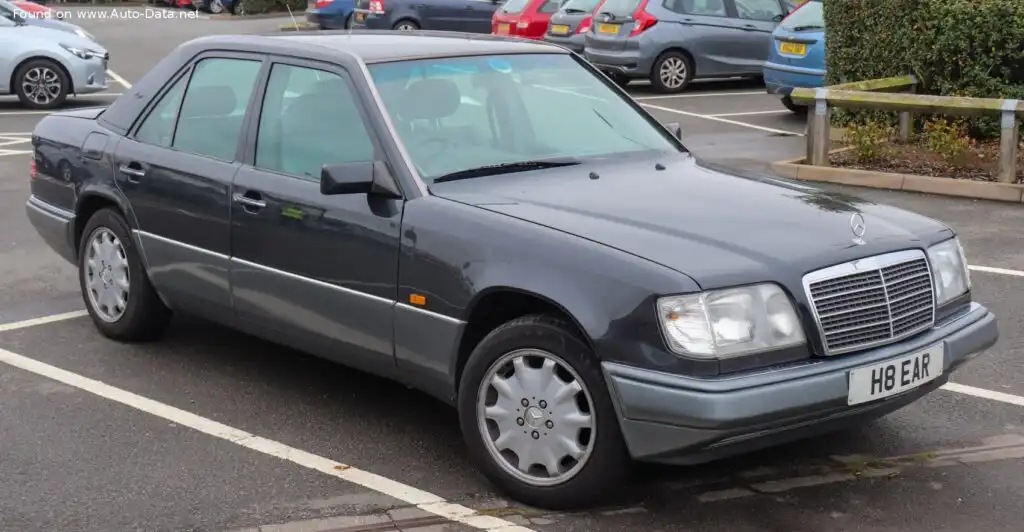
The Mercedes-Benz E 250 Turbodiesel, produced between July 1993 and June 1995, was a significant variant within the W124 E-Class range. Positioned as a fuel-efficient and durable option, it catered to buyers prioritizing long-distance comfort and reliability over outright performance. This model represented a refinement of Mercedes-Benz’s diesel technology, offering a blend of respectable power and impressive economy within the mid-size luxury sedan segment. It was a popular choice in Europe, where diesel fuel was more readily available and economically advantageous, and found a niche following in North America as well.
Technical Specifications
| Brand | Mercedes-Benz |
| Model | E-class |
| Generation | E-class (W124) |
| Type (Engine) | E 250 Turbodiesel (126 Hp) |
| Start of production | July, 1993 |
| End of production | June, 1995 |
| Powertrain Architecture | Internal Combustion engine |
| Body type | Sedan |
| Seats | 5 |
| Doors | 4 |
| Fuel consumption (urban) | 9.6 l/100 km (24.5 US mpg) |
| Fuel consumption (extra urban) | 5.6 l/100 km (42 US mpg) |
| Fuel Type | Diesel |
| Acceleration 0 – 100 km/h | 12.3 sec |
| Acceleration 0 – 62 mph | 12.3 sec |
| Acceleration 0 – 60 mph | 11.7 sec |
| Maximum speed | 198 km/h (123.03 mph) |
| Weight-to-power ratio | 11.4 kg/Hp |
| Weight-to-torque ratio | 6.2 kg/Nm |
| Power | 126 Hp @ 4600 rpm |
| Power per litre | 50.5 Hp/l |
| Torque | 231 Nm @ 2400 rpm (170.38 lb.-ft. @ 2400 rpm) |
| Engine layout | Front, Longitudinal |
| Engine Model/Code | OM 602 D 25 A / 602.962 |
| Engine displacement | 2497 cm3 (152.38 cu. in.) |
| Number of cylinders | 5 |
| Engine configuration | Inline |
| Cylinder Bore | 87 mm (3.43 in.) |
| Piston Stroke | 84 mm (3.31 in.) |
| Compression ratio | 22:1 |
| Number of valves per cylinder | 2 |
| Fuel injection system | Precombustion chamber injection |
| Engine aspiration | Turbocharger |
| Valvetrain | SOHC |
| Engine oil capacity | 7.5 l (7.93 US qt | 6.6 UK qt) |
| Coolant | 9.5 l (10.04 US qt | 8.36 UK qt) |
| Kerb Weight | 1440 kg (3174.66 lbs.) |
| Max. weight | 2030 kg (4475.38 lbs.) |
| Max load | 590 kg (1300.73 lbs.) |
| Fuel tank capacity | 70 l (18.49 US gal | 15.4 UK gal) |
| Length | 4740 mm (186.61 in.) |
| Width | 1740 mm (68.5 in.) |
| Height | 1430 mm (56.3 in.) |
| Wheelbase | 2800 mm (110.24 in.) |
| Front track | 1501 mm (59.09 in.) |
| Rear track | 1491 mm (58.7 in.) |
| Drivetrain Architecture | Rear wheel drive |
| Number of gears | 5 gears, manual transmission |
| Front suspension | Wishbone |
| Rear suspension | Independent multi-link suspension |
| Front brakes | Ventilated discs |
| Rear brakes | Disc |
| Assisting systems | ABS (Anti-lock braking system) |
| Steering type | Cone worm with recirculation balls |
| Power steering | Hydraulic Steering |
| Tires size | 195/65 R15 |
| Wheel rims size | 6.5J x 15 |
Introduction
The W124 E-Class, launched in 1985, represented a significant leap forward in Mercedes-Benz engineering and safety. The E 250 Turbodiesel, introduced in 1993, was a late-production model within this generation, benefitting from ongoing refinements. It aimed to provide a balance between the performance of the gasoline-powered E 280 and E 320 models, and the exceptional fuel economy of the non-turbocharged diesel variants. The “Turbodiesel” designation indicated the presence of a turbocharger, significantly boosting power output compared to naturally aspirated diesel engines of the time. This variant was primarily sold in Europe, where diesel engines were favored due to fuel costs and taxation, but also found a dedicated following in the United States among those seeking a durable and economical luxury vehicle.
Powertrain & Engine Architecture
The heart of the E 250 Turbodiesel is the OM 602 D 25 A engine, a 2.5-liter inline five-cylinder diesel. This engine utilized precombustion chamber injection, a system where fuel is partially combusted in a small chamber before entering the main cylinder, promoting more complete combustion and reducing engine noise. The turbocharger, a Garrett unit, forces more air into the cylinders, increasing power output to 126 horsepower and 231 Nm (170 lb-ft) of torque. The engine featured a single overhead camshaft (SOHC) valvetrain, operating two valves per cylinder. The five-cylinder configuration offered a smoother running experience compared to traditional four-cylinder diesels. The E 250 Turbodiesel was typically paired with a five-speed manual transmission, although an optional four-speed automatic transmission was available. The automatic, while offering convenience, did slightly diminish acceleration and fuel economy.
Driving Characteristics
The E 250 Turbodiesel, even with the manual transmission, wasn’t designed for rapid acceleration. Its 0-60 mph time of around 11.7 seconds reflects its focus on efficiency rather than outright speed. However, the turbocharger provided a noticeable boost in power, making highway overtaking manageable. The engine delivered strong low-end torque, making it well-suited for relaxed cruising and towing. The manual transmission allowed for greater control and engagement, while the automatic offered a smoother, more effortless driving experience. Compared to the more powerful E 280 or E 320, the E 250 Turbodiesel felt less responsive, but it offered significantly better fuel economy. Compared to the naturally aspirated diesel models, the turbocharger provided a substantial increase in power, making the E 250 Turbodiesel a more versatile option for various driving conditions.
Equipment & Trim Levels
The E 250 Turbodiesel typically came with a respectable level of standard equipment, befitting a Mercedes-Benz. This included power windows, central locking, and a basic audio system. Interior upholstery was usually cloth, although leather was available as an option. Trim levels varied depending on the market, but common options included a sunroof, automatic climate control, and upgraded audio systems. The dashboard layout was typical of the W124, featuring a functional and understated design. The E 250 Turbodiesel was often seen as a step up from the base diesel models, offering a more refined interior and additional features.
Chassis & Braking
The W124 E-Class featured a robust chassis with independent suspension all around. The front suspension utilized wishbones, while the rear employed a multi-link setup, providing a comfortable and controlled ride. The E 250 Turbodiesel was equipped with ventilated disc brakes at the front and solid discs at the rear. Anti-lock braking system (ABS) was standard, enhancing safety and stability. The steering was a recirculating ball system with hydraulic power assistance, offering a good balance of feel and ease of use. The suspension was tuned to prioritize comfort, but it also provided adequate handling for a vehicle of its size and weight.
Market Reception & Comparison
The E 250 Turbodiesel was generally well-received by automotive critics, who praised its fuel efficiency, durability, and comfortable ride. However, some criticized its relatively slow acceleration compared to its gasoline-powered counterparts. In terms of fuel economy, the E 250 Turbodiesel significantly outperformed the E 280 and E 320, making it an attractive option for high-mileage drivers. Reliability was a strong point, with the OM 602 engine being known for its longevity. Compared to other diesel models in the lineup, the E 250 Turbodiesel offered a noticeable performance advantage thanks to the turbocharger.
Legacy
The OM 602 engine, found in the E 250 Turbodiesel, is renowned for its robustness and longevity. Well-maintained examples can still be found on the road today, often with very high mileage. The E 250 Turbodiesel has gained a reputation as a reliable and economical classic car, appealing to enthusiasts who appreciate its understated elegance and durable engineering. In the used car market, these models are generally sought after for their potential for long-term ownership and relatively low running costs. While parts availability can be a concern for some W124 models, the OM 602 engine benefits from a relatively good supply of aftermarket components.