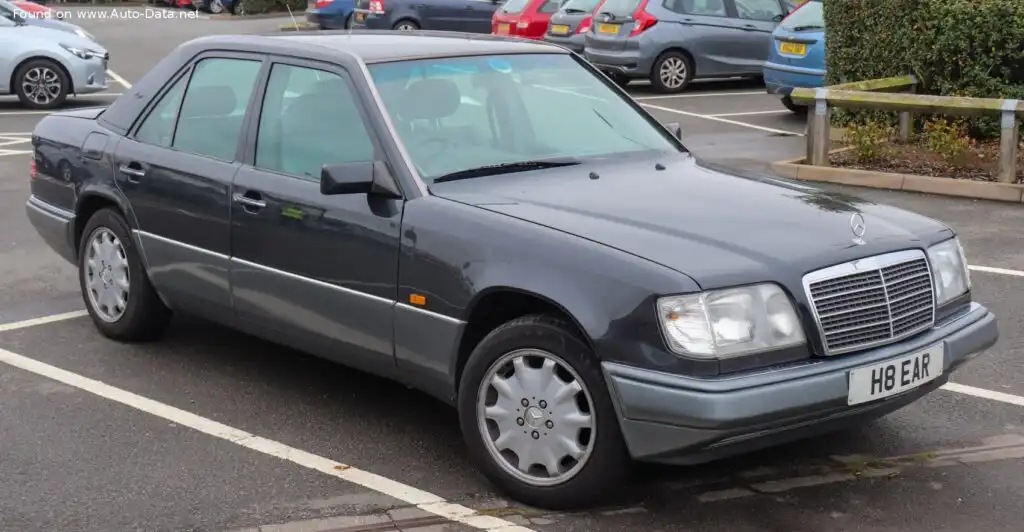
The Mercedes-Benz E 250 Turbodiesel Automatic, produced between July 1993 and June 1995, represents a compelling blend of fuel efficiency and robust engineering within the W124 E-Class range. Positioned as a mid-range offering, it catered to buyers seeking a comfortable, durable, and economical luxury sedan. This variant utilized a turbocharged 2.5-liter inline-five cylinder diesel engine paired with a four-speed automatic transmission, offering a refined driving experience compared to the base model while remaining more accessible than the higher-performance gasoline options. The W124 platform, renowned for its build quality and longevity, provided a solid foundation for this practical and dependable vehicle.
Technical Specifications
| Brand | Mercedes-Benz |
| Model | E-class |
| Generation | E-class (W124) |
| Type (Engine) | E 250 Turbodiesel (126 Hp) Automatic |
| Start of production | July, 1993 |
| End of production | June, 1995 |
| Powertrain Architecture | Internal Combustion engine |
| Body type | Sedan |
| Seats | 5 |
| Doors | 4 |
| Fuel consumption (urban) | 9.2 l/100 km (25.6 US mpg) |
| Fuel consumption (extra urban) | 6 l/100 km (39.2 US mpg) |
| Fuel Type | Diesel |
| Acceleration 0 – 100 km/h | 12.3 sec |
| Acceleration 0 – 62 mph | 12.3 sec |
| Acceleration 0 – 60 mph | 11.7 sec |
| Maximum speed | 195 km/h (121.17 mph) |
| Weight-to-power ratio | 11.4 kg/Hp |
| Weight-to-torque ratio | 6.2 kg/Nm |
| Power | 126 Hp @ 4600 rpm |
| Power per litre | 50.5 Hp/l |
| Torque | 231 Nm @ 2400 rpm (170.38 lb.-ft. @ 2400 rpm) |
| Engine layout | Front, Longitudinal |
| Engine Model/Code | OM 602 D 25 A / 602.962 |
| Engine displacement | 2497 cm3 (152.38 cu. in.) |
| Number of cylinders | 5 |
| Engine configuration | Inline |
| Cylinder Bore | 87 mm (3.43 in.) |
| Piston Stroke | 84 mm (3.31 in.) |
| Compression ratio | 22:1 |
| Number of valves per cylinder | 2 |
| Fuel injection system | Precombustion chamber injection |
| Engine aspiration | Turbocharger |
| Valvetrain | SOHC |
| Engine oil capacity | 7.5 l (7.93 US qt | 6.6 UK qt) |
| Coolant | 9.5 l (10.04 US qt | 8.36 UK qt) |
| Kerb Weight | 1440 kg (3174.66 lbs.) |
| Max. weight | 2030 kg (4475.38 lbs.) |
| Max load | 590 kg (1300.73 lbs.) |
| Fuel tank capacity | 70 l (18.49 US gal | 15.4 UK gal) |
| Length | 4740 mm (186.61 in.) |
| Width | 1740 mm (68.5 in.) |
| Height | 1430 mm (56.3 in.) |
| Wheelbase | 2800 mm (110.24 in.) |
| Front track | 1501 mm (59.09 in.) |
| Rear track | 1491 mm (58.7 in.) |
| Drivetrain Architecture | Rear wheel drive |
| Number of gears | 4 |
| Gearbox type | automatic transmission |
| Front suspension | Wishbone |
| Rear suspension | Independent multi-link suspension |
| Front brakes | Ventilated discs |
| Rear brakes | Disc |
| Assisting systems | ABS (Anti-lock braking system) |
| Steering type | Cone worm with recirculation balls |
| Power steering | Hydraulic Steering |
| Tires size | 195/65 R15 |
| Wheel rims size | 6.5J x 15 |
Powertrain & Engine Architecture
The heart of the E 250 Turbodiesel is the OM 602 D 25 A engine, a 2.5-liter inline-five cylinder diesel. This engine utilizes precombustion chamber injection, a system where fuel is injected into a small pre-chamber connected to the main combustion chamber, promoting more complete combustion and reducing noise. The addition of a turbocharger significantly boosted power output to 126 horsepower and 231 Nm (170 lb-ft) of torque. The four-speed automatic transmission, a common unit in Mercedes-Benz vehicles of the era, was chosen for its smoothness and ease of use. While not offering the sporty responsiveness of a manual gearbox, it complemented the engine’s torque curve, providing effortless cruising and acceptable acceleration. The engine’s longitudinal front-engine layout was typical for rear-wheel-drive Mercedes-Benz sedans.
Driving Characteristics
The E 250 Turbodiesel Automatic delivered a comfortable and refined driving experience. The automatic transmission, while lacking the direct control of a manual, provided smooth gear changes and made city driving particularly easy. Acceleration was adequate, with a 0-60 mph time of around 11.7 seconds, but it wasn’t designed for outright speed. The engine’s strong low-end torque made it well-suited for highway cruising and overtaking. Compared to the more powerful E 320 gasoline models, the E 250 Turbodiesel offered significantly better fuel economy, but at the expense of performance. Compared to the manual transmission version, the automatic traded some responsiveness for convenience.
Equipment & Trim Levels
The E 250 Turbodiesel Automatic typically came standard with features expected of a luxury sedan in the early 1990s. These included power windows, central locking, air conditioning, and a basic audio system. Interior upholstery was usually cloth, though leather was available as an option. Dashboard configuration was consistent across the W124 range, featuring a straightforward layout with clearly marked gauges. Optional extras included a sunroof, upgraded audio systems, and automatic climate control. The trim level was generally considered mid-range, offering a good balance of features and affordability.
Chassis & Braking
The W124 chassis provided a robust and comfortable ride. The front suspension utilized wishbones, while the rear featured an independent multi-link setup, contributing to good handling and stability. Braking duties were handled by ventilated discs at the front and solid discs at the rear. Anti-lock braking system (ABS) was standard, enhancing safety. The E 250 Turbodiesel’s weight of approximately 1440 kg (3175 lbs) was relatively moderate for a vehicle of its size, contributing to manageable handling characteristics. Stabilizer bars were fitted front and rear to reduce body roll during cornering.
Market Reception & Comparison
The E 250 Turbodiesel Automatic was well-received in European markets, where diesel engines were popular due to their fuel efficiency and lower running costs. Critics praised its comfortable ride, robust build quality, and economical engine. However, some noted that the automatic transmission could feel slightly sluggish compared to the manual option. Compared to other trims in the E-Class lineup, the E 250 Turbodiesel offered a compelling value proposition for buyers prioritizing fuel economy and durability over outright performance. It was a practical choice for long-distance drivers and those seeking a reliable family sedan.
Legacy
The OM 602 engine family, including the 2.5-liter variant found in the E 250 Turbodiesel, is renowned for its longevity and reliability. With proper maintenance, these engines can accumulate very high mileage. Today, the W124 E-Class, including the E 250 Turbodiesel, enjoys a strong following among classic car enthusiasts. The combination of robust engineering, comfortable ride, and relatively simple mechanics makes it a popular choice for restoration and preservation. While finding parts can sometimes be a challenge, the availability of aftermarket support ensures that these vehicles can remain on the road for years to come. The E 250 Turbodiesel Automatic stands as a testament to Mercedes-Benz’s commitment to building durable and dependable automobiles.