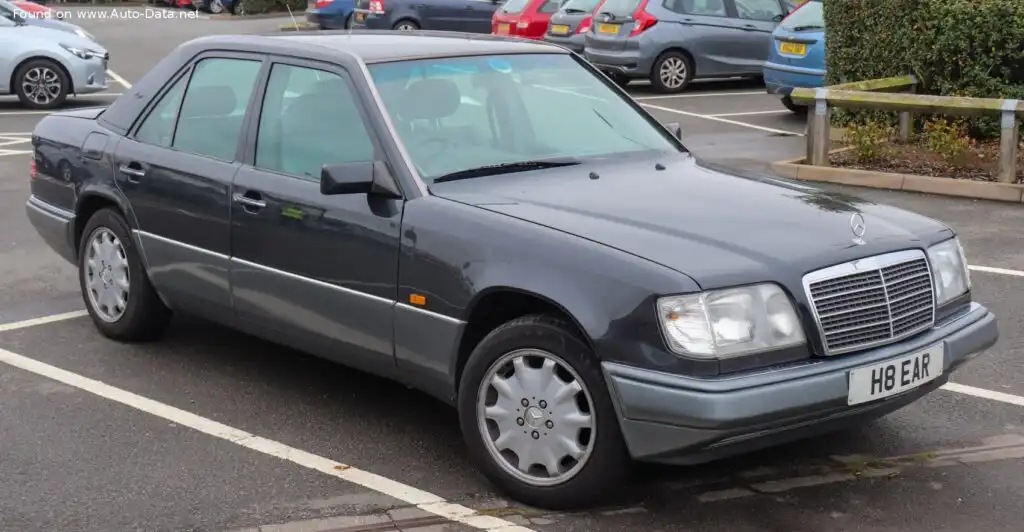
The Mercedes-Benz E 280 (W124), produced between July 1993 and August 1995, represented a compelling blend of luxury and performance within the highly successful W124 E-Class range. Positioned as a mid-to-upper tier offering, it slotted above the E 220 and E 230 models, offering a significant power upgrade without reaching the price point of the flagship E 320 or E 420. This variant was primarily aimed at buyers seeking a refined driving experience with ample power for both comfortable cruising and spirited driving, particularly on the Autobahn. The W124 platform, renowned for its build quality and durability, provided a solid foundation for the E 280’s sophisticated engineering.
Technical Specifications
| Brand | Mercedes-Benz |
| Model | E-class |
| Generation | E-class (W124) |
| Type (Engine) | E 280 (193 Hp) Automatic |
| Start of production | July, 1993 |
| End of production | August, 1995 |
| Powertrain Architecture | Internal Combustion engine |
| Body type | Sedan |
| Seats | 5 |
| Doors | 4 |
| Fuel consumption (urban) | 13.3 l/100 km (17.7 US mpg, 21.2 UK mpg, 7.5 km/l) |
| Fuel consumption (extra urban) | 8.5 l/100 km (27.7 US mpg, 33.2 UK mpg, 11.8 km/l) |
| Fuel Type | Petrol (Gasoline) |
| Acceleration 0 – 100 km/h | 8.8 sec |
| Acceleration 0 – 62 mph | 8.8 sec |
| Acceleration 0 – 60 mph | 8.4 sec |
| Maximum speed | 225 km/h (139.81 mph) |
| Weight-to-power ratio | 7.7 kg/Hp, 129.5 Hp/tonne |
| Weight-to-torque ratio | 5.5 kg/Nm, 181.2 Nm/tonne |
| Power | 193 Hp @ 5500 rpm |
| Power per litre | 69 Hp/l |
| Torque | 270 Nm @ 3750 rpm (199.14 lb.-ft. @ 3750 rpm) |
| Engine layout | Front, Longitudinal |
| Engine Model/Code | M 104 E 28 / 104.942 |
| Engine displacement | 2799 cm3 (170.81 cu. in.) |
| Number of cylinders | 6 |
| Engine configuration | Inline |
| Cylinder Bore | 89.9 mm (3.54 in.) |
| Piston Stroke | 73.5 mm (2.89 in.) |
| Compression ratio | 10:1 |
| Number of valves per cylinder | 4 |
| Fuel injection system | Multi-port manifold injection |
| Engine aspiration | Naturally aspirated engine |
| Valvetrain | DOHC |
| Engine oil capacity | 7.5 l (7.93 US qt | 6.6 UK qt) |
| Coolant | 9 l (9.51 US qt | 7.92 UK qt) |
| Kerb Weight | 1490 kg (3284.89 lbs.) |
| Max. weight | 2050 kg (4519.48 lbs.) |
| Max load | 560 kg (1234.59 lbs.) |
| Trunk (boot) space – minimum | 520 l (18.36 cu. ft.) |
| Fuel tank capacity | 70 l (18.49 US gal | 15.4 UK gal) |
| Length | 4740 mm (186.61 in.) |
| Width | 1740 mm (68.5 in.) |
| Height | 1430 mm (56.3 in.) |
| Wheelbase | 2800 mm (110.24 in.) |
| Front track | 1501 mm (59.09 in.) |
| Rear (Back) track | 1491 mm (58.7 in.) |
| Drivetrain Architecture | The Internal combustion engine (ICE) drives the rear wheels of the vehicle. |
| Drive wheel | Rear wheel drive |
| Number of gears and type of gearbox | 4 gears, automatic transmission |
| Front suspension | Wishbone |
| Rear suspension | Independent multi-link suspension |
| Front brakes | Ventilated discs |
| Rear brakes | Disc |
| Assisting systems | ABS (Anti-lock braking system) |
| Steering type | Cone worm with recirculation balls |
| Power steering | Hydraulic Steering |
| Tires size | Front wheel tires: 195/65 R15Rear wheel tires: 195/65 R15 |
| Wheel rims size | Front wheel rims: 6.5J x 15Rear wheel rims: 6.5J x 15 |
Powertrain & Engine Architecture
The heart of the E 280 is the M104.942 engine, a 2.8-liter inline-six cylinder powerplant. This engine, a descendant of the renowned M104 series, was known for its smoothness and reliability. It featured a cast iron block with an aluminum cylinder head, incorporating dual overhead camshafts (DOHC) and four valves per cylinder. The M104 utilized Bosch Motronic fuel injection, a sophisticated system for its time, delivering precise fuel metering for optimal performance and emissions control. The 10:1 compression ratio contributed to the engine’s respectable power output. Paired with the engine was a four-speed automatic transmission (typically the 722.3), chosen for its smooth operation and suitability for long-distance cruising. This transmission, while not offering the sportiness of a manual, provided a comfortable and effortless driving experience.
Driving Characteristics
The E 280 Automatic offered a distinctly different driving experience compared to its manual counterparts or the higher-performance E 320. While the 193 horsepower and 270 Nm (199 lb-ft) of torque provided adequate acceleration – 0-60 mph in around 8.4 seconds – it wasn’t a particularly sporty car. The automatic transmission, while smooth, did introduce some power loss and a less direct connection to the engine. Gear ratios were optimized for comfortable cruising rather than rapid acceleration. The focus was on refinement and ease of use, making it an ideal grand tourer. Compared to the E 220, the E 280 offered a noticeable increase in power and responsiveness, making overtaking maneuvers and highway driving significantly more relaxed.
Equipment & Trim Levels
The E 280 typically came well-equipped, reflecting its position in the Mercedes-Benz lineup. Standard features included power windows, power locks, central locking, air conditioning, and a high-quality audio system. Interior upholstery was typically cloth, but leather was a popular optional extra. Wood trim adorned the dashboard and door panels, adding to the luxurious ambiance. Optional extras included a sunroof, heated seats, automatic climate control, and upgraded audio systems. The level of equipment could vary depending on the specific market and individual customer preferences.
Chassis & Braking
The W124 chassis provided a robust and comfortable platform for the E 280. Front suspension utilized independent wishbones, while the rear featured an independent multi-link suspension, contributing to a smooth and controlled ride. Braking was handled by ventilated discs at the front and solid discs at the rear, with ABS (Anti-lock Braking System) as standard equipment. The steering was a recirculating ball system with hydraulic power assistance, providing a relatively light and precise feel. Stabilizer bars were fitted front and rear to reduce body roll during cornering.
Market Reception & Comparison
The E 280 was generally well-received by automotive critics. It was praised for its smooth engine, comfortable ride, and high build quality. However, some critics noted that the automatic transmission dulled the driving experience compared to the manual versions. Fuel economy was considered reasonable for a car of its size and performance, although not exceptional. Compared to the E 220, the E 280 offered a significant performance upgrade, justifying the higher price tag for many buyers. Against the E 320, the E 280 represented a more affordable option, albeit with slightly less power.
Legacy
The Mercedes-Benz E 280 (W124) has earned a reputation for exceptional durability and reliability. The M104 engine is particularly well-regarded for its longevity, and many examples are still on the road today with high mileage. The W124 platform as a whole is known for its robust construction and resistance to rust. In the used car market, the E 280 is sought after by enthusiasts who appreciate its classic styling, comfortable ride, and reliable powertrain. Maintenance costs can be moderate, but the availability of spare parts is generally good. The E 280 remains a testament to Mercedes-Benz’s engineering prowess and a desirable classic for those seeking a refined and dependable luxury sedan.