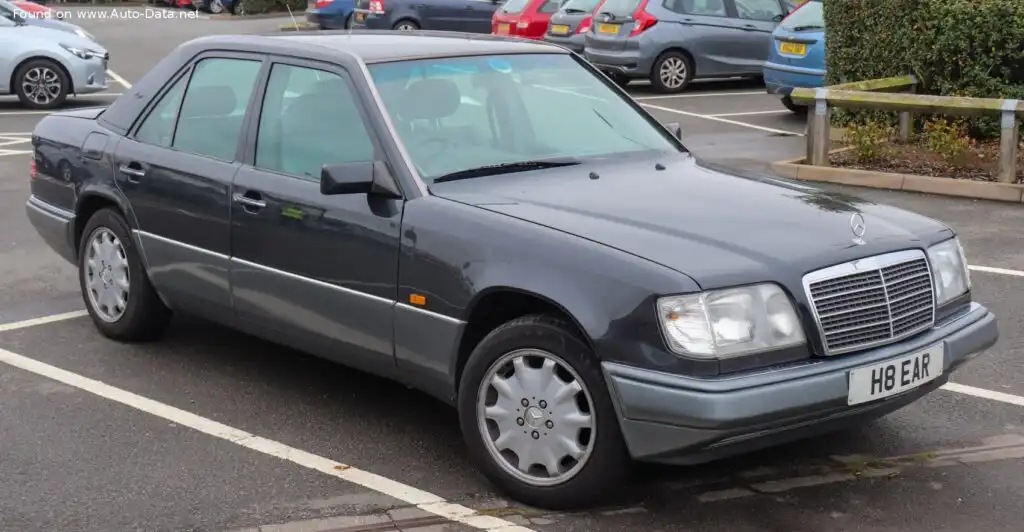
The Mercedes-Benz W124 E 300 D, produced from December 1992 to August 1995, represents a refined iteration of the popular W124 series, known for its robust build quality and engineering. This variant, powered by the OM606 D 30 engine, occupied a middle ground within the E-Class lineup, offering a balance between performance, fuel economy, and luxury. It served as a compelling alternative to the gasoline-powered E 320 and the more economical E 250 Diesel, appealing to buyers seeking a sophisticated and durable touring sedan. The W124 platform itself was a significant step forward for Mercedes-Benz, introducing advancements in safety, comfort, and aerodynamics compared to its predecessor, the W123.
Technical Specifications
| Brand | Mercedes-Benz |
| Model | E-class |
| Generation | E-class (W124) |
| Type (Engine) | E 300 D (136 Hp) |
| Start of production | December, 1992 |
| End of production | August, 1995 |
| Powertrain Architecture | Internal Combustion engine |
| Body type | Sedan |
| Seats | 5 |
| Doors | 4 |
| Fuel consumption (urban) | 9.8 l/100 km (24 US mpg) |
| Fuel consumption (extra urban) | 5.5 l/100 km (42.8 US mpg) |
| Fuel Type | Diesel |
| Acceleration 0 – 100 km/h | 13 sec |
| Acceleration 0 – 62 mph | 13 sec |
| Acceleration 0 – 60 mph | 12.4 sec |
| Maximum speed | 200 km/h (124.27 mph) |
| Weight-to-power ratio | 10.8 kg/Hp |
| Weight-to-torque ratio | 7 kg/Nm |
| Power | 136 Hp @ 5000 rpm |
| Torque | 210 Nm @ 2200 rpm (154.89 lb.-ft. @ 2200 rpm) |
| Engine layout | Front, Longitudinal |
| Engine Model/Code | OM 606 D 30 / 606.910 |
| Engine displacement | 2996 cm3 (182.83 cu. in.) |
| Number of cylinders | 6 |
| Engine configuration | Inline |
| Cylinder Bore | 87 mm (3.43 in.) |
| Piston Stroke | 84 mm (3.31 in.) |
| Compression ratio | 22:1 |
| Number of valves per cylinder | 4 |
| Fuel injection system | Precombustion chamber injection |
| Engine aspiration | Naturally aspirated |
| Valvetrain | DOHC |
| Engine oil capacity | 7.5 l (7.93 US qt | 6.6 UK qt) |
| Coolant | 9 l (9.51 US qt | 7.92 UK qt) |
| Kerb Weight | 1470 kg (3240.8 lbs.) |
| Max. weight | 2050 kg (4519.48 lbs.) |
| Max load | 580 kg (1278.68 lbs.) |
| Trunk (boot) space – minimum | 520 l (18.36 cu. ft.) |
| Fuel tank capacity | 70 l (18.49 US gal | 15.4 UK gal) |
| Length | 4740 mm (186.61 in.) |
| Width | 1740 mm (68.5 in.) |
| Height | 1430 mm (56.3 in.) |
| Wheelbase | 2800 mm (110.24 in.) |
| Front track | 1501 mm (59.09 in.) |
| Rear (Back) track | 1491 mm (58.7 in.) |
| Drivetrain Architecture | Rear wheel drive |
| Number of gears | 5 |
| Type of gearbox | Manual transmission |
| Front suspension | Wishbone |
| Rear suspension | Independent multi-link suspension |
| Front brakes | Ventilated discs |
| Rear brakes | Disc |
| Assisting systems | ABS (Anti-lock braking system) |
| Steering type | Cone worm with recirculation balls |
| Power steering | Hydraulic |
| Tires size | 195/65 R15 |
| Wheel rims size | 6.5J x 15 |
Powertrain & Engine Architecture
The heart of the E 300 D is the OM606 D 30, a 3.0-liter inline-six cylinder diesel engine. This engine is renowned for its durability and relatively smooth operation for a diesel of its era. It utilizes a precombustion chamber injection system, a hallmark of Mercedes-Benz diesel technology at the time. This system involves injecting fuel into a small pre-chamber where it partially combusts, then igniting the main combustion chamber. This design promotes more complete combustion and reduces engine noise. The engine features a double overhead camshaft (DOHC) valvetrain, contributing to its improved breathing and power output compared to earlier Mercedes-Benz diesel engines. The 5-speed manual transmission was standard, providing a direct connection to the engine and allowing for precise control. The transmission’s gear ratios were tuned for a balance of acceleration and fuel efficiency, prioritizing comfortable highway cruising.
Driving Characteristics
The E 300 D with the manual transmission offered a surprisingly engaging driving experience. While not a sports car, the 136 horsepower and 210 lb-ft of torque provided adequate power for everyday driving and even confident overtaking maneuvers. The engine’s torque curve was relatively flat, meaning that usable power was available across a wide range of engine speeds. The manual gearbox allowed drivers to fully exploit the engine’s capabilities, while the rear-wheel drive configuration contributed to balanced handling. Compared to the automatic transmission option, the manual version felt more responsive and offered better fuel economy. However, it lacked the convenience of an automatic, particularly in stop-and-go traffic.
Equipment & Trim Levels
The E 300 D typically came well-equipped, reflecting Mercedes-Benz’s commitment to luxury and comfort. Standard features included power windows, central locking, a sunroof, and cloth upholstery. Leather upholstery, automatic climate control, and upgraded audio systems were available as optional extras. The interior design was characterized by its understated elegance and high-quality materials. The dashboard layout was functional and ergonomic, with clearly labeled controls. Trim levels were relatively simple, with most variations stemming from the addition of optional packages.
Chassis & Braking
The W124 chassis featured an independent suspension system at all four wheels, providing a comfortable ride and good handling. The front suspension utilized wishbones, while the rear suspension employed a multi-link design. This setup minimized body roll and ensured a stable ride, even on uneven surfaces. The E 300 D was equipped with ventilated disc brakes at the front and solid discs at the rear, providing ample stopping power. Anti-lock braking system (ABS) was standard, enhancing safety by preventing wheel lockup during hard braking.
Market Reception & Comparison
The E 300 D was generally well-received by automotive critics and buyers alike. It was praised for its build quality, reliability, and comfortable ride. However, some critics noted that its performance was not as exhilarating as that of its gasoline-powered counterparts. Compared to the E 250 Diesel, the E 300 D offered significantly more power and refinement. Against the E 320, it provided a more fuel-efficient alternative, albeit with slightly less horsepower. The E 300 D’s fuel economy was a major selling point, particularly in Europe, where diesel fuel was significantly cheaper than gasoline.
Legacy
The OM606 engine, found in the E 300 D, is widely regarded as one of the most durable and reliable diesel engines ever produced. Many examples have surpassed 300,000 miles with proper maintenance. Today, the W124 E 300 D remains a popular choice among classic Mercedes-Benz enthusiasts. Its robust construction, relatively simple mechanicals, and readily available parts make it a relatively easy car to maintain. The manual transmission version is particularly sought after by those who appreciate a more engaging driving experience. While prices have been steadily increasing in recent years, the W124 E 300 D remains a relatively affordable entry point into the world of classic Mercedes-Benz ownership.