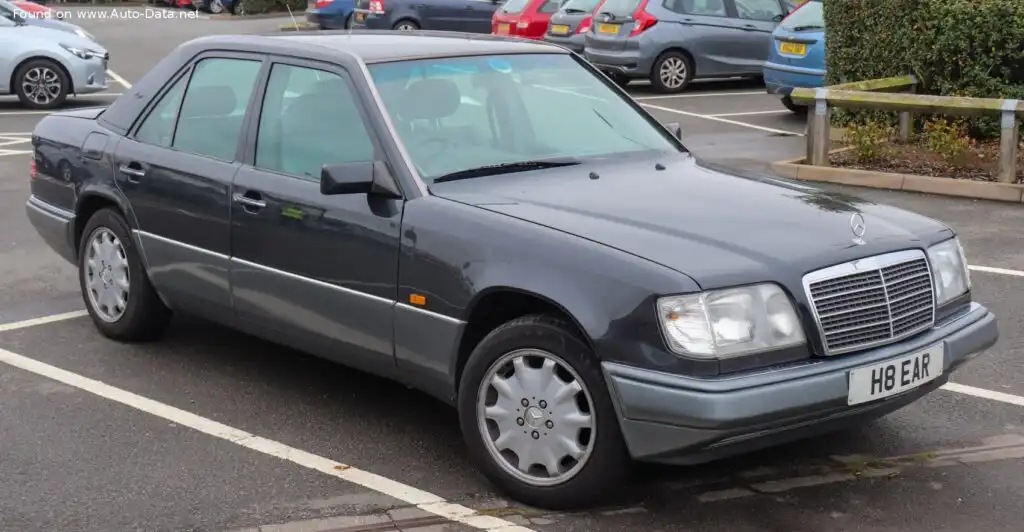
The Mercedes-Benz E 420, produced for the 1993 model year, represented the pinnacle of performance within the W124 E-Class sedan range. Positioned as the flagship variant, it offered a substantial upgrade over the more common four and six-cylinder models, and even the E 320. The W124 chassis, renowned for its robust build quality and engineering, provided a solid foundation for the potent 4.2-liter V8 engine. Production was limited to a single year, making it a relatively rare and sought-after vehicle among enthusiasts today. It was primarily aimed at the North American market, where larger displacement engines were favored.
Technical Specifications
| Brand | Mercedes-Benz |
| Model | E-class |
| Generation | E-class (W124) |
| Type (Engine) | E 420 V8 (286 Hp) Automatic |
| Start of production | 1993 |
| End of production | 1993 |
| Powertrain Architecture | Internal Combustion engine |
| Body type | Sedan |
| Seats | 5 |
| Doors | 4 |
| Fuel consumption (combined) | 11.8 l/100 km (19.9 US mpg, 23.9 UK mpg, 8.5 km/l) |
| Fuel Type | Petrol (Gasoline) |
| Acceleration 0 – 100 km/h | 7.2 sec |
| Acceleration 0 – 62 mph | 7.2 sec |
| Acceleration 0 – 60 mph | 6.8 sec |
| Maximum speed | 250 km/h (155.34 mph) |
| Weight-to-power ratio | 6 kg/Hp, 166.3 Hp/tonne |
| Weight-to-torque ratio | 4.3 kg/Nm, 232.6 Nm/tonne |
| Power | 286 Hp @ 5700 rpm |
| Power per litre | 68.2 Hp/l |
| Torque | 400 Nm @ 3900 rpm (295.02 lb.-ft. @ 3900 rpm) |
| Engine layout | Front, Longitudinal |
| Engine Model/Code | M 119 |
| Engine displacement | 4196 cm3 (256.06 cu. in.) |
| Number of cylinders | 8 |
| Engine configuration | V-engine |
| Cylinder Bore | 92 mm (3.62 in.) |
| Piston Stroke | 78.9 mm (3.11 in.) |
| Compression ratio | 11:1 |
| Number of valves per cylinder | 4 |
| Fuel injection system | Multi-port manifold injection |
| Engine aspiration | Naturally aspirated engine |
| Valvetrain | DOHC |
| Engine oil capacity | 8 l (8.45 US qt | 7.04 UK qt) |
| Coolant | 12.5 l (13.21 US qt | 11 UK qt) |
| Kerb Weight | 1720 kg (3791.95 lbs.) |
| Max. weight | 2170 kg (4784.03 lbs.) |
| Max load | 450 kg (992.08 lbs.) |
| Trunk (boot) space – minimum | 520 l (18.36 cu. ft.) |
| Fuel tank capacity | 70 l (18.49 US gal | 15.4 UK gal) |
| Length | 4740 mm (186.61 in.) |
| Width | 1740 mm (68.5 in.) |
| Height | 1431 mm (56.34 in.) |
| Wheelbase | 2800 mm (110.24 in.) |
| Front track | 1501 mm (59.09 in.) |
| Rear (Back) track | 1491 mm (58.7 in.) |
| Drivetrain Architecture | The Internal combustion engine (ICE) drives the rear wheels of the vehicle. |
| Drive wheel | Rear wheel drive |
| Number of gears and type of gearbox | 4 gears, automatic transmission |
| Front suspension | Wishbone |
| Rear suspension | Coil spring |
| Front brakes | Ventilated discs |
| Rear brakes | Ventilated discs |
| Assisting systems | ABS (Anti-lock braking system), Hydraulic Steering |
| Tires size | 215/55 R16 |
Powertrain & Engine Architecture
The heart of the E 420 is the M119 engine, a 4.2-liter (4196 cc) naturally aspirated V8. This engine, a descendant of the earlier M117 series, featured a cast-iron block and aluminum cylinder heads. It employed a dual overhead camshaft (DOHC) design with four valves per cylinder, contributing to its impressive power output. Fuel delivery was handled by a Bosch multi-port fuel injection system, carefully calibrated for smooth operation and optimal efficiency. The M119 was known for its robust construction and relatively simple design, enhancing long-term reliability. Paired exclusively with a four-speed automatic transmission (typically the 722.3), the powertrain was designed for effortless cruising and responsive acceleration. The automatic transmission, while not offering the latest technology, was known for its durability and smooth shifts.
Driving Characteristics
The E 420 offered a distinctly different driving experience compared to its six and four-cylinder siblings. The V8 engine delivered a substantial increase in torque, providing effortless acceleration in virtually any gear. While the 0-60 mph time of around 6.8 seconds wasn’t groundbreaking, the car felt significantly faster in real-world driving situations. The automatic transmission, while smooth, did result in some power loss compared to a manual transmission, but it perfectly suited the car’s grand touring character. The gear ratios were optimized for comfortable highway cruising, and the engine remained remarkably quiet and refined even at higher speeds. Compared to the E 320, the E 420 offered a more luxurious and powerful experience, but at the cost of slightly increased fuel consumption.
Equipment & Trim Levels
The E 420 came standard with a comprehensive list of features, reflecting its position as the top-of-the-line E-Class model. Standard equipment included leather upholstery, power-adjustable front seats with memory function, a sunroof, automatic climate control, and a premium sound system. Wood trim adorned the interior, adding to the luxurious ambiance. Optional extras included heated front seats, a rear sunshade, and upgraded audio systems. The exterior was typically finished in metallic paint, and alloy wheels were standard. The overall interior design was typical of Mercedes-Benz at the time – understated elegance with a focus on quality materials and craftsmanship.
Chassis & Braking
The E 420 utilized the W124’s independent suspension system, featuring wishbone suspension at the front and coil springs at the rear. The suspension was tuned for a comfortable ride, absorbing bumps and imperfections in the road with ease. To cope with the increased power and weight, the E 420 was equipped with ventilated disc brakes on all four wheels, providing ample stopping power. An Anti-lock Braking System (ABS) was standard, enhancing safety and control during emergency braking situations. The steering was hydraulically assisted, offering a precise and responsive feel. Stabilizer bars were fitted front and rear to reduce body roll during cornering.
Market Reception & Comparison
The E 420 was generally well-received by automotive critics, who praised its powerful engine, luxurious interior, and comfortable ride. However, its relatively high price and fuel consumption were noted as drawbacks. Compared to the E 320, the E 420 offered a significant performance advantage, but it was also more expensive to purchase and operate. The E 420’s fuel economy of around 19.9 US mpg was considerably lower than that of the four and six-cylinder models. Despite these drawbacks, the E 420 appealed to buyers who prioritized performance and luxury above all else.
Legacy
The M119 engine, found in the E 420, is considered one of Mercedes-Benz’s most reliable V8 engines. With proper maintenance, these engines can easily exceed 200,000 miles. The W124 chassis itself is renowned for its durability and build quality. Today, the E 420 is a sought-after classic car, appreciated by enthusiasts for its combination of performance, luxury, and reliability. Values have been steadily increasing in recent years, particularly for well-maintained examples. While parts availability can be a challenge, a dedicated community of owners and suppliers ensures that the E 420 will continue to be enjoyed for years to come. The 4-speed automatic transmission, while not as sophisticated as modern gearboxes, has proven to be remarkably durable.