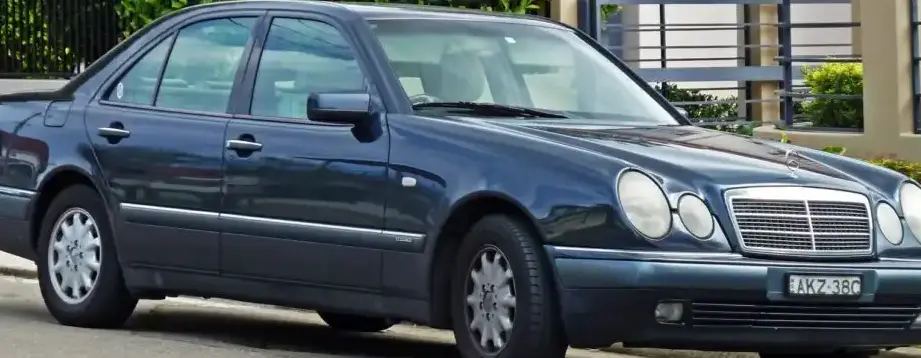
The Mercedes-Benz E 200 (W210), produced from August 1994 to July 1999, represented the entry point into the significantly redesigned E-Class range (W210). Positioned as a more accessible alternative to the higher-performance E 280 and E 320 models, the E 200 offered a blend of Mercedes-Benz luxury and refinement with a focus on fuel efficiency and affordability. It was a key model for broadening the appeal of the W210 platform, particularly in markets where taxation favored smaller displacement engines. The W210 generation marked a substantial departure from its predecessor (W124), introducing a more aerodynamic design and a host of new technologies focused on safety and comfort.
Technical Specifications
| Brand | Mercedes-Benz |
| Model | E-class |
| Generation | E-class (W210) |
| Type (Engine) | E 200 (136 Hp) |
| Start of production | August, 1994 |
| End of production | July, 1999 |
| Powertrain Architecture | Internal Combustion engine |
| Body type | Sedan |
| Seats | 5 |
| Doors | 4 |
| Fuel consumption (urban) | 10.9 l/100 km (21.6 US mpg) |
| Fuel consumption (extra urban) | 6.1 l/100 km (38.6 US mpg) |
| Fuel Type | Petrol (Gasoline) |
| Acceleration 0 – 100 km/h | 11.4 sec |
| Acceleration 0 – 62 mph | 11.4 sec |
| Acceleration 0 – 60 mph | 10.8 sec |
| Maximum speed | 205 km/h (127.38 mph) |
| Weight-to-power ratio | 10.6 kg/Hp |
| Weight-to-torque ratio | 7.6 kg/Nm |
| Power | 136 Hp @ 5500 rpm |
| Power per litre | 68.1 Hp/l |
| Torque | 190 Nm @ 4000 rpm (140.14 lb.-ft. @ 4000 rpm) |
| Engine layout | Front, Longitudinal |
| Engine Model/Code | M 111 E 20 / 111.942 |
| Engine displacement | 1998 cm3 (121.93 cu. in.) |
| Number of cylinders | 4 |
| Engine configuration | Inline |
| Cylinder Bore | 89.9 mm (3.54 in.) |
| Piston Stroke | 78.7 mm (3.1 in.) |
| Compression ratio | 9.6:1 |
| Number of valves per cylinder | 4 |
| Fuel injection system | Multi-port manifold injection |
| Engine aspiration | Naturally aspirated engine |
| Valvetrain | DOHC |
| Engine oil capacity | 5.5 l (5.81 US qt | 4.84 UK qt) |
| Coolant | 8.5 l (8.98 US qt | 7.48 UK qt) |
| Kerb Weight | 1440 kg (3174.66 lbs.) |
| Max. weight | 1940 kg (4276.97 lbs.) |
| Max load | 500 kg (1102.31 lbs.) |
| Fuel tank capacity | 65 l (17.17 US gal | 14.3 UK gal) |
| Length | 4795 mm (188.78 in.) |
| Width | 1799 mm (70.83 in.) |
| Height | 1436 mm (56.54 in.) |
| Wheelbase | 2833 mm (111.54 in.) |
| Front track | 1542 mm (60.71 in.) |
| Rear track | 1536 mm (60.47 in.) |
| Drivetrain Architecture | Rear wheel drive |
| Number of gears | 5 gears, manual transmission |
| Front suspension | Double wishbone |
| Rear suspension | Independent multi-link spring suspension with stabilizer |
| Front brakes | Ventilated discs |
| Rear brakes | Disc |
| Assisting systems | ABS (Anti-lock braking system) |
| Steering type | Steering rack and pinion |
| Power steering | Hydraulic Steering |
| Tires size | 195/65 R15 |
| Wheel rims size | 6.5J x 15 |
Powertrain & Engine Architecture
The E 200 was powered by the M111 E 20 engine, a 1.998-liter (2.0L) inline-four cylinder gasoline engine. This engine was a significant upgrade over the previous generation’s four-cylinder offerings, featuring a dual overhead camshaft (DOHC) valvetrain and multi-port fuel injection. The M111 engine family was known for its relatively smooth operation and good refinement. The engine code 111.942 specifically identifies this variant. The engine produced 136 horsepower at 5500 rpm and 190 Nm (140 lb-ft) of torque at 4000 rpm. The five-speed manual transmission was standard, providing a reasonably direct connection to the rear wheels. While an automatic transmission was available, it impacted acceleration and fuel economy.
Driving Characteristics
The E 200, particularly with the manual transmission, offered a balanced driving experience. Acceleration was adequate for everyday driving, with a 0-60 mph time of around 10.8 seconds. However, it wasn’t a particularly sporty car. The engine felt somewhat strained at higher RPMs, and the power delivery was linear rather than exciting. Compared to the E 280 or E 320, the E 200 lacked the effortless surge of power. The automatic transmission, while providing convenience, further dulled the driving experience, resulting in slower acceleration and a less engaging feel. The rear-wheel drive configuration provided a balanced chassis, contributing to predictable handling.
Equipment & Trim Levels
The E 200 typically came standard with features expected of a mid-size luxury sedan in the 1990s. This included power windows, power locks, central locking, and air conditioning. Interior upholstery was typically cloth, although leather was available as an option. Dashboard configuration was relatively straightforward, emphasizing functionality over flashy design. Optional extras included a sunroof, upgraded audio system, and automatic climate control. The E 200 served as the base model, and therefore lacked some of the more luxurious appointments found in the higher-trim E-Class variants.
Chassis & Braking
The W210 E-Class featured a double wishbone front suspension and an independent multi-link rear suspension, providing a comfortable and controlled ride. The E 200, being the lighter model, generally felt more agile than its larger-engined siblings. Braking was accomplished via ventilated discs at the front and solid discs at the rear. Anti-lock Braking System (ABS) was standard, enhancing safety. Stabilizer bars were fitted front and rear to reduce body roll during cornering. The suspension tuning prioritized comfort over outright sportiness, making it a pleasant cruiser.
Market Reception & Comparison
The E 200 was generally well-received as an affordable entry point into the W210 E-Class range. Critics praised its comfortable ride, refined interior, and relatively fuel-efficient engine. However, some reviewers found the engine to be underpowered, particularly when paired with the automatic transmission. Compared to the E 280 and E 320, the E 200 offered significantly lower running costs but lacked the performance and prestige of those models. The E 200 competed with other mid-size luxury sedans such as the BMW 3 Series and Audi A4, offering a different blend of comfort and practicality.
Legacy
The M111 engine, in general, proved to be a reliable powerplant, and the E 200 is no exception. While not known for blistering performance, the engine is relatively robust and can withstand high mileage with proper maintenance. Today, the W210 E 200 represents an affordable entry into classic Mercedes-Benz ownership. Parts availability is generally good, and the car’s relatively simple mechanicals make it a viable option for DIY mechanics. However, potential buyers should be aware of common W210 issues, such as corrosion and electrical problems. The E 200 remains a popular choice for those seeking a comfortable, reliable, and relatively inexpensive classic sedan.