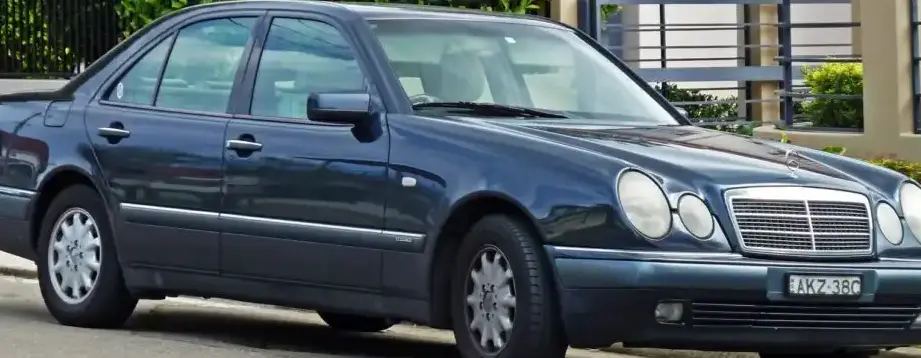
The Mercedes-Benz E 200 Kompressor, produced between March 1997 and July 1999, was a significant variant within the W210 E-Class range. Positioned as a mid-range offering, it bridged the gap between the base E 200 and the more powerful E 230 and E 280 models. This model represented Mercedes-Benz’s move towards forced induction in the mainstream, utilizing a supercharger to enhance performance and efficiency. The W210 generation, launched in 1995, aimed to modernize the E-Class while retaining its reputation for luxury and engineering excellence, and the E 200 Kompressor played a key role in attracting a broader customer base.
Technical Specifications
| Brand | Mercedes-Benz |
| Model | E-class |
| Generation | E-class (W210) |
| Type (Engine) | E 200 Kompressor (192 Hp) |
| Start of production | March, 1997 |
| End of production | July, 1999 |
| Powertrain Architecture | Internal Combustion engine |
| Body type | Sedan |
| Seats | 5 |
| Doors | 4 |
| Fuel consumption (urban) | 10.6 l/100 km (22.2 US mpg) |
| Fuel consumption (extra urban) | 6.4 l/100 km (36.8 US mpg) |
| Fuel consumption (combined) | 8 l/100 km (29.4 US mpg) |
| Fuel Type | Petrol (Gasoline) |
| Acceleration 0 – 100 km/h | 8.9 sec |
| Acceleration 0 – 62 mph | 8.9 sec |
| Acceleration 0 – 60 mph | 8.5 sec |
| Maximum speed | 231 km/h (143.54 mph) |
| Weight-to-power ratio | 7.9 kg/Hp |
| Weight-to-torque ratio | 5.6 kg/Nm |
| Power | 192 Hp @ 5300 rpm |
| Torque | 270 Nm @ 2500-4800 rpm (199.14 lb.-ft.) |
| Engine layout | Front, Longitudinal |
| Engine Model/Code | M 111 E 20 ML / 111.947 |
| Engine displacement | 1998 cm3 (121.93 cu. in.) |
| Number of cylinders | 4 |
| Engine configuration | Inline |
| Cylinder Bore | 89.9 mm (3.54 in.) |
| Piston Stroke | 78.7 mm (3.1 in.) |
| Compression ratio | 8.5:1 |
| Number of valves per cylinder | 4 |
| Fuel injection system | Multi-port manifold injection |
| Engine aspiration | Supercharger, Intercooler |
| Valvetrain | DOHC |
| Engine oil capacity | 5.5 l (5.81 US qt | 4.84 UK qt) |
| Coolant | 8.5 l (8.98 US qt | 7.48 UK qt) |
| Kerb Weight | 1510 kg (3328.98 lbs.) |
| Max. weight | 2010 kg (4431.29 lbs.) |
| Max load | 500 kg (1102.31 lbs.) |
| Fuel tank capacity | 65 l (17.17 US gal | 14.3 UK gal) |
| Length | 4795 mm (188.78 in.) |
| Width | 1799 mm (70.83 in.) |
| Height | 1436 mm (56.54 in.) |
| Wheelbase | 2833 mm (111.54 in.) |
| Front track | 1542 mm (60.71 in.) |
| Rear track | 1536 mm (60.47 in.) |
| Drivetrain Architecture | Rear wheel drive |
| Drive wheel | Rear wheel drive |
| Number of gears | 5 gears, manual transmission |
| Front suspension | Double wishbone |
| Rear suspension | Independent multi-link spring suspension with stabilizer |
| Front brakes | Ventilated discs |
| Rear brakes | Disc |
| Assisting systems | ABS (Anti-lock braking system) |
| Steering type | Steering rack and pinion |
| Power steering | Hydraulic Steering |
| Tires size | 215/55 R16 |
| Wheel rims size | 7.5J x 16 |
Powertrain & Engine Architecture
The heart of the E 200 Kompressor was the M111 E 20 ML engine, a 1.998-liter inline-four cylinder powerplant. This engine was a significant departure from the naturally aspirated engines previously offered in the E-Class. The “Kompressor” designation indicated the presence of a mechanically driven supercharger, specifically a Lysholm-type unit. This supercharger provided boost across a wide RPM range, resulting in a flatter torque curve and improved throttle response compared to a naturally aspirated engine of similar displacement. The engine featured multi-port fuel injection and a double overhead camshaft (DOHC) valvetrain with four valves per cylinder. The engine code, 111.947, is crucial for identifying specific parts and service information. The five-speed manual transmission was standard, offering precise gear changes and contributing to the car’s engaging driving experience.
Driving Characteristics
The E 200 Kompressor offered a compelling blend of performance and efficiency. The supercharger noticeably improved acceleration, delivering a 0-60 mph time of around 8.5 seconds and a top speed of 143.54 mph. While not as overtly sporty as the E 230 or E 280, the E 200 Kompressor provided ample power for everyday driving and overtaking maneuvers. The supercharger’s boost was readily available from low RPMs, making the car feel responsive and effortless in city traffic. Compared to the naturally aspirated E 200, the Kompressor version felt significantly more powerful. The manual transmission allowed for greater driver control, while the gear ratios were optimized for both acceleration and fuel economy. The rear-wheel drive configuration provided a balanced driving experience, although it could be challenging in slippery conditions.
Equipment & Trim Levels
The E 200 Kompressor typically came equipped with a respectable level of standard features, reflecting Mercedes-Benz’s commitment to luxury. These included power windows, central locking, air conditioning, and an AM/FM radio. Interior upholstery was typically cloth, although leather was available as an option. Dashboard trim could be specified in wood or aluminum. Optional extras included a sunroof, upgraded audio system, automatic climate control, and heated seats. The E 200 Kompressor was often seen as a stepping stone to the more luxurious trims, offering a good balance of features and affordability.
Chassis & Braking
The W210 E-Class featured a robust chassis with a double wishbone front suspension and an independent multi-link rear suspension. This suspension setup provided a comfortable ride while maintaining good handling characteristics. The E 200 Kompressor was equipped with ventilated disc brakes at the front and solid disc brakes at the rear. Anti-lock braking system (ABS) was standard, enhancing safety and stability during hard braking. The steering was a rack and pinion system with hydraulic power assistance, providing precise and responsive steering feel. The standard tire size was 215/55 R16, mounted on 7.5J x 16 alloy wheels.
Market Reception & Comparison
The E 200 Kompressor was generally well-received by automotive critics. It was praised for its smooth engine, responsive performance, and comfortable ride. However, some critics noted that the engine lacked the refinement of the larger six-cylinder engines offered in the E-Class range. Compared to the naturally aspirated E 200, the Kompressor version offered significantly improved performance for a relatively small price increase. Fuel economy was respectable, averaging around 29.4 US mpg in combined driving. Reliability was generally good, although some owners reported issues with the supercharger and its associated components over the long term.
Legacy
The E 200 Kompressor represents an important step in Mercedes-Benz’s adoption of forced induction technology. The M111 engine proved to be a durable and reliable powerplant, and many examples are still on the road today. In the used car market, the E 200 Kompressor offers a relatively affordable entry point into Mercedes-Benz ownership. While it may not have the prestige of the larger E-Class models, it provides a comfortable, well-equipped, and surprisingly capable driving experience. The supercharged engine, while requiring occasional maintenance, remains a unique and appealing feature for enthusiasts.