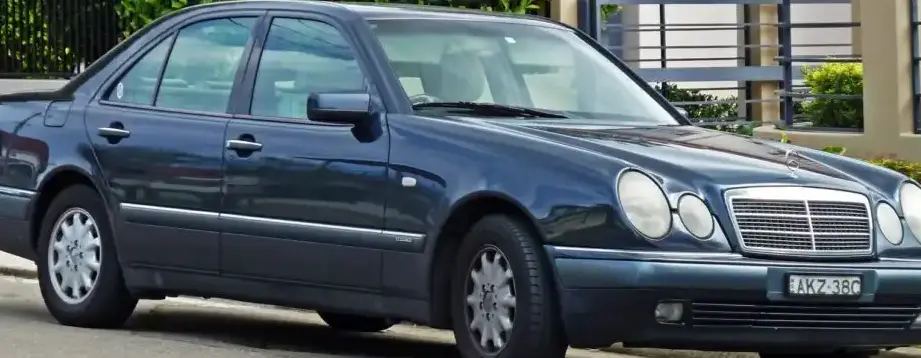
The Mercedes-Benz E 220 D Automatic, produced between August 1996 and June 1999, was a key variant within the W210 E-Class range. Positioned as an entry-level diesel offering, it provided a balance of fuel efficiency and comfortable motoring for the European market, where diesel sedans were – and continue to be – highly popular. This model represented a significant step forward in diesel technology for Mercedes-Benz, offering improved refinement and performance compared to its predecessors. The W210 generation, launched in 1995, aimed to modernize the E-Class while retaining its reputation for build quality and engineering excellence.
Technical Specifications
| Brand | Mercedes-Benz |
| Model | E-class |
| Generation | E-class (W210) |
| Type (Engine) | E 220 D (95 Hp) Automatic |
| Start of production | August, 1996 |
| End of production | June, 1999 |
| Powertrain Architecture | Internal Combustion engine |
| Body type | Sedan |
| Seats | 5 |
| Doors | 4 |
| Fuel consumption (urban) | 8.4 l/100 km (28 US mpg, 33.6 UK mpg, 11.9 km/l) |
| Fuel consumption (extra urban) | 5.3 l/100 km (44.4 US mpg, 53.3 UK mpg, 18.9 km/l) |
| Fuel Type | Diesel |
| Acceleration 0 – 100 km/h | 17.4 sec |
| Acceleration 0 – 62 mph | 17.4 sec |
| Acceleration 0 – 60 mph | 16.5 sec |
| Maximum speed | 177 km/h (109.98 mph) |
| Weight-to-power ratio | 15.4 kg/Hp, 65.1 Hp/tonne |
| Weight-to-torque ratio | 9.7 kg/Nm, 102.7 Nm/tonne |
| Power | 95 Hp @ 5000 rpm |
| Power per litre | 44.1 Hp/l |
| Torque | 150 Nm @ 3100-4500 rpm (110.63 lb.-ft. @ 3100-4500 rpm) |
| Engine layout | Front, Longitudinal |
| Engine Model/Code | OM 604 D 22 / 604.910 |
| Engine displacement | 2155 cm3 (131.51 cu. in.) |
| Number of cylinders | 4 |
| Engine configuration | Inline |
| Cylinder Bore | 89 mm (3.5 in.) |
| Piston Stroke | 86.6 mm (3.41 in.) |
| Compression ratio | 22:1 |
| Number of valves per cylinder | 4 |
| Fuel injection system | Precombustion chamber injection |
| Engine aspiration | Naturally aspirated engine |
| Valvetrain | DOHC |
| Engine oil capacity | 6.5 l (6.87 US qt | 5.72 UK qt) |
| Coolant | 8.5 l (8.98 US qt | 7.48 UK qt) |
| Kerb Weight | 1460 kg (3218.75 lbs.) |
| Max. weight | 1960 kg (4321.06 lbs.) |
| Max load | 500 kg (1102.31 lbs.) |
| Trunk (boot) space – minimum | 520 l (18.36 cu. ft.) |
| Fuel tank capacity | 65 l (17.17 US gal | 14.3 UK gal) |
| Length | 4795 mm (188.78 in.) |
| Width | 1799 mm (70.83 in.) |
| Height | 1436 mm (56.54 in.) |
| Wheelbase | 2833 mm (111.54 in.) |
| Front track | 1542 mm (60.71 in.) |
| Rear (Back) track | 1536 mm (60.47 in.) |
| Minimum turning circle | 11 m (36.09 ft.) |
| Drivetrain Architecture | The Internal combustion engine (ICE) drives the rear wheels of the vehicle. |
| Drive wheel | Rear wheel drive |
| Number of gears and type of gearbox | 5 gears, automatic transmission |
| Front suspension | Wishbone |
| Rear suspension | Independent multi-link spring suspension with stabilizer |
| Front brakes | Ventilated discs |
| Rear brakes | Disc |
| Assisting systems | ABS (Anti-lock braking system) |
| Steering type | Steering rack and pinion |
| Power steering | Hydraulic Steering |
| Tires size | 195/65 R15 |
| Wheel rims size | 6.5J x 15 |
Powertrain & Engine Architecture
The E 220 D was powered by the OM 604 D 22 engine, a 2.2-liter inline-four cylinder diesel. This engine utilized precombustion chamber injection, a system common in Mercedes-Benz diesels of the era. This system involved injecting fuel into a small precombustion chamber connected to the main cylinder, promoting more complete combustion and reducing engine noise. The engine produced 95 horsepower at 5000 rpm and 150 Nm (110.63 lb-ft) of torque between 3100 and 4500 rpm. The engine featured a double overhead camshaft (DOHC) valvetrain, contributing to improved breathing and efficiency. The five-speed automatic transmission was a crucial component, designed to provide smooth shifts and enhance the car’s usability for everyday driving. This transmission was not known for its sportiness, prioritizing comfort and fuel economy over rapid acceleration.
Driving Characteristics
The E 220 D Automatic offered a comfortable, albeit unhurried, driving experience. Acceleration was modest, with a 0-60 mph time of around 16.5 seconds. The automatic transmission, while smooth, had relatively long gear ratios, prioritizing fuel efficiency over performance. Compared to the more powerful E 280 or E 320 models, the E 220 D felt significantly slower. However, it offered a noticeable improvement in fuel economy. The engine’s torque delivery was relatively flat, making it suitable for relaxed cruising and highway driving. The rear-wheel drive configuration provided a balanced feel, although it wasn’t particularly engaging for enthusiastic drivers.
Equipment & Trim Levels
The E 220 D Automatic typically came equipped with standard features such as power windows, central locking, and air conditioning. Interior upholstery was usually cloth, although leather was available as an option. The dashboard layout was typical of the W210, featuring a functional and understated design. Optional extras included a sunroof, upgraded audio system, and automatic climate control. The trim level was generally considered to be mid-range, offering a good balance of features and affordability. It was a step up from the base models but lacked the luxury appointments of the higher-end trims.
Chassis & Braking
The W210 E-Class featured a robust chassis with independent suspension all around. The front suspension utilized wishbones, while the rear employed a multi-link setup with a stabilizer bar. This configuration provided a comfortable ride and decent handling. The E 220 D was equipped with ventilated disc brakes at the front and solid discs at the rear. Anti-lock braking system (ABS) was standard, enhancing safety and control. The steering was rack and pinion with hydraulic power assistance, providing a reasonably direct feel.
Market Reception & Comparison
The E 220 D Automatic was well-received in Europe as a practical and economical option. Critics praised its fuel efficiency and comfortable ride, but noted its lack of outright performance. Compared to the more powerful E-Class variants, the E 220 D offered a lower purchase price and significantly better fuel economy. However, it lacked the refinement and driving enjoyment of the higher-spec models. Against competitors like the BMW 525tds and Audi A6 2.5 TDI, the E 220 D held its own in terms of build quality and reliability, but often lagged behind in terms of performance.
Legacy
The OM 604 engine, found in the E 220 D, is known for its durability and longevity. Properly maintained examples can accumulate very high mileage with minimal issues. The W210 E-Class, in general, has developed a reputation as a reliable and well-built vehicle. Today, the E 220 D Automatic is a relatively affordable classic car, appealing to those seeking a comfortable and economical cruiser. While not a performance icon, it represents a significant chapter in Mercedes-Benz’s diesel engine development and remains a popular choice for enthusiasts and everyday drivers alike. Finding well-maintained examples is becoming increasingly difficult, but the E 220 D continues to offer a compelling blend of practicality, comfort, and German engineering.