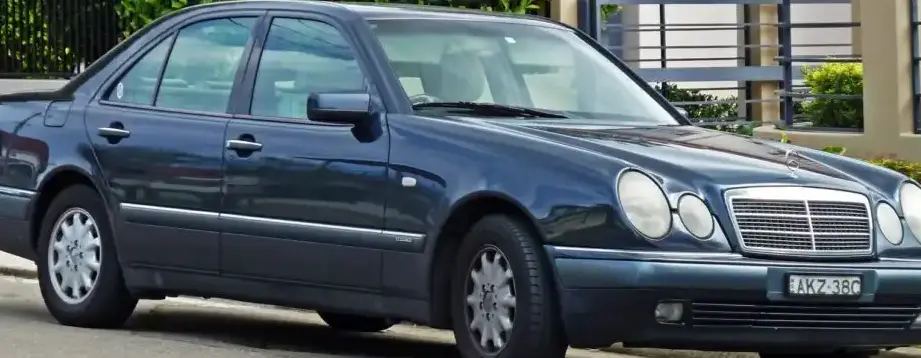
The Mercedes-Benz E 230, produced between July 1994 and June 1998, was a key variant within the W210 E-Class range. Representing a significant update to the mid-size executive car, the W210 aimed to blend luxury, performance, and advanced technology. The E 230 specifically occupied a middle ground in the lineup, offering a balance between affordability and the more potent engine options like the E 320 or the later E 420. It was positioned as a practical and refined choice for buyers seeking a comfortable and reliable German sedan. This model was primarily aimed at the European and North American markets, where Mercedes-Benz sought to maintain its reputation for quality and engineering excellence.
Technical Specifications
| Brand | Mercedes-Benz |
| Model | E-class |
| Generation | E-class (W210) |
| Type (Engine) | E 230 (150 Hp) |
| Start of production | July, 1994 |
| End of production | June, 1998 |
| Powertrain Architecture | Internal Combustion engine |
| Body type | Sedan |
| Seats | 5 |
| Doors | 4 |
| Fuel consumption (urban) | 11.3 l/100 km (20.8 US mpg) |
| Fuel consumption (extra urban) | 6.1 l/100 km (38.6 US mpg) |
| Fuel Type | Petrol (Gasoline) |
| Acceleration 0 – 100 km/h | 10.5 sec |
| Acceleration 0 – 62 mph | 10.5 sec |
| Acceleration 0 – 60 mph | 10 sec |
| Maximum speed | 215 km/h (133.59 mph) |
| Weight-to-power ratio | 9.7 kg/Hp |
| Weight-to-torque ratio | 6.6 kg/Nm |
| Power | 150 Hp @ 5400 rpm |
| Power per litre | 65.4 Hp/l |
| Torque | 220 Nm @ 3800 rpm (162.26 lb.-ft. @ 3800 rpm) |
| Engine layout | Front, Longitudinal |
| Engine Model/Code | M 111 E 23 / 111.970 |
| Engine displacement | 2295 cm3 (140.05 cu. in.) |
| Number of cylinders | 4 |
| Engine configuration | Inline |
| Cylinder Bore | 90.9 mm (3.58 in.) |
| Piston Stroke | 88.4 mm (3.48 in.) |
| Compression ratio | 10.4:1 |
| Number of valves per cylinder | 4 |
| Fuel injection system | Multi-port manifold injection |
| Engine aspiration | Naturally aspirated engine |
| Valvetrain | DOHC |
| Engine oil capacity | 5.5 l (5.81 US qt | 4.84 UK qt) |
| Coolant | 8.5 l (8.98 US qt | 7.48 UK qt) |
| Kerb Weight | 1450 kg (3196.7 lbs.) |
| Max. weight | 1950 kg (4299.01 lbs.) |
| Max load | 500 kg (1102.31 lbs.) |
| Trunk (boot) space – minimum | 520 l (18.36 cu. ft.) |
| Fuel tank capacity | 65 l (17.17 US gal | 14.3 UK gal) |
| Length | 4795 mm (188.78 in.) |
| Width | 1799 mm (70.83 in.) |
| Height | 1436 mm (56.54 in.) |
| Wheelbase | 2833 mm (111.54 in.) |
| Front track | 1542 mm (60.71 in.) |
| Rear (Back) track | 1536 mm (60.47 in.) |
| Drivetrain Architecture | The Internal combustion engine (ICE) drives the rear wheels of the vehicle. |
| Drive wheel | Rear wheel drive |
| Number of gears and type of gearbox | 5 gears, manual transmission |
| Front suspension | Double wishbone |
| Rear suspension | Independent multi-link spring suspension with stabilizer |
| Front brakes | Ventilated discs |
| Rear brakes | Disc |
| Assisting systems | ABS (Anti-lock braking system) |
| Steering type | Steering rack and pinion |
| Power steering | Hydraulic Steering |
| Tires size | 195/65 R15 |
| Wheel rims size | 6.5J x 15 |
Powertrain & Engine Architecture
The E 230 was powered by the M111 E 23 engine, a 2.3-liter inline-four cylinder gasoline engine. This engine was a significant departure from the older iron-block designs, utilizing an all-aluminum block and head to reduce weight and improve thermal efficiency. The M111 featured a double overhead camshaft (DOHC) valvetrain with four valves per cylinder, contributing to its relatively high specific output. Fuel delivery was handled by a Bosch multi-port fuel injection system, optimized for smooth operation and reduced emissions. The engine produced 150 horsepower at 5400 rpm and 220 Nm (162 lb-ft) of torque at 3800 rpm. The standard transmission for the E 230 was a 5-speed manual gearbox, providing precise control and engaging driving experience. A 4-speed automatic transmission was also available, catering to drivers prioritizing comfort and convenience.
Driving Characteristics
The E 230 with the manual transmission offered a reasonably engaging driving experience. While not a sports car, the engine provided adequate power for everyday driving and highway cruising. The 0-60 mph acceleration time of around 10 seconds was respectable for the era. The automatic transmission, while smooth, did slightly diminish performance due to its less efficient power transfer and taller gear ratios. The rear-wheel drive configuration provided balanced handling, although it lacked the all-weather capability of all-wheel drive systems offered on other E-Class models. The suspension, tuned for comfort, absorbed bumps effectively, providing a refined ride quality.
Equipment & Trim Levels
The E 230 typically came standard with features such as power windows, power locks, air conditioning, and an AM/FM stereo. Higher trim levels offered options like leather upholstery, sunroof, automatic climate control, and upgraded audio systems. The interior design was characterized by its functional layout and high-quality materials. Safety features included ABS anti-lock brakes and airbags. The E 230 was often seen as a more accessible entry point into the E-Class range, offering a good balance of features and affordability.
Chassis & Braking
The W210 E-Class featured a robust chassis with a double wishbone front suspension and an independent multi-link rear suspension. This suspension setup provided a comfortable ride and good handling characteristics. The E 230 typically came equipped with ventilated disc brakes at the front and solid disc brakes at the rear. The ABS anti-lock braking system enhanced safety by preventing wheel lockup during hard braking. The steering was a rack-and-pinion system with hydraulic power assistance, providing precise and responsive steering feel.
Market Reception & Comparison
The E 230 was generally well-received by automotive critics as a practical and well-built sedan. It was praised for its comfortable ride, refined interior, and solid build quality. However, some critics noted that the engine lacked the punch of the larger E 320 or E 420 models. Compared to the E 320, the E 230 offered better fuel economy but less performance. The E 230 also represented a more affordable entry point into the E-Class range, making it an attractive option for buyers on a budget. Reliability was generally good, although like all cars of this era, regular maintenance was crucial to prevent issues.
Legacy
The M111 engine, found in the E 230, proved to be a durable and reliable powerplant when properly maintained. Today, well-maintained W210 E 230s are sought after by enthusiasts who appreciate their classic Mercedes-Benz styling and engineering. While not as collectible as some of the higher-performance E-Class variants, the E 230 offers a relatively affordable way to experience the luxury and refinement of a 1990s Mercedes-Benz. Common issues with these vehicles often relate to age-related wear and tear, such as suspension components, electrical systems, and cooling system components. However, parts availability remains relatively good, making it feasible to keep these cars on the road for years to come.