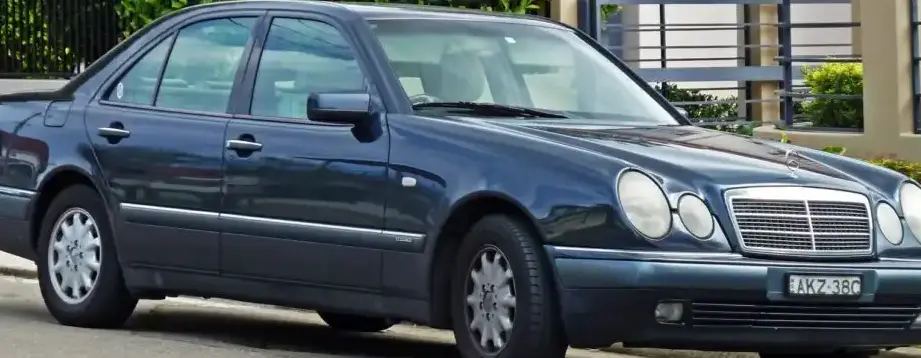
The Mercedes-Benz E 280, produced between August 1995 and March 1997, was a significant variant within the W210 E-Class range. Representing a sweet spot in the lineup, it offered a blend of performance and refinement that appealed to buyers seeking a step up from the base models without the added cost of the more powerful E 320 or E 420. Positioned as a mid-range offering, the E 280 aimed to deliver a comfortable and capable driving experience, particularly for those prioritizing smooth automatic transmission and a respectable level of equipment. It was a key model for Mercedes-Benz in the North American and European markets, embodying the brand’s reputation for engineering excellence and build quality.
Technical Specifications
| Brand | Mercedes-Benz |
| Model | E-class |
| Generation | E-class (W210) |
| Type (Engine) | E 280 (193 Hp) Automatic |
| Start of production | August, 1995 |
| End of production | March, 1997 |
| Powertrain Architecture | Internal Combustion engine |
| Body type | Sedan |
| Seats | 5 |
| Doors | 4 |
| Fuel consumption (urban) | 12.7 l/100 km (18.5 US mpg) |
| Fuel consumption (extra urban) | 7.3 l/100 km (32.2 US mpg) |
| Fuel Type | Petrol (Gasoline) |
| Acceleration 0 – 100 km/h | 8.9 sec |
| Acceleration 0 – 62 mph | 8.9 sec |
| Acceleration 0 – 60 mph | 8.5 sec |
| Maximum speed | 225 km/h (139.81 mph) |
| Weight-to-power ratio | 8.1 kg/Hp |
| Weight-to-torque ratio | 5.8 kg/Nm |
| Power | 193 Hp @ 5500 rpm |
| Power per litre | 69 Hp/l |
| Torque | 270 Nm @ 3750 rpm (199.14 lb.-ft. @ 3750 rpm) |
| Engine layout | Front, Longitudinal |
| Engine Model/Code | M 104 E 28 / 104.945 |
| Engine displacement | 2799 cm3 (170.81 cu. in.) |
| Number of cylinders | 6 |
| Engine configuration | Inline |
| Cylinder Bore | 89.9 mm (3.54 in.) |
| Piston Stroke | 73.5 mm (2.89 in.) |
| Compression ratio | 10:1 |
| Number of valves per cylinder | 4 |
| Fuel injection system | Multi-port manifold injection |
| Engine aspiration | Naturally aspirated engine |
| Valvetrain | DOHC |
| Engine oil capacity | 7.5 l (7.93 US qt | 6.6 UK qt) |
| Coolant | 10 l (10.57 US qt | 8.8 UK qt) |
| Kerb Weight | 1570 kg (3461.26 lbs.) |
| Max. weight | 2100 kg (4629.71 lbs.) |
| Max load | 530 kg (1168.45 lbs.) |
| Trunk (boot) space – minimum | 500 l (17.66 cu. ft.) |
| Fuel tank capacity | 80 l (21.13 US gal | 17.6 UK gal) |
| Length | 4795 mm (188.78 in.) |
| Width | 1799 mm (70.83 in.) |
| Height | 1439 mm (56.65 in.) |
| Wheelbase | 2833 mm (111.54 in.) |
| Front track | 1534 mm (60.39 in.) |
| Rear (Back) track | 1528 mm (60.16 in.) |
| Drivetrain Architecture | The Internal combustion engine (ICE) drives the rear wheels of the vehicle. |
| Drive wheel | Rear wheel drive |
| Number of gears and type of gearbox | 5 gears, automatic transmission |
| Front suspension | Double wishbone |
| Rear suspension | Independent multi-link spring suspension with stabilizer |
| Front brakes | Ventilated discs |
| Rear brakes | Disc |
| Assisting systems | ABS (Anti-lock braking system) |
| Steering type | Steering rack and pinion |
| Power steering | Hydraulic Steering |
| Tires size | 215/55 R16 |
| Wheel rims size | 7.5J x 16 |
Powertrain & Engine Architecture
The heart of the E 280 was the M104 E 28 inline-six engine. This 2.8-liter powerplant, designated with engine code 104.945, was a naturally aspirated, three-valve-per-cylinder design. It featured multi-port fuel injection and a double overhead camshaft (DOHC) valvetrain, contributing to its smooth operation and respectable power output. The engine’s architecture was a direct descendant of Mercedes-Benz’s long-standing tradition of inline-six engines, known for their inherent balance and refinement. The five-speed automatic transmission (typically the 722.3) was specifically tuned to complement the engine’s characteristics, prioritizing smooth shifts and comfortable cruising. This transmission was a torque converter type, offering a balance between efficiency and responsiveness.
Driving Characteristics
The E 280 Automatic offered a distinctly different driving experience compared to its manual counterparts or the higher-performance E 320. While not overtly sporty, the 193 horsepower and 270 Nm (199 lb-ft) of torque provided adequate acceleration for everyday driving and highway cruising. The 0-60 mph time of around 8.5 seconds was respectable for the era. The automatic transmission, while smooth, did result in some power loss compared to the manual version. Gear ratios were optimized for fuel efficiency and comfortable cruising, rather than outright performance. The car felt composed and stable at highway speeds, with the automatic transmission seamlessly managing gear changes.
Equipment & Trim Levels
The E 280 typically came well-equipped, reflecting Mercedes-Benz’s commitment to luxury and comfort. Standard features included power windows, power locks, a sunroof, and air conditioning. Interior upholstery was typically cloth, with leather options available as an upgrade. The dashboard layout was typical of the W210, featuring a wood trim and a straightforward, functional design. Optional extras included a premium sound system, heated seats, and automatic climate control. The E 280 often served as a base for buyers who then added specific packages to tailor the car to their preferences.
Chassis & Braking
The W210 E-Class chassis was a robust and well-engineered platform. The E 280 utilized a double wishbone front suspension and an independent multi-link rear suspension, providing a comfortable ride and good handling characteristics. The braking system consisted of ventilated discs at the front and solid discs at the rear, coupled with an Anti-lock Braking System (ABS) as standard. The suspension was tuned to prioritize ride comfort, making it well-suited for long-distance driving. Stabilizer bars were fitted front and rear to reduce body roll during cornering.
Market Reception & Comparison
The E 280 Automatic was generally well-received by automotive critics. It was praised for its smooth engine, comfortable ride, and well-appointed interior. However, some critics noted that it lacked the sporting character of the E 320 or the fuel efficiency of the diesel models. Compared to the E 320, the E 280 offered a more affordable entry point into the W210 E-Class range, but at the expense of some performance. The E 280’s fuel economy was reasonable for a car of its size and class, but it was not as frugal as the four-cylinder or diesel options.
Legacy
The M104 engine, found in the E 280, is known for its durability and reliability. With proper maintenance, these engines can easily exceed 200,000 miles. The five-speed automatic transmission is also generally reliable, although regular fluid changes are essential. In the used car market today, the E 280 represents a relatively affordable way to experience classic Mercedes-Benz luxury. While not as sought-after as the higher-performance models, it remains a popular choice for those seeking a comfortable, well-built, and reliable sedan. Parts availability is generally good, making it a relatively easy car to maintain. The E 280 stands as a testament to Mercedes-Benz’s engineering prowess during the 1990s, offering a blend of refinement, comfort, and durability that continues to appeal to enthusiasts today.