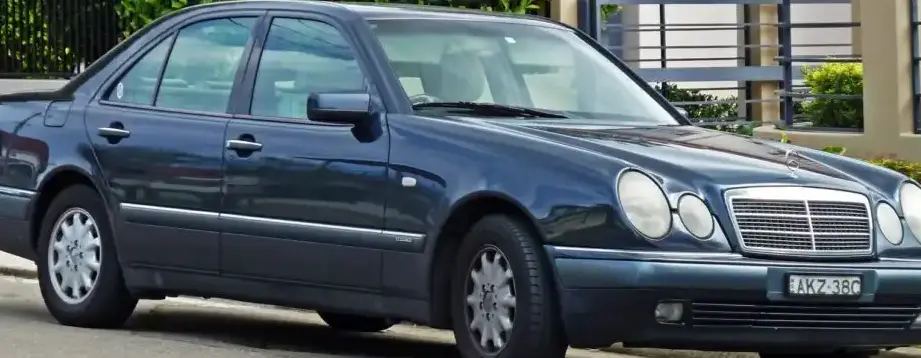
The Mercedes-Benz E 300 D, produced between August 1994 and March 1997, was a key variant within the W210 E-Class range. Representing a blend of luxury and fuel efficiency, this model aimed to provide a comfortable and capable sedan for buyers prioritizing diesel power and long-distance cruising. It occupied a mid-range position in the W210 lineup, slotting between the entry-level E 220 D and the more powerful E 320 models. The W210 generation marked a significant departure in design for Mercedes-Benz, introducing a more contemporary and aerodynamic aesthetic compared to its predecessor, the W124.
Technical Specifications
| Brand | Mercedes-Benz |
| Model | E-class |
| Generation | E-class (W210) |
| Type (Engine) | E 300 D (136 Hp) |
| Start of production | August, 1994 |
| End of production | March, 1997 |
| Powertrain Architecture | Internal Combustion engine |
| Body type | Sedan |
| Seats | 5 |
| Doors | 4 |
| Fuel consumption (urban) | 10 l/100 km (23.5 US mpg) |
| Fuel consumption (extra urban) | 5.3 l/100 km (44.4 US mpg) |
| Fuel Type | Diesel |
| Acceleration 0 – 100 km/h | 12.9 sec |
| Acceleration 0 – 62 mph | 12.9 sec |
| Acceleration 0 – 60 mph | 12.3 sec |
| Maximum speed | 205 km/h (127.38 mph) |
| Weight-to-power ratio | 11.5 kg/Hp |
| Weight-to-torque ratio | 7.4 kg/Nm |
| Power | 136 Hp @ 5000 rpm |
| Power per litre | 45.4 Hp/l |
| Torque | 210 Nm @ 2200 rpm (154.89 lb.-ft. @ 2200 rpm) |
| Engine layout | Front, Longitudinal |
| Engine Model/Code | OM 606 D 30 / 606.912 |
| Engine displacement | 2996 cm3 (182.83 cu. in.) |
| Number of cylinders | 6 |
| Engine configuration | Inline |
| Cylinder Bore | 87 mm (3.43 in.) |
| Piston Stroke | 84 mm (3.31 in.) |
| Compression ratio | 22:1 |
| Number of valves per cylinder | 4 |
| Fuel injection system | Precombustion chamber injection |
| Engine aspiration | Naturally aspirated engine |
| Valvetrain | DOHC |
| Engine oil capacity | 7 l (7.4 US qt | 6.16 UK qt) |
| Coolant | 9 l (9.51 US qt | 7.92 UK qt) |
| Kerb Weight | 1560 kg (3439.21 lbs.) |
| Max. weight | 2060 kg (4541.52 lbs.) |
| Max load | 500 kg (1102.31 lbs.) |
| Trunk (boot) space – minimum | 520 l (18.36 cu. ft.) |
| Fuel tank capacity | 65 l (17.17 US gal | 14.3 UK gal) |
| Length | 4795 mm (188.78 in.) |
| Width | 1799 mm (70.83 in.) |
| Height | 1438 mm (56.61 in.) |
| Wheelbase | 2833 mm (111.54 in.) |
| Front track | 1542 mm (60.71 in.) |
| Rear (Back) track | 1536 mm (60.47 in.) |
| Drivetrain Architecture | The Internal combustion engine (ICE) drives the rear wheels of the vehicle. |
| Drive wheel | Rear wheel drive |
| Number of gears and type of gearbox | 5 gears, manual transmission |
| Front suspension | Double wishbone |
| Rear suspension | Independent multi-link spring suspension with stabilizer |
| Front brakes | Ventilated discs |
| Rear brakes | Disc |
| Assisting systems | ABS (Anti-lock braking system) |
| Steering type | Steering rack and pinion |
| Power steering | Hydraulic Steering |
| Tires size | 205/65 R15 |
| Wheel rims size | 7J x 15 |
Powertrain & Engine Architecture
The heart of the E 300 D was the OM 606 D 30 inline-six cylinder diesel engine, a 2.996-liter (182.83 cubic inches) naturally aspirated powerplant. This engine utilized precombustion chamber injection, a system common in Mercedes-Benz diesels of the era, known for its relatively quiet operation and good combustion efficiency. The OM606 featured a double overhead camshaft (DOHC) valvetrain, operating four valves per cylinder. This configuration contributed to improved breathing and power delivery compared to older designs. The engine produced 136 horsepower at 5000 rpm and 210 Nm (154.89 lb-ft) of torque at 2200 rpm. The five-speed manual transmission was standard, providing a balance between fuel economy and driver control. While an automatic transmission was available, it was often criticized for slightly diminishing the engine’s responsiveness.
Driving Characteristics
The E 300 D with the manual transmission offered a reasonably engaging driving experience, particularly for a diesel sedan. While not a sports car, the engine’s torque provided ample power for everyday driving and overtaking maneuvers. The five-speed gearbox allowed drivers to keep the engine in its optimal power band. The automatic transmission, while offering convenience, resulted in a noticeable decrease in acceleration and a less direct feel. The W210 chassis provided a comfortable ride, absorbing bumps and imperfections in the road effectively. Steering was precise, though perhaps a bit heavier than some contemporary rivals. Overall, the E 300 D prioritized comfort and refinement over outright performance.
Equipment & Trim Levels
The E 300 D typically came equipped with a respectable level of standard features, including power windows, central locking, and air conditioning. Interior upholstery was generally cloth, though leather was available as an option. The dashboard layout was typical of Mercedes-Benz at the time, featuring a clean and functional design with wood trim accents. Optional extras included a sunroof, upgraded audio system, and automatic climate control. The E 300 D was positioned as a well-equipped, comfortable sedan, appealing to buyers who valued practicality and luxury.
Chassis & Braking
The W210 E-Class featured a double wishbone front suspension and an independent multi-link rear suspension, providing a comfortable and controlled ride. Stabilizer bars were fitted to both axles to reduce body roll during cornering. Braking duties were handled by ventilated discs at the front and solid discs at the rear. Anti-lock braking system (ABS) was standard, enhancing safety and stability during emergency braking. The suspension setup was tuned to prioritize ride comfort, making the E 300 D a pleasant vehicle for long journeys.
Market Reception & Comparison
The E 300 D was generally well-received by automotive critics, who praised its comfortable ride, refined interior, and fuel efficiency. However, some reviewers noted that the engine lacked the outright power of its gasoline-powered counterparts. Compared to the E 220 D, the E 300 D offered a noticeable performance improvement. In contrast to the E 320, it provided a more economical option, albeit with less power. The E 300 D’s fuel economy was a significant selling point, particularly in Europe, where diesel fuel was often cheaper than gasoline.
Legacy
The OM 606 engine, found in the E 300 D, is renowned for its durability and longevity. Properly maintained examples can accumulate very high mileage with minimal issues. Today, the W210 E 300 D is a popular choice among enthusiasts seeking a classic Mercedes-Benz sedan. Its robust engine, comfortable ride, and relatively simple mechanicals make it a reliable and rewarding vehicle to own. While finding well-maintained examples can be challenging, the E 300 D remains a testament to Mercedes-Benz’s engineering prowess and commitment to quality.