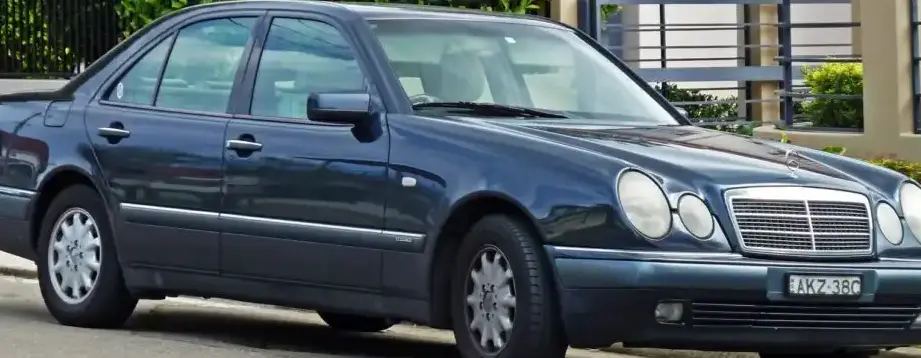
The Mercedes-Benz E 300 Turbodiesel Automatic, produced between September 1996 and July 1999, was a significant variant within the W210 E-Class range. Positioned as a premium offering, it combined the robust OM606 diesel engine with a five-speed automatic transmission, appealing to buyers seeking a blend of performance, refinement, and long-distance comfort. This model represented a key part of Mercedes-Benz’s strategy to offer a sophisticated diesel option in a market increasingly focused on fuel efficiency and reduced emissions, particularly in Europe where the W210 saw its largest sales volume. In the US market, while diesel acceptance was lower, the E300 Turbodiesel offered a unique alternative to gasoline-powered luxury sedans.
Technical Specifications
| Brand | Mercedes-Benz |
| Model | E-class |
| Generation | E-class (W210) |
| Type (Engine) | E 300 Turbodiesel (177 Hp) Automatic |
| Start of production | September, 1996 |
| End of production | July, 1999 |
| Powertrain Architecture | Internal Combustion engine |
| Body type | Sedan |
| Seats | 5 |
| Doors | 4 |
| Fuel consumption (urban) | 10.9 l/100 km (21.6 US mpg) |
| Fuel consumption (extra urban) | 6.1 l/100 km (38.6 US mpg) |
| Fuel consumption (combined) | 7.9 l/100 km (29.8 US mpg) |
| Fuel Type | Diesel |
| Acceleration 0 – 100 km/h | 8.9 sec |
| Acceleration 0 – 62 mph | 8.9 sec |
| Acceleration 0 – 60 mph | 8.5 sec |
| Maximum speed | 220 km/h (136.7 mph) |
| Weight-to-power ratio | 9.2 kg/Hp |
| Weight-to-torque ratio | 4.9 kg/Nm |
| Power | 177 Hp @ 4400 rpm |
| Torque | 330 Nm @ 1600 rpm (243.4 lb.-ft. @ 1600 rpm) |
| Engine layout | Front, Longitudinal |
| Engine Model/Code | OM 606 D 30 LA / 606.962 |
| Engine displacement | 2996 cm3 (182.83 cu. in.) |
| Number of cylinders | 6 |
| Engine configuration | Inline |
| Cylinder Bore | 87 mm (3.43 in.) |
| Piston Stroke | 84 mm (3.31 in.) |
| Compression ratio | 22:1 |
| Number of valves per cylinder | 4 |
| Fuel injection system | Precombustion chamber injection |
| Engine aspiration | Turbocharger, Intercooler |
| Valvetrain | DOHC |
| Engine oil capacity | 7.5 l (7.93 US qt | 6.6 UK qt) |
| Coolant | 9 l (9.51 US qt | 7.92 UK qt) |
| Kerb Weight | 1630 kg (3593.53 lbs.) |
| Max. weight | 2130 kg (4695.85 lbs.) |
| Max load | 500 kg (1102.31 lbs.) |
| Trunk (boot) space – minimum | 520 l (18.36 cu. ft.) |
| Fuel tank capacity | 65 l (17.17 US gal | 14.3 UK gal) |
| Length | 4795 mm (188.78 in.) |
| Width | 1799 mm (70.83 in.) |
| Height | 1437 mm (56.57 in.) |
| Wheelbase | 2833 mm (111.54 in.) |
| Front track | 1534 mm (60.39 in.) |
| Rear (Back) track | 1528 mm (60.16 in.) |
| Drivetrain Architecture | Rear wheel drive |
| Number of gears and type of gearbox | 5 gears, automatic transmission |
| Front suspension | Double wishbone |
| Rear suspension | Independent multi-link spring suspension with stabilizer |
| Front brakes | Ventilated discs |
| Rear brakes | Disc |
| Assisting systems | ABS (Anti-lock braking system) |
| Steering type | Steering rack and pinion |
| Power steering | Hydraulic Steering |
| Tires size | 205/65 R15 |
| Wheel rims size | 7J x 15 |
Powertrain & Engine Architecture
The heart of the E 300 Turbodiesel was the OM606 D 30 LA engine, a 2.996-liter inline-six cylinder diesel. This engine utilized precombustion chamber injection, a system common in Mercedes-Benz diesels of the era, known for its quiet operation and relatively clean combustion. The addition of a turbocharger and intercooler boosted power output to 177 horsepower and 330 Nm (243 lb-ft) of torque. The engine featured a double overhead camshaft (DOHC) valvetrain, contributing to its efficient operation. The five-speed automatic transmission (typically the 5G-Tronic) was specifically calibrated to handle the engine’s torque curve, providing smooth shifts and adequate acceleration. This transmission was known for its durability and refinement, though it wasn’t as quick-shifting as some modern automatics.
Driving Characteristics
The E 300 Turbodiesel Automatic offered a distinctly different driving experience compared to its gasoline-powered siblings, such as the E 320. While not as overtly sporty, it excelled in providing effortless cruising and strong mid-range torque. The automatic transmission, while smooth, did slightly diminish the engine’s responsiveness compared to the available manual transmission. Acceleration to 60 mph took around 8.5-8.9 seconds, respectable for a large luxury sedan of the time. The focus was on relaxed power delivery and fuel efficiency, making it ideal for long highway journeys. The gear ratios were optimized for comfortable cruising, with a relatively tall final drive contributing to good fuel economy.
Equipment & Trim Levels
The E 300 Turbodiesel Automatic typically came well-equipped, reflecting its position as a premium model. Standard features included automatic climate control, power windows and locks, a sunroof, and a high-quality audio system. Interior upholstery was generally cloth, with leather options available as an upgrade. Wood trim was standard, adding to the luxurious ambiance. Optional extras included heated seats, a navigation system (a relatively new feature at the time), and upgraded audio systems. The trim level often dictated the availability of certain features, with higher trims offering more customization options.
Chassis & Braking
The W210 E-Class featured a robust chassis with a double wishbone front suspension and an independent multi-link rear suspension. This setup provided a comfortable ride and good handling characteristics. The E 300 Turbodiesel, due to its weight, often had slightly stiffer spring rates compared to lighter models. Braking was handled by ventilated discs at the front and solid discs at the rear, with ABS (Anti-lock Braking System) standard. The braking system was generally considered effective, providing ample stopping power for a vehicle of its size and weight.
Market Reception & Comparison
The E 300 Turbodiesel Automatic received generally positive reviews, particularly for its refinement, fuel economy, and long-distance comfort. Critics praised the engine’s quiet operation and strong torque output. However, some noted that the automatic transmission could feel slightly sluggish compared to the manual option. Compared to the E 320, the E 300 Turbodiesel offered a more economical alternative, albeit with slightly less outright performance. Against other diesel-powered competitors, such as the BMW 525tds, the E 300 Turbodiesel was often seen as offering a more luxurious and refined experience.
Legacy
The OM606 engine, found in the E 300 Turbodiesel, is renowned for its durability and longevity. Properly maintained examples can accumulate very high mileage with minimal issues. Today, the W210 E 300 Turbodiesel Automatic is a sought-after classic, particularly among enthusiasts who appreciate its robust engineering and fuel efficiency. While finding well-maintained examples can be challenging, the E 300 Turbodiesel remains a testament to Mercedes-Benz’s commitment to building high-quality, long-lasting vehicles. The combination of a durable engine, a comfortable chassis, and a refined interior has ensured its continued appeal in the used car market.